Best online ordering for upselling and repeat orders (2027)
Menuthere is our pick for growing online orders, because it adds to an order at every step on its own.
See it on your own menu in a short call.
We set it up with your own dishes and show each moment live.
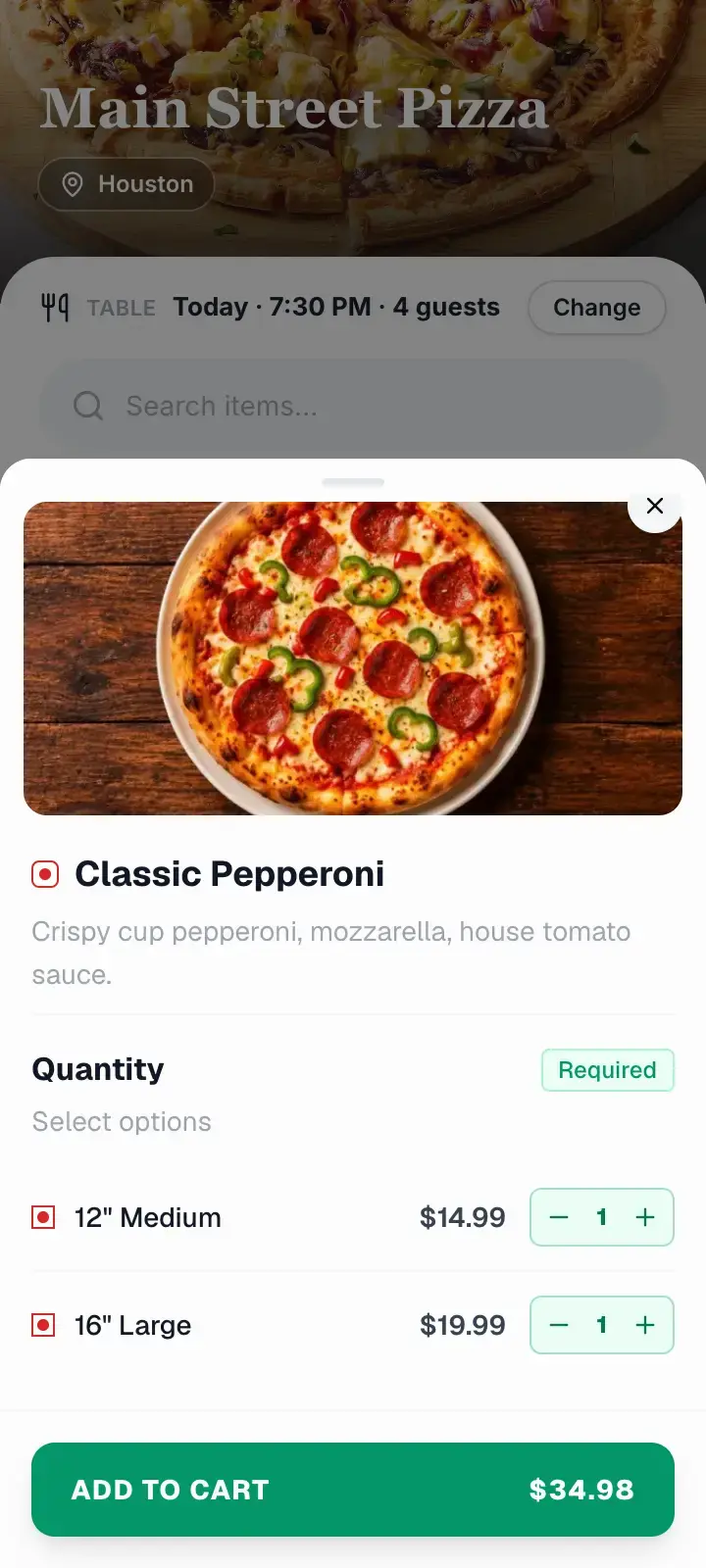
A dish sheet with a required group. Until the customer picks a size, the button reads Select and the group's name instead of Add to cart.
Menuthere is our pick for growing online orders, because it adds to an order at every step on its own: Order again and Popular now rows, dish pairings, required choices, a free-delivery target, a cart reminder on WhatsApp and loyalty points. Suggestions and add-ons are on every plan, offers and cart reminders start on Starter at $49 a month per location, and loyalty and comeback messages are on Growth at $129. There is 0% commission on orders and a 14-day free trial. Below is a timeline of the seven moments an order can grow, what each nudge costs you, and the exact settings.
Our pick for bigger and repeat orders
Menuthere
Menuthere puts a nudge at each step of an order, from the first look at the menu to the next visit, and each one runs without daily work from you. You can see what every nudge costs: the discount, the waived delivery fee and the WhatsApp message price.
- 0% commission
- From $49 a month
- 14-day free trial
- Suggestions on every plan
- Order again and Popular now rows on your menu, counted from real orders (no AI). Popular now waits until your store has 10 orders.
- Your own pairings per dish, plus up to 3 learned "bought together" dishes, never from the same category.
- Sizes, add-ons and required choices: the button reads Select and the group's name until the customer picks, so nothing is forgotten.
- Free or reduced delivery bands with an "Add more for free delivery" bar at checkout, and Cart rewards (free delivery, money off or a free dish as the cart grows) shown as a progress bar in the cart (Starter and up).
- Discount codes, automatic discounts and codes that only work in one area you draw on a map (Starter and up).
- An abandoned cart reminder on your own WhatsApp number, with a one-tap button that rebuilds the cart, at most once every 12 hours per customer (Starter and up).
- Loyalty points, comeback messages and review requests to bring people back (Growth and up).
Our framework
The seven moments an order can grow
Most upselling advice is a list of tactics. The tactics act at different moments, and two nudges at the same moment fight each other. Give each moment ONE job, and know when it starts to hurt.
01
First look: show what people already buy
Order again shows a signed-in customer up to 8 of their own dishes, ranked by how often and how recently they ordered them, a little higher for what they usually order at this time of day. Popular now shows your 8 most-ordered dishes of the last 30 days. Every plan. When it hurts: if your best sellers have a thin margin, you push the wrong dishes. Check with the menu engineering matrix.
02
Picking a dish: make the right choice easy
Sizes, add-ons and required groups. While a required group is empty the button reads Select plus the group's name and takes the customer there. A forgotten sauce is a lost or wrong order, not just a lost upsell. Every plan. When it hurts: more than two or three required groups on one dish.
03
Adding to cart: one good pairing, not five
Your own picks from Add recommendation, then up to 3 learned "bought together" dishes while the list has fewer than 4. Every plan. When it hurts: pairing a pizza with another pizza. Pair across categories: a side, a drink, a dessert.
04
Looking at the cart: one clear target
A free-delivery band ("Add more for free delivery" with a progress bar at checkout) or Cart rewards, a progress bar in the cart that gives free delivery, money off or a free dish at amounts you set. Starter and up. When it hurts: a target more than about one extra dish away, or so low that most orders were already above it. Set it near your average order plus one side.
05
Checkout: the right code for the right street
Discount codes, and a Location based discount that only works inside a circle you draw. Customers outside never see it. Starter and up. When it hurts: codes posted everywhere teach people to wait for a code.
06
Walking away: bring the cart back, once
The abandoned cart reminder on WhatsApp goes to a signed-in customer whose cart sat for 10 minutes (you can pick 5 minutes to 24 hours) with no order since. It only goes to a number that has messaged your WhatsApp number or had an order accepted by you, and at most once every 12 hours per customer. Starter and up, with your own WhatsApp Business number. When it hurts: more than one reminder feels like chasing.
07
Next visit: give a reason to come back
Loyalty points on every completed order, Comeback messages to people who have not ordered for a while, and a review request after the order. Growth and up. When it hurts: points so generous they replace full-price orders.
The order-growth test. Run it on any ordering system, one moment at a time. Ask three questions: Does it happen without me doing anything every day? Does it know what MY customers buy? Can I see what it costs me? Three yeses at a moment means a sales engine. Fewer means a feature list you will have to run by hand.
Menuthere compared with other kinds of tools
We compare kinds of tools, not brands. Each kind is good at something; the question is which moments it covers for you.
| What matters | Menuthere | Delivery marketplaces | Website builders and ordering widgets | Rule-only upsell add-ons on a POS | Separate loyalty or WhatsApp tools |
|---|---|---|---|---|---|
| Whose customer and order history | Yours | The marketplace's | Yours | Yours | Yours, but a second list |
| Repeat-order rows (Order again) | Yes, every plan | Inside their app | Rarely | Rarely | Usually not, it can't see the menu |
| Suggestions learned from orders | Yes, counted, plus your own picks | Their own rules | No | No, you write each rule | No |
| Required choices on a dish | Yes, with a Select button | Yes | Often basic | Yes | Not their job |
| Free-delivery target shown to the customer | Yes, Starter and up | Their promos, often part-paid by you | Sometimes | Sometimes | No |
| Abandoned cart reminder | WhatsApp, on your own number | Their app's own messages | Often email only | Rarely | Usually not, it can't see the cart |
| Loyalty and comeback messages | Yes, Growth and up | Their own programme | Add-on | Sometimes | Yes, a separate login |
| Commission on each order | 0% | A share of every order | Varies | Varies | Not an ordering tool |
Payment gateway fees and Meta's WhatsApp message prices apply on top for every kind of tool, Menuthere included.
What your customers see
Real screens from Menuthere demo stores.
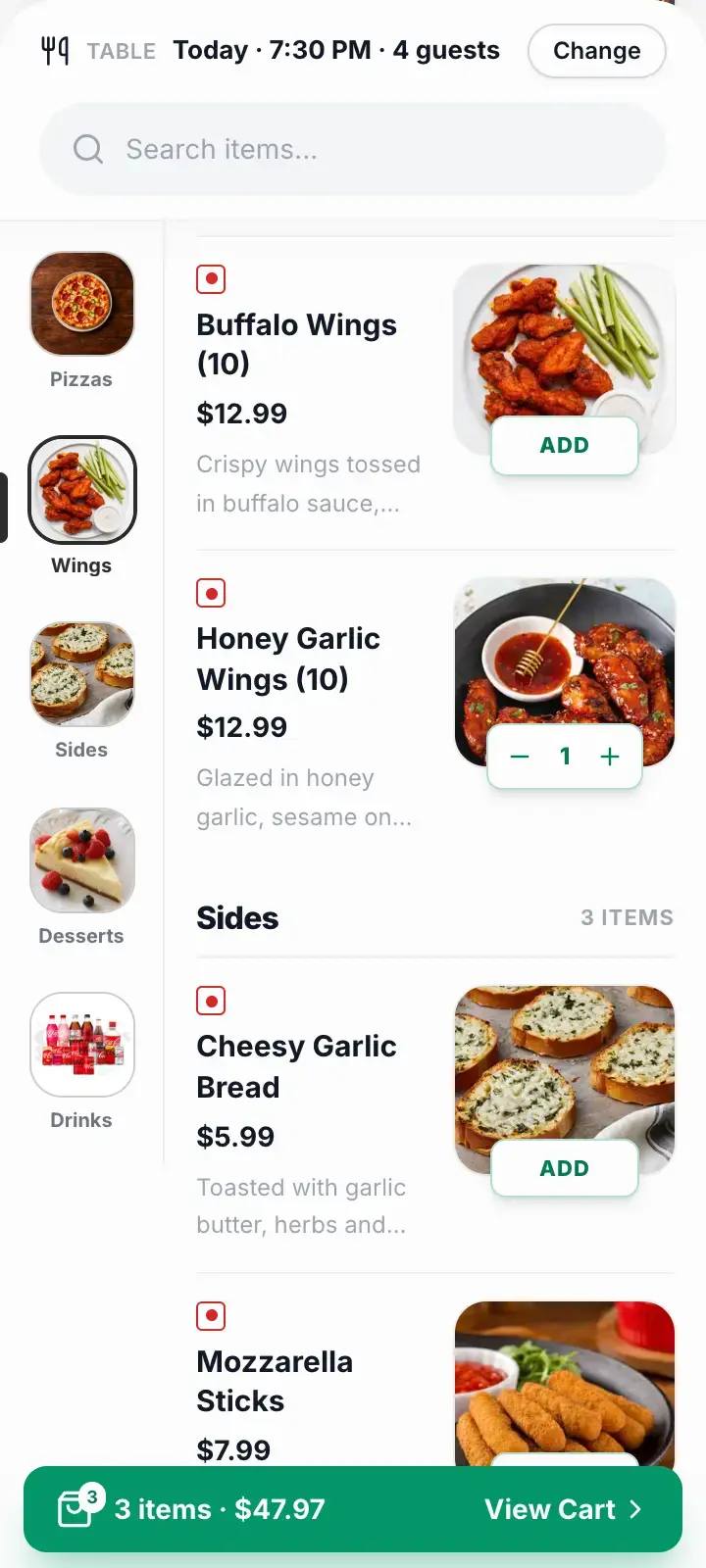

Wings and sides one scroll away from the pizzas, with the cart total always in view.
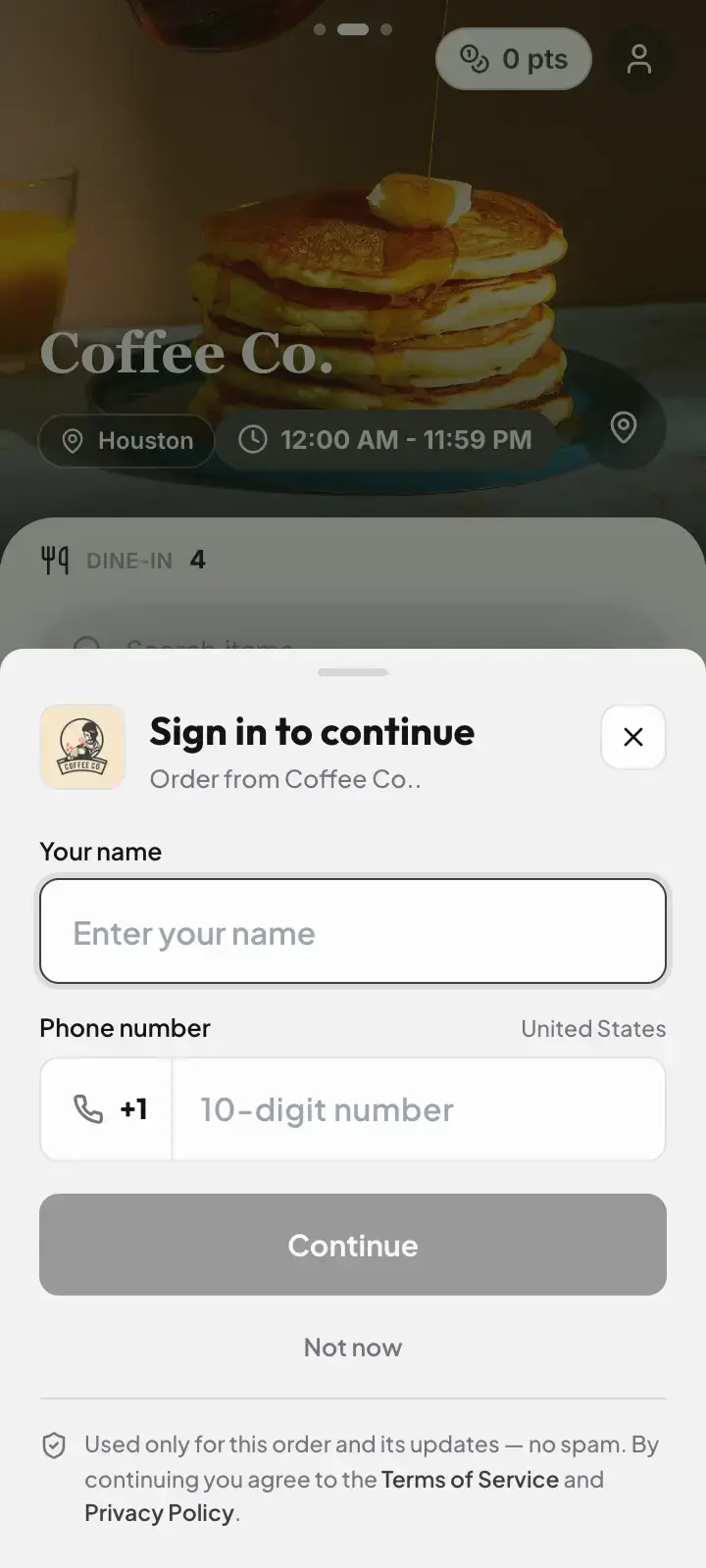
Sign-in asks for a name and phone only. Signed-in customers get Order again rows, and cart reminders once their number is proven by a message or an accepted order.
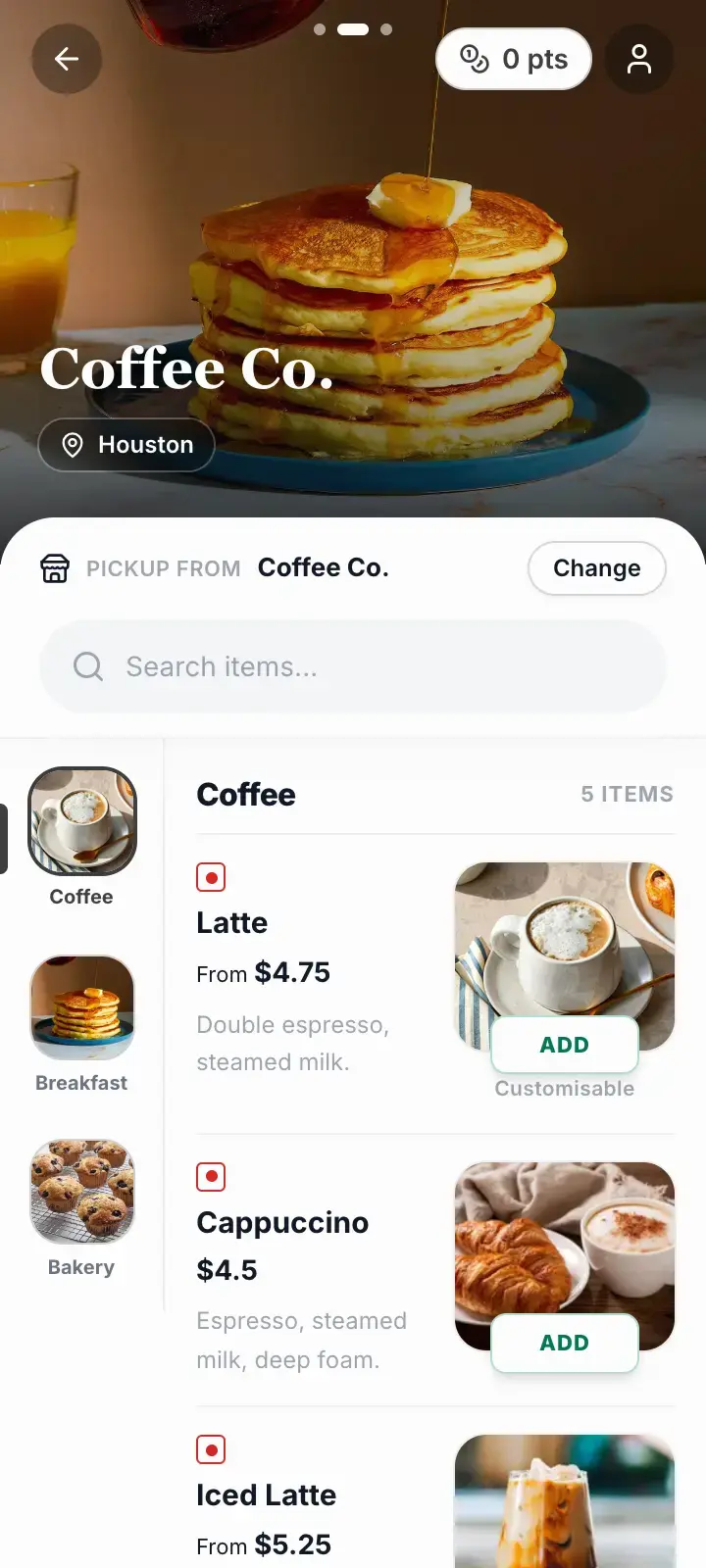
Moment 7: the loyalty points pill on the menu (Growth and up).

Main Street Pizza and Coffee Co. are Menuthere demo stores.
Worked example
What each nudge adds, and what it costs
This is example arithmetic, not a result. A pizza shop with 400 online orders a month at an average of $24 (example numbers). Put your own numbers in.
Moment 2, add-ons. If 1 in 5 orders adds $2 extra cheese, that is $0.40 more per order on average.
Moment 3, pairing. If 1 in 10 orders adds a $5 suggested side, that is $0.50 more per order.
Moment 4, free-delivery target. Free delivery over $30, waiving a $3 fee. If 1 in 8 orders adds about $6 of food to reach it, that is $0.75 more food per order, minus $3 × 1/8 = $0.375 in fees for those orders. But orders that were already over $30 now get free delivery too: if 1 in 10 orders was already there, that is another $3 × 1/10 = $0.30 given away. Net: about $0.075 per order. This is the moment that most often costs more than it adds, so check your own share of orders already above the target before you set it.
Together: about $0.98 more per order ($0.40 + $0.50 + $0.075), so $24 becomes about $24.98. On 400 orders that is about $390 more in sales a month. This is sales, not profit: take off your food cost with the restaurant profit margin calculator.
Moment 6, the cost of a cart reminder. Outside the 24-hour chat window the reminder is a template, and Meta bills it per message on your own WhatsApp account. Menuthere submits it as a marketing template, so use the marketing price. 60 reminders a month at the North America marketing price of $0.025 is about $1.50. At the UK marketing price of $0.0635 it is about $3.81 (prices from our WhatsApp cost calculator). Inside the window it is a service message, priced at $0.0034 in North America on Meta's rates for 1 October 2026, with the first 1,000 a month on each number free (same calculator).
Why carts matter. Baymard Institute's average documented online cart abandonment rate is 70.22%, from 50 studies. That is all online shopping, not restaurants, but it shows how many carts are left behind.
The plan cost. Starter at $49 a month covers moments 1 to 6. Growth at $129 adds loyalty points, comeback messages, review requests, buy X, get Y free and a free item with an order.
- Add-ons: +$0.40 an order (example)
- Pairing: +$0.50 an order (example)
- Free-delivery target: +$0.075 an order after waived fees (example)
- Cart reminders: about $1.50 to $3.81 a month for 60 templates
Check the numbers yourself
Two of our free tools, used in this guide.
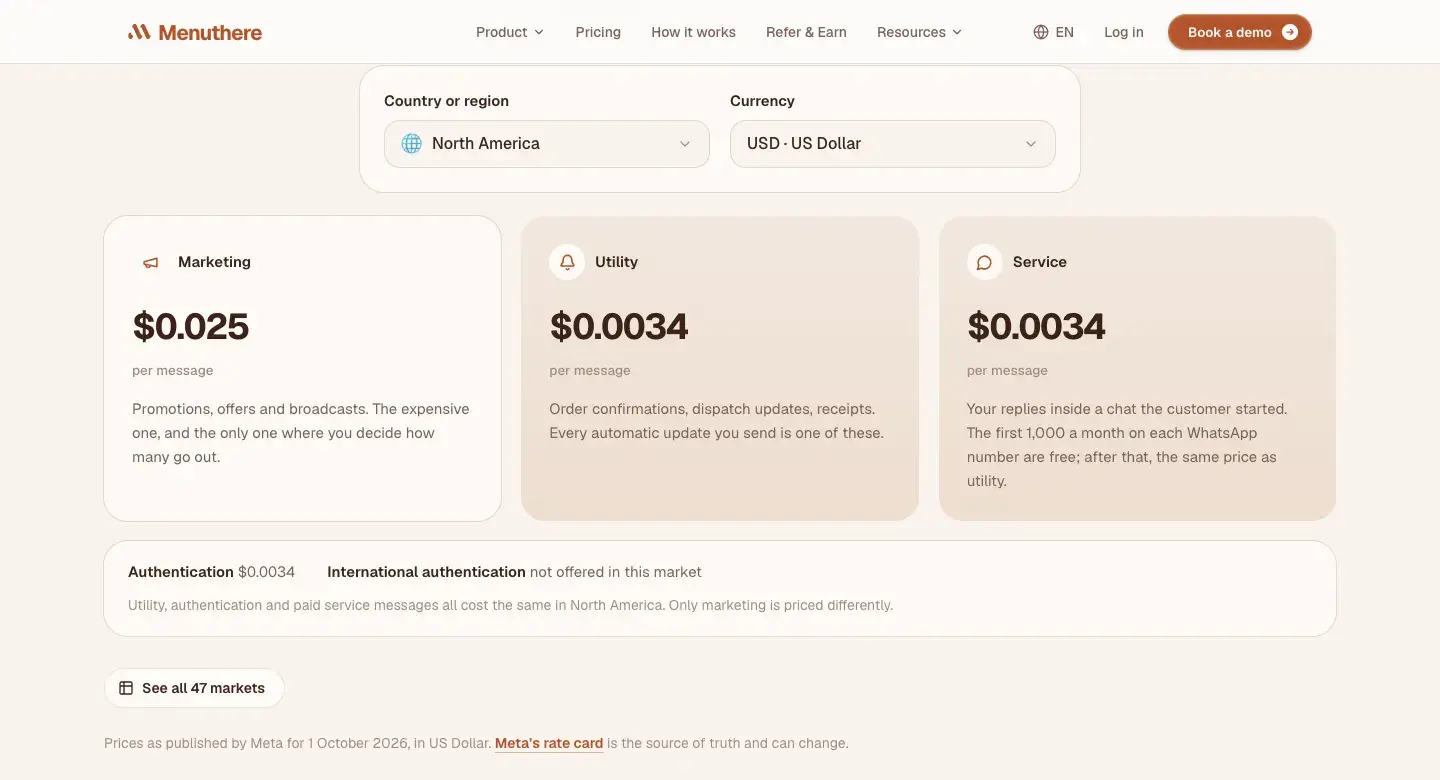
Meta's per-message prices for North America, as used in the cart reminder maths.
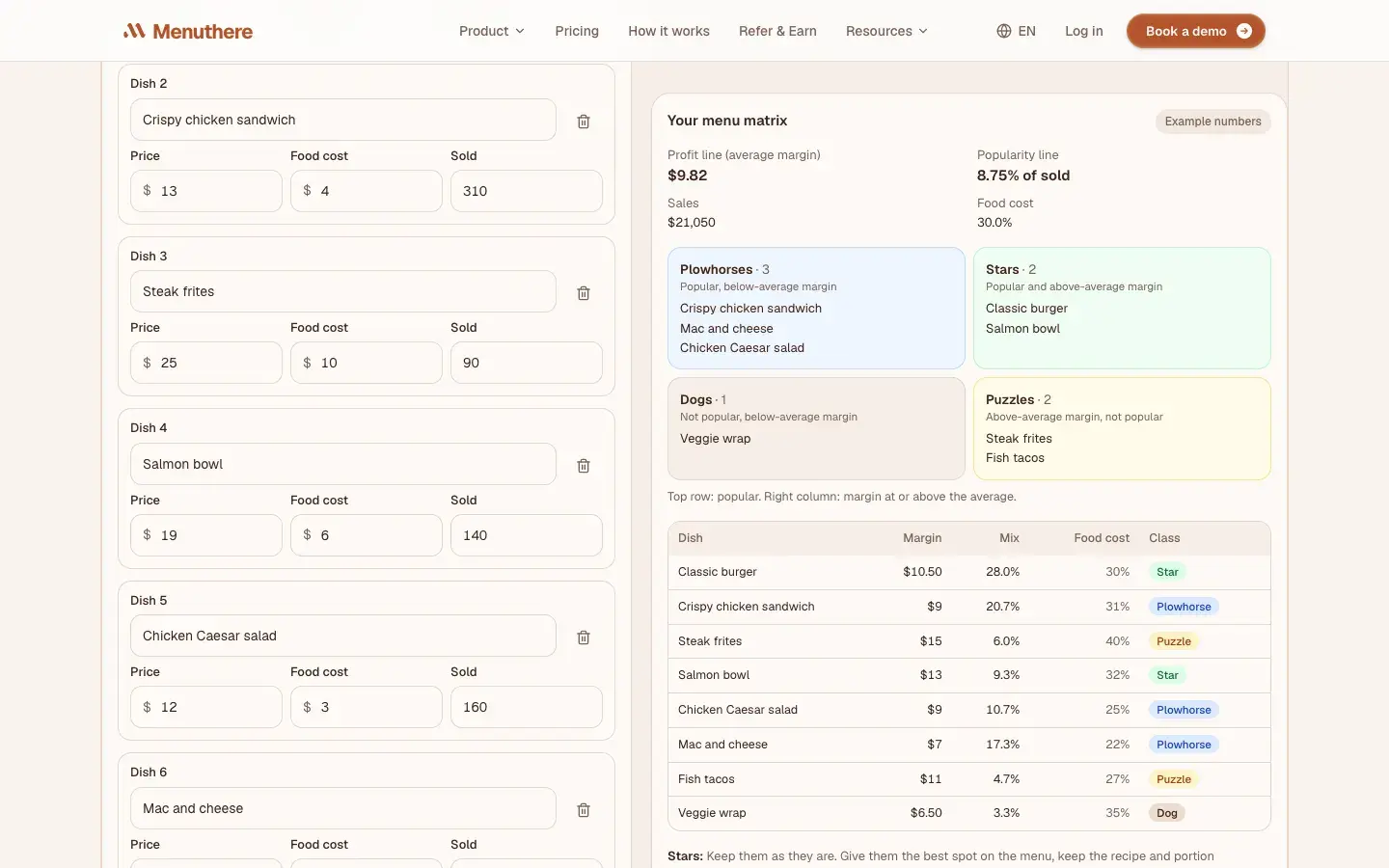
Before you promote a dish, check it is a Star or a Puzzle, not a Dog. Example menu.
How to set it up in Menuthere
01
Turn on suggestions
Settings → Branding → Menu design → Personalised suggestions. On by default. It controls Order again, Popular now and the learned pairings together.
02
Add choices and pairings to your best dishes
Menu, open a dish, then Add addons for sizes, extras and required groups, and Add recommendation for the one or two dishes that go with it.
03
Set a free-delivery target
Settings → Ordering → Delivery settings, switch on Free delivery minimum purchase, then set the order amount and whether delivery is free or reduced, within a distance or inside delivery zones you pick.
04
Create one offer
Promotions → Offers → Create new offer, then pick Item discount, Discount code, Automatic order discount, Location based discount or Cart rewards. Cart rewards show only in the new cart; if it is off, the same screen offers Turn on the new cart.
05
Switch on the cart reminder
Sales channel → WhatsApp → Flows → Global flows, find Abandoned cart under Recover sales, press Add to my flows and switch it on. Your WhatsApp Business number must be connected first. The reminder template goes to Meta for review on its own.
06
Bring people back (Growth)
Promotions → Loyalty points → Loyalty settings for the points rate and redeem limits, Sales channel → WhatsApp → Comeback messages for customers who stopped ordering, and Customers → Reviews for review requests.
What Menuthere does not do
Know these before you choose.
Menuthere does not promise bigger orders. Every nudge here depends on your menu, your prices and your customers. Track your orders in Analytics before and after each change.
- Suggestions are counting, not AI. Popular now waits for 10 store orders in 30 days, so a brand-new store shows it later.
- Order again and cart reminders work only for signed-in customers. Guests get neither.
- Cart reminders need your own WhatsApp Business number, and Meta bills each message on your account.
- No reminder goes when the store is closed, a payment is pending, the customer was reminded in the last 12 hours, or their number has never messaged you or had an order accepted.
- Cart rewards show in the new cart only. A store still on the old checkout turns the new cart on first.
- Free-delivery bands, offers, cart rewards and cart reminders are not on the Free plan. Loyalty points, comeback messages, review requests, buy X, get Y free and free items are Growth and up.
- Learned pairings use dish names across stores only. Another store's sales or prices are never shown.
Answered, plainly.
Sources (3) · checked 2026-11-25
- Pricing for the WhatsApp Business Platform · Meta for Developers, 2026-11-25
- Non-template message pricing · Meta for Developers, 2026-11-25
- Cart abandonment rate statistics · Baymard Institute, 2026-11-25
See the seven moments on your own menu
Book a demo. We add your dishes, set a pairing and a free-delivery target, and show you what each nudge costs.
- 0% commission
- 14-day free trial
- No contract