The Takeaway Counter Is a Channel Nobody Manages
Dine in has a menu and a server. Delivery has a dashboard and analytics. Takeaway has a person standing at a counter being served by whoever is nearest.
By the Menuthere editorial team ·
Dine in has a menu and a server. Delivery has a dashboard and analytics. Takeaway has a person standing at a counter being served by whoever is nearest.
By the Menuthere editorial team ·
Previous article
Most of your revenue arrives in two or three hours, which means most people meet your kitchen at its worst. And you have never tasted that version.
Next article
Most operators know this number. It gets quoted in every WhatsApp group in the industry. What gets discussed far less is the second cost, the one that never appears on the invoice.
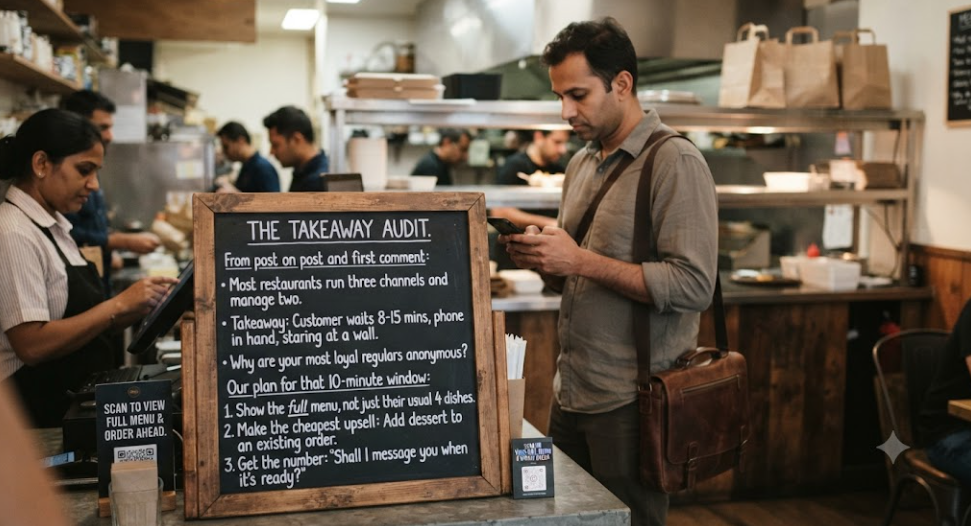
Most restaurants run three channels and manage two of them.
Dine in gets everything. A menu with photographs, a server who can recommend, a table, a check average somebody tracks, a manager who notices when it dips.
Delivery gets a dashboard. Listing photos, item descriptions, ratings that get watched closely, promotions, hour by hour analytics, and someone in the business who can tell you the average order value to the rupee.
Takeaway gets a person standing at a counter.
No menu, or a laminated card behind glass. No recommendation, because whoever is at the till is also billing, also answering the phone and also handing a bag to a delivery rider. No record of who came. No way to reach them again. No number anybody looks at.
It is frequently a serious share of revenue, and it is the only channel in the building with no owner.
The reason is worth understanding, because it is not neglect exactly.
Dine in got digitised because of COVID. QR menus arrived everywhere in eighteen months, and in India the shift was dramatic, with a third of restaurants adopting QR ordering during the pandemic and adoption climbing steeply from there.
Delivery got digitised because the aggregators forced it. If you wanted the orders you had to build the listing, photograph the food, write the descriptions and watch the dashboard.
Takeaway never got digitised because it never broke.
The customer is physically present. They know what they want. They ask, they pay, they wait, they leave. The system works, has always worked, and required nobody to change anything.
So it is the one channel that survived into 2026 completely untouched, and the thing about a process that never breaks is that nobody ever looks at it closely enough to notice what it is not doing.
This matters more in India than in most markets. Parcel is not a modern convenience here, it is a habit older than any delivery app, and for a very large number of restaurants it has quietly been a major part of the business for decades.
Line up the takeaway counter against your other two channels and the gaps are stark.
There is no menu in any meaningful sense. There may be a board, or a card behind glass, or nothing at all because the customer is expected to already know. Which means a takeaway customer sees a fraction of what you sell, forever. Somebody who has collected from you eleven times may have no idea you make three of your best dishes.
There is no recommendation. Nobody says porotta with that. On dine in, a server has the opportunity and sometimes takes it. On delivery, the interface can suggest. At the counter, the person capable of suggesting is doing four other things at once.
There is no data. The order goes into the POS as a walk in. No name, no number, no history. A takeaway regular who has come forty times this year is completely invisible to you, which is worse than the delivery customer you at least have an address for.
There is no follow up, ever. You cannot tell them the menu changed, cannot invite them back, cannot notice when they stop coming.
And there is no experience during the wait, which is the biggest miss of all.
This is the part I find genuinely surprising, because it is the most valuable unused moment in the entire business.
Think about where the customer actually is in each channel.
Dine in: seated, being served, occupied.
Delivery: at home, somewhere else, unreachable except through a screen.
Takeaway: standing inside your restaurant, holding their phone, with nothing at all to do, for eight to fifteen minutes, having already decided to give you money.
There is no other moment like that anywhere in the business. Physically present. Idle. Phone already in hand. Order already committed. Kitchen already working.
And the standard use of that moment is to make them look at a wall.
Consider what the wait could do instead.
It could show them the rest of your menu. Not to order from now, but so that next time they know the other sixty items exist. The single biggest constraint on a takeaway customer's spend is that they only order the four things they happen to know about.
It could add to the order. This is the cheapest upsell available to any restaurant, because the order is already placed and the kitchen is already in motion. A dessert, a drink, an extra bread added five minutes before the bag is handed over costs you nothing in additional coordination.
It could capture the number. Not through a loyalty form nobody fills in, but through a question that is straightforwardly useful: shall I message you when it is ready. That is a service offer, it saves the customer standing there watching the pass, and it produces a phone number and an order attached to it.
Which is how a takeaway regular stops being anonymous.
Here is a quick test.
You know your delivery average order value. Most operators can quote it immediately, because the aggregator dashboard shows it and everybody watches that number.
You probably know your dine in check average, or can work it out.
Now what is your takeaway average? What has it done over the last six months? Which items over index at the counter compared with the dining room?
Almost nobody can answer, because takeaway orders sit in the POS as generic walk in transactions, mixed together, unsegmented, unexamined.
You cannot manage a channel you cannot see, and this one is not hidden by any technical difficulty. It is hidden because nobody ever separated it out.
Split it in the POS first. Tag takeaway as its own order type and look at it monthly the way you look at delivery. Average value, item mix, time of day. The first month of that data usually contains at least one surprise, most often that the takeaway mix is much narrower than the dine in mix, which tells you exactly how little of your menu those customers have ever seen.
Put a QR on the counter, at eye level, for the menu rather than for ordering. The person waiting has nothing to do and a phone in their hand. Let them discover what else you make.
Ask one question, consistently. Not a script, one question. Shall I message you when it is ready is the best one, because it helps the customer and gives you the number. Anything with a bread or a drink is the second best, and it works precisely because the order is already in.
Let them order ahead. A takeaway customer who can order from the road and collect on arrival is a better customer and a shorter queue. Menuthere handles takeaway as its own order type alongside dine in and delivery, so somebody can order from your WhatsApp number or your ordering link, pay, and arrive when the food is ready rather than standing at the counter for twelve minutes.
Then treat the number like a relationship rather than a receipt. Once you have it attached to an order history, your takeaway regular is as visible as your delivery customer, which is to say visible at all for the first time.
Every restaurant has an unmanaged channel, and in most of them it is the same one.
It gets no menu, no suggestion, no data, no follow up and no attention, largely because it has been working adequately for thirty years without any of those things.
Working adequately is a low bar for something delivering a meaningful share of your revenue, and it is a particularly odd bar to accept when the customer is standing directly in front of you with their phone out and nothing to do.
The delivery customer is at home. The dine in customer is being served.
The takeaway customer is in the room, and nobody is talking to them.
Give your counter the same attention as your dashboard. Menuthere handles takeaway as a first class order type, with ordering ahead, a shareable menu link and QR for the counter, and the order landing straight in your POS.
Sources: Sauce 2026 (off premise share of restaurant traffic), National Restaurant Association via Restaurant.org (operators reporting off premise growth since 2019), Mordor Intelligence 2026 (takeaway and walk up counter growth, off premise share at leading brands), Restroworks 2026 (India QR adoption and average check impact), MenuTiger 2026 (historic takeaway market share).
QR menus
The fastest way to serve faster is not hiring another server. It is removing the wait that happens before the order is even placed.
Menu strategy
Ask the internet how often a restaurant should update its menu and you get a remarkably consistent answer.