Your Busiest Hour Has Your Worst Food
Most of your revenue arrives in two or three hours, which means most people meet your kitchen at its worst. And you have never tasted that version.
By the Menuthere editorial team ·
Most of your revenue arrives in two or three hours, which means most people meet your kitchen at its worst. And you have never tasted that version.
By the Menuthere editorial team ·
Previous article
The phone rings at 8:40pm asking whether to refund a customer. What breaks while you are away is a map of everything that was never written down.
Next article
Dine in has a menu and a server. Delivery has a dashboard and analytics. Takeaway has a person standing at a counter being served by whoever is nearest.
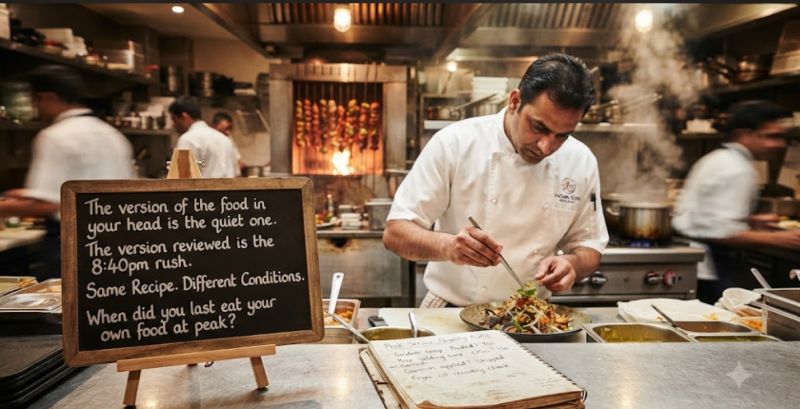
Read enough restaurant reviews and one line keeps appearing.
It was better last time.
The instinct is to treat that as nostalgia, or as a complaint with no information in it. Something changed, the customer is remembering an idealised version, nothing to act on.
It is almost never nostalgia. It is a timestamp.
The useful question is not what changed in the kitchen. It is what time they came, both times. In most cases the good visit was at seven, and the bad one was at half past eight.
Same recipe. Same chef. Same supplier. Different conditions.
Here is the uncomfortable arithmetic underneath this.
Roughly 70 to 80 percent of daily revenue in most restaurants arrives during two or three peak hours.
Which means the version of your food that most customers experience is the peak version. Not the version that leaves the kitchen at four in the afternoon when there are three tickets up and the chef has time to wipe the rim of the plate.
And here is the part that should genuinely bother you.
You have almost certainly never eaten your own restaurant's food at half past eight on a Saturday.
Owners taste at prep. They check the gravy in the afternoon. They eat before service or after it. The version of the food you believe you serve, the one you have in your head when you think about your restaurant, is the quiet version.
The version that gets reviewed is the other one.
The framing that industry analysts keep landing on is worth taking seriously: peak hours are not simply busy periods, they are stress tests that reveal whether the kitchen system can actually handle real demand.
One 2026 analysis of quality breakdowns puts it precisely. Peak periods expose problems that stay hidden during slower shifts. The recipes have not changed, the standards are posted, the team knows what good looks like. Consistency slips because the line fills, stations fall out of sync, and orders pass through more hands. These are rarely employee problems. They begin in workflows that rely on memory, informal ownership, or manual checks that become unreliable under load.
That last sentence is the whole diagnosis. Any check that depends on somebody remembering to do it is the first thing that disappears when the line fills.
Which means the quality controls you believe you have are precisely the ones that stop existing at the exact hour they matter most.
This is the part that gets missed when consistency is treated purely as a training issue.
Your equipment is operating in a different state at peak, and it changes the food regardless of how good the cook is.
There is a clean documented example. A kitchen was consistently waiting two to three minutes on the fry station during service. The root cause was not staffing or skill. Oil temperature was drifting from 340 degrees down to 315 during peak orders, because cold food was going in continuously and the fryer never recovered. The fix cost about three hundred dollars in a thermometer, nightly calibration and better filtration. Ticket time at peak dropped to 8.2 minutes, table turns rose 12 percent, and food cost fell 1.2 percent from fewer remakes. That single variable had been costing them eight hundred to a thousand dollars a week.
Now translate that to an Indian kitchen at 8:40pm.
The tandoor is packed, so nothing sits in it at full heat. The pan never recovers between dishes. The rice has been holding for forty minutes rather than ten. The gravy at the back of the range has reduced past where it should be. The garnish gets skipped because both hands are occupied. The plate gets wiped less carefully, or not at all.
The recipe is identical. The conditions are not.
So consistency at peak is not primarily a discipline problem. It is a capacity problem wearing a discipline problem's clothes, and shouting at the line will not fix a fryer that cannot hold temperature.
The standard reaction to peak degradation is to try to go faster. More prep, more hands, more urgency, a better expediter.
Some of that helps. Mise en place should cover roughly 1.5 times your busiest hour without restocking, because the moment a cook runs out mid service they stop cooking and start prepping, and ticket time explodes. Station layout matters. Clear ownership matters.
But there is a ceiling, and past it you are asking the same equipment and the same number of hands to produce the same quality at three times the rate. That is not a motivational problem.
Here is the argument I have not seen made anywhere, and I think it is the most useful one available.
Your menu is a promise about what you can produce. At 8:40 on a Saturday, you cannot produce all eighty items to the same standard, and everybody in the kitchen knows it.
So stop selling the ones that fail.
Not all of them. The specific ones that degrade under load, which every chef can name in about ninety seconds if you ask them. It is usually the same list: anything crisp, anything cooked to order and finished quickly, anything needing the tandoor at full heat, anything with a delicate garnish, anything requiring a pan that has had time to recover.
Peak hour guidance from operators already suggests reducing the menu to around 70 percent of normal during very high volume periods, focusing on what the kitchen executes reliably.
Almost nobody in India does this, because it feels like turning away money at the hour when money is most available. But you are not turning away the order. You are turning away the bad version of the order, and the bad version is the one that produces the review saying it was better last time.
This is daypart menu control applied to quality rather than to occasion. Same mechanism as running a different lunch menu, aimed at a different problem. Menuthere lets you switch items off and on across every channel instantly, or run a different menu for a specific window, so the peak menu can be the one your kitchen can actually deliver.
Eat your own food at 8:40 on a Saturday. Not a tasting portion in the kitchen. Order it properly, let it sit under the pass the way a real order does, and eat it at a table. Most owners have genuinely never done this and it is the single most informative hour available to them.
Ask the chef which five dishes suffer most at peak. They know. Nobody has asked. That list is your entire agenda.
Then split that list in two. Some are equipment constraints with a fixable cause, like the fryer holding temperature or the tandoor being overloaded. Those are worth spending money on, and the spend is usually small relative to the loss. The rest are dishes that cannot be produced well at volume with the kitchen you have, and those should come off the menu during peak.
Stop relying on checks that need somebody to remember. If a quality step matters, it has to be built into how the work moves, not into what a stressed person recalls at the busiest moment of the night.
Read your bad reviews by time of day rather than by theme. Pull the last fifty, note the hour of the visit where you can, and see how many cluster in the same ninety minutes. Most owners have never sorted them this way, and the pattern is usually obvious once you look.
And check your mise coverage. If cooks are prepping mid service, everything downstream of that moment is worse.
There is a version of your restaurant that you know intimately: the one at four in the afternoon, unhurried, tasted carefully, plated properly.
There is another version that most of your customers meet, that generates most of your revenue, and that produces almost all of your bad reviews.
You have never eaten at that one.
The gap between those two versions is not a training gap or an attitude gap. It is the gap between what your kitchen can do with time and what it can do without, and the honest response is not to demand the impossible faster.
It is to sell what you can actually make at eight forty.
Sell the menu your kitchen can deliver. Menuthere lets you switch items off, on, or into a separate peak menu instantly across every channel you run.
Sources: Plainsight 2026 (quality control breakdown at peak, memory dependent workflows), Purimax 2026 (fryer oil temperature case, ticket time and remake cost impact, mise en place coverage), Misekit 2026 (peak revenue share, menu reduction during high volume), Grill Advantage 2026 (peak hours as stress test, station structure), Alto Hartley 2026 (system constraints versus staff performance).
Menu strategy
Most restaurants think of the menu as something that happens after a customer has chosen them. They sit down, you hand it over, they read it.
Operations
Every restaurant treats "sorry, that's finished" as a small operational embarrassment. Something you apologize for, offer an alternative, and move past.