
AI & Technology as Strategic Imperative: How Restaurants Are Competing in 2026
The restaurants winning in 2026 aren't necessarily the ones with the biggest budgets or the flashiest marketing. They're the ones with the smartest systems running in the background.
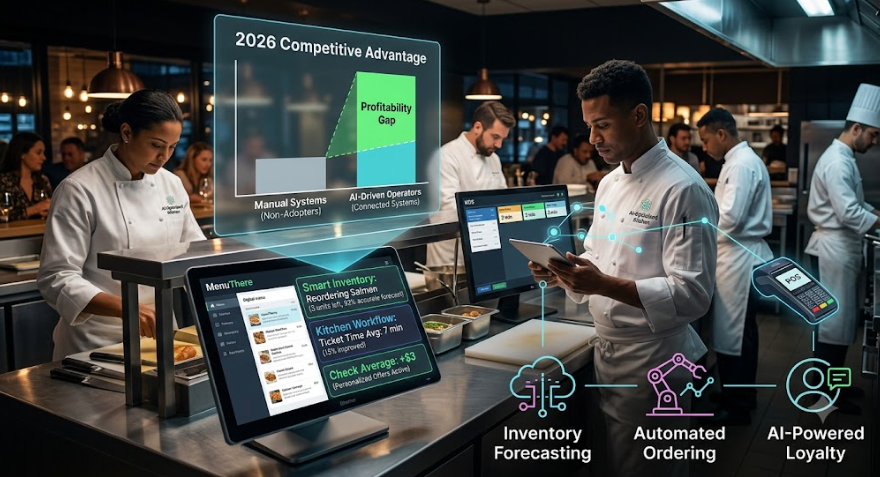
Here's what the data shows: operators using AI to optimize operations are reporting 60% improvements in operational efficiency, 52% better customer retention, and 30% higher check averages from mobile ordering alone. Meanwhile, restaurants still relying on manual processes are watching margins compress as traffic stays flat and consumer spending pulls back.
This isn't a technology trend anymore. It's a profitability gap.
The New Competitive Divide
In 2026, the National Restaurant Association's strategic research highlighted four industry shifts, but one stands out: AI adoption is now mission critical. Not optional. Not "nice to have for the future." Critical.
Here's why: traffic growth across the industry is projected at less than 1% in 2026. Only about one-third of tracked brands saw positive comparable sales in 2025. When traffic isn't growing, profitability becomes a matter of operational excellence. And that excellence now lives in the data.
The operators pulling ahead aren't winning on menu creativity alone or customer experience alone. They're winning because they've connected their operational data to real P&L outcomes. Restaurant365's mid-year 2026 analysis of over 420 operators running nearly 10,000 locations found a clear pattern: AI adopters reported measurable reductions in food and labor costs alongside greater operational efficiency, while non-adopters struggled to keep pace.
This is the Restaurant Profitability Gap, and it's widening.
Where AI Is Actually Creating Impact
The biggest misconception about restaurant technology is that it's customer-facing. That's not where the real leverage is. The real impact is operational.
Data That Actually Works
For years, restaurants generated enormous amounts of data every single day: sales patterns, customer habits, peak hours, ingredient usage, delivery performance. But most of that information went underutilized. Restaurants collected the data but lacked the systems to act on it.
AI changes that equation. Instead of simply recording sales data, smart systems now analyze patterns and provide actionable insights automatically. A pizza chain that adopted AI-powered inventory forecasting eliminated days of manual data aggregation and cut ingredient wastage by 18%. That's not a nice efficiency gain. That directly impacts food cost percentage and bottom-line profit.
Order Accuracy and Kitchen Speed
Toast's 2025 research found that automated ordering systems reduce errors by 25%, and 81% of restaurant operators now plan to expand AI usage in reservations and order processing. That reduction in errors compounds across shifts, locations, and quarters. Fewer remakes. Fewer customer complaints. Fewer credits applied to bills.
On the kitchen side, digital workflow optimization significantly improves ticket times and reduces bottlenecks during peak service. Consistency in speed is one of the biggest drivers of long-term customer loyalty. You can't build a repeatable customer experience if your ticket times vary by 15 minutes depending on the day.
Labor and Inventory Intelligence
When AI takes over repetitive operational tasks like data aggregation, inventory forecasting, and staffing optimization, your staff has newfound time to focus on what actually matters: customer connection and service quality. Hospitality leader Cassie Davison notes that "as technology takes care of more background processes, businesses can reconnect with why they exist, strengthen their teams, and build deeper relationships with customers."
That's not just morale. That's retention. And in an industry where labor turnover erodes both consistency and margins, it matters.
The data backs this up: 82% of restaurant executives are planning to expand AI usage specifically to improve customer experience and operational efficiency. Seventy percent of respondents in recent Deloitte surveys are either actively using or piloting AI to boost loyalty programs.
Why Digital Menus Are Part of the AI Stack
Here's where Menuthere fits into this picture. A digital menu platform isn't just about aesthetics or convenience. It's a data collection and optimization layer that feeds directly into AI-driven decision making.
When your menu exists as a static printed piece, you have no visibility into what's selling, what's not, which daypart performs best, or how customer preferences shift across locations. That's data you can't act on. When your menu is digital, you can track every view, every add-to-cart, every abandoned order. You can A/B test menu engineering changes without reprinting thousands of pieces. You can switch daypart menus based on real demand patterns, not guesses.
More importantly, you can surface the most profitable items to the right customers at the right time based on their order history and preferences. That's personalization at scale. It's also data that feeds into your broader AI stack, whether that's loyalty programs, demand forecasting, or pricing optimization.
The restaurants building competitive moats in 2026 aren't just adopting isolated AI tools. They're connecting their menu platforms to their inventory systems, their POS systems, and their customer data platforms. That integration is where the magic happens.
The Implementation Reality
Importantly, this doesn't require throwing a six-figure budget at a complete technology overhaul. Restaurant365's research emphasizes that successful AI implementation follows a disciplined approach: focus on one priority area, clean and connect data sources, pilot the solution in a single unit, then expand once consistency is proven.
The operators winning aren't the ones experimenting with five different AI tools simultaneously. They're the ones with one clear problem to solve, clean operational data, and a measurement strategy that tracks ROI back to food cost, labor cost, or customer lifetime value.
Cross-functional ownership also matters. Operations leads guide execution. Finance tracks ROI. IT ensures secure data integration. When those teams work together, outcomes improve dramatically. When they work in silos, AI initiatives often stall or fail to drive measurable impact.
What This Means for Your Restaurant in 2026
If traffic is flat and competition for every customer is intense, operational excellence isn't a competitive advantage anymore. It's the price of staying in business.
The question isn't whether to invest in technology. The question is how to invest smartly. Start by auditing your data: Where does it live? How connected are your systems? Which operational area costs you the most money or creates the most customer friction? That's your starting point.
Then build from there. Connect your menu platform. Implement demand forecasting. Clean up your inventory data. Watch your margins respond.
The winners in 2026 are choosing speed, consistency, and data-driven decisions over guesswork. That's how they're competing when growth is scarce.
Ready to turn your operational data into a competitive advantage?
Menuthere's digital menu platform integrates with your POS and customer data to give you the visibility and control you need to optimize menu performance, track what's actually selling, and personalize customer experiences at scale. Start with your menu. Build from there.