From Order History to Repeat Revenue: How a Saved Number Becomes Your Best Marketing
Your most profitable customer already ate at your restaurant. Here is how a saved phone number and order history turn into your usual reorders and win back revenue.
Your most profitable customer already ate at your restaurant. Here is how a saved phone number and order history turn into your usual reorders and win back revenue.
Previous article
On the apps, the platform owns your customer, not you. Here is why the customer relationship is the spine of your brand, and how to own it through WhatsApp.
Next article
The most profitable customer your restaurant will serve this month is not a new one. It is someone who already ate your food, already liked it, and is sitting at home right now deciding what to order for dinner. The only question is whether they think of you, and whether ordering from you again is effortless or a small hassle.
That is the whole game of repeat revenue, and the numbers behind it are lopsided. Regulars drive the majority of restaurant sales, a returning guest is worth many times a one time visitor over their lifetime, and existing customers spend more per order than first timers. Keeping a customer costs a fraction of winning a new one. And yet most restaurants pour almost all of their money and attention into acquisition, chasing the next new face while the people who already love them quietly drift away.
The fix is not a bigger ad budget. It is two pieces of information you may already be throwing away.
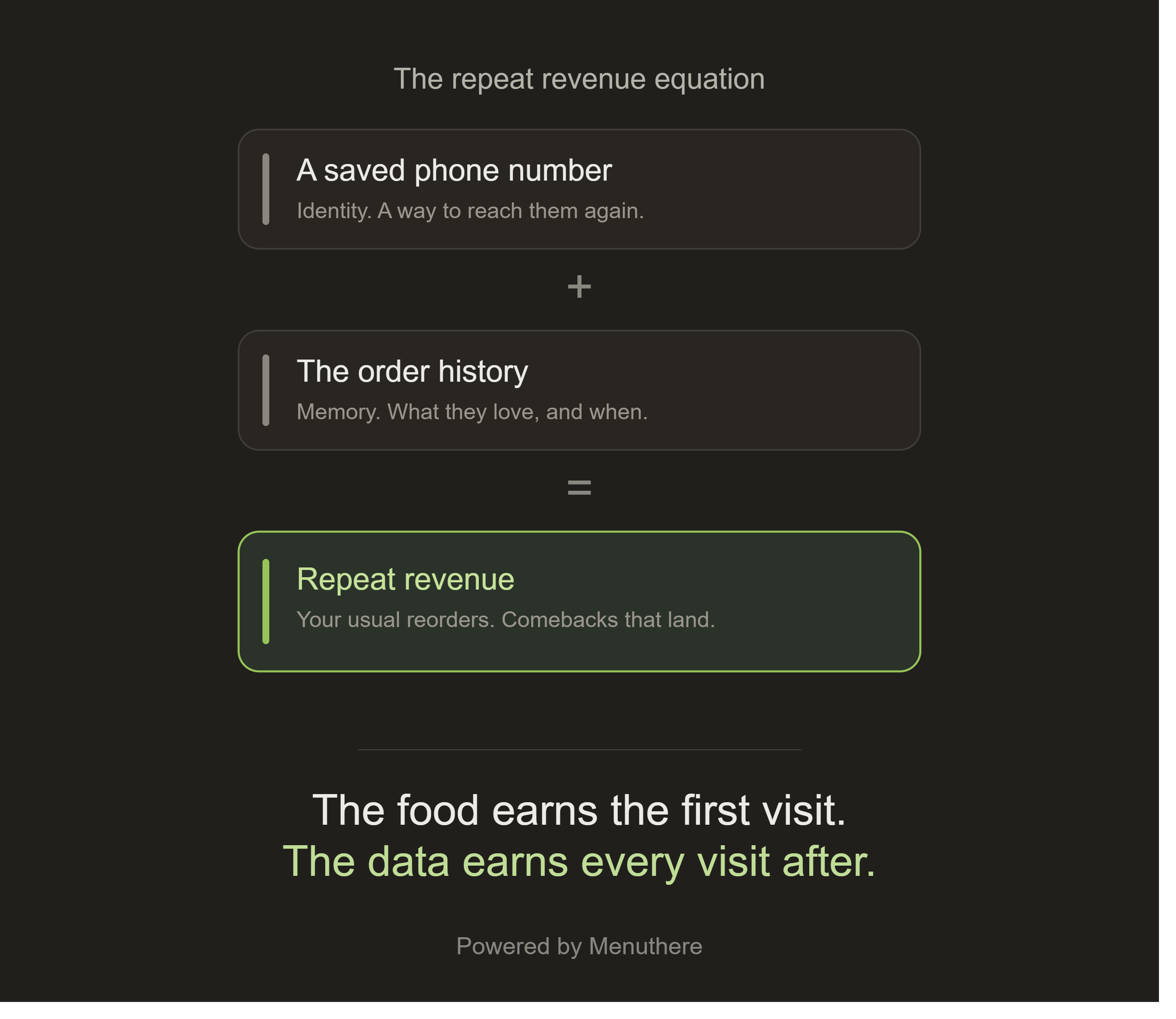
To turn a past customer into repeat revenue, you need exactly two things. Identity, which is a way to recognise and reach the person again. And memory, which is a record of what they ordered before. A phone number is the identity. The order history is the memory. Together they are almost everything you need for marketing that actually works.
This is precisely what the aggregators never gave you. The number was masked, the history sat on their servers, and you were left guessing. The moment you capture both, on a channel you own, three things become possible that were impossible before.
Most repeat orders are lost not to a competitor but to friction. The customer wanted your biryani, opened an app, faced a menu, a search, a cart, a login, and somewhere in that little maze the impulse cooled. Frequency dies in friction.
Order history removes the friction entirely. When you know what someone ordered last time, their next order becomes a single message: "Your usual? Beef fry and two parotta, same as last Friday." One tap and it is done. You have turned a decision into a confirmation. Personalised, relevant prompts based on what a guest actually bought beat generic promotions every time, and the easier you make the reorder, the more often it happens.
Every restaurant has a quiet leak: the regular who used to come every week and simply stopped. No complaint, no drama, they just faded. Without identity and memory, you never even notice. With them, the lapse is visible and fixable.
Set a simple trigger. When a known customer has not ordered in a few weeks, they get a warm, specific message, the comeback. Not a blast to everyone, but a note to that person, referencing the food they loved, with a small reason to return. This is the Comeback campaign made real, and it works because it is personal. Restaurants using automated re engagement recover a meaningful share of lapsed guests who would otherwise have been gone for good.
Identity and memory let you stop shouting and start speaking. A new dish goes to the people who order that style of food, not the whole list. A slow Tuesday gets filled with a nudge to your most frequent guests. A festival menu reaches the people who ordered last Onam. Relevance beats frequency: one well timed message tied to a guest's real behaviour outperforms five untargeted blasts, and it protects the relationship instead of wearing it out.
You can do all of this over email, but in practice almost nobody opens it. Email open rates hover around a fifth of recipients. WhatsApp messages open at roughly nineteen in twenty. The number that powers your reorder is also the channel that reaches your customer, and it is already on their phone, already trusted, with the whole order history sitting in one thread. No app to download, no list to export, no platform in the middle.
Menuthere is built around exactly this loop. Your QR menu becomes a WhatsApp ordering channel, so every order captures the number with consent and remembers what was ordered, which means "your usual" reorders and comeback messages are not a project you have to build, they are simply how the channel works.
You do not need a dramatic change to feel this. Reorder rate is one of the most sensitive numbers in a restaurant. Nudging the share of customers who come back from one in twenty to one in ten does not add a few rupees, it reshapes the profitability of the whole base, because each retained customer keeps spending with almost no new marketing cost attached. A modest, steady improvement in repeat orders compounds into revenue that an equivalent spend on acquisition could never match.
This is the foundation. Ask permission to send order updates and offers at the point of ordering, and protect that consent. No number, no repeat revenue.
Hold on to what each customer ordered, and turn it into a "your usual" prompt. The goal is to make reordering the single easiest thing your customer does all day.
Decide on a lapse window, for many restaurants a few weeks, and let a warm comeback message go out automatically to anyone who crosses it. Reference what they used to love.
Tie each message to the person's actual orders and a real reason: a new dish in a style they like, a festival menu, a slow day offer. Generic blasts get ignored and erode trust. Specific messages get tapped.
Owned does not mean unlimited. Send when you have something relevant, not constantly. The fastest way to lose an owned audience is to spam it.
Watch your repeat order rate, the average days between a customer's orders, and the share of orders coming through your own channel. These three tell you whether your repeat revenue engine is actually running.
Acquisition gets all the attention, but repeat revenue is where restaurants actually make their margin. The people who already love your food are the cheapest, highest spending, most forgiving customers you will ever have, and most restaurants reach almost none of them on purpose.
A saved phone number and a remembered order are all it takes to change that. They turn a past customer into a one tap reorder, a quiet lapse into a comeback, and a generic promotion into a message that lands. The food earns the first visit. The number and the history earn every visit after that.
Turn one orders into many. Menuthere turns your QR menu into a WhatsApp ordering channel that remembers your customers, so your usual reorders and comeback campaigns run on the channel you own.
Sources: Restroworks and Bloom Intelligence 2025 and 2026 restaurant retention data, Olo and Bain and Company research on repeat customer revenue and retention economics, Paytronix and National Restaurant Association loyalty data, and industry reporting on behaviour triggered messaging and win back automation.
Restaurants miss 30 to 60 percent of calls at peak, and most callers never ring back. Here is how to turn every call into a saved number and a WhatsApp order.
Menu strategy
Ask the internet how often a restaurant should update its menu and you get a remarkably consistent answer.
Restaurant technology
You'd recognize him instantly. You have no way to reach him. And when he stops coming, nothing in your restaurant will notice.