"Restaurants are set for a humbling year." That's BTIG analyst Peter Saleh writing in his December 2025 forecast, citing depressed valuations, pending unit closures, consumer price sensitivity, and strategy overhauls across the industry.
The numbers backed him up before the year even ended. Through November, Black Box Intelligence had measured four consecutive months of comparable sales and traffic declines. Only about one in three brands they track posted positive comparable sales for 2025. The National Restaurant Association projects industry sales to hit $1.55 trillion in 2026, but with real, inflation adjusted growth of just 1.3 percent.
Translation: the topline isn't coming back fast enough to save anyone. Margin per cover is the only number that matters in 2026.
Which means menu engineering, a discipline first formalized in 1982 and ignored by most operators ever since, just became the most important skill in the restaurant.
The numbers that should be on every operator's wall
Three data points reframe the planning conversation.
Only one third of brands grew. Black Box Intelligence tracks comparable sales across thousands of restaurant brands. Roughly one in three posted positive comp sales in 2025. The other two thirds were treading water or sliding. That's not a recession. That's a sorting event. The brands that figured out their menu math kept growing. The ones that didn't, didn't.
1.3 percent real growth. The NRA's $1.55 trillion projection sounds impressive until you adjust for inflation. Real growth of 1.3 percent means the industry as a whole will earn roughly the same dollar per cover in 2026 as in 2025. Any operator who wants more is taking it from someone else's menu, not from category growth.
Four straight months of comp declines. When Black Box measured comp sales and traffic both down for four consecutive months heading into 2026, the message to operators was unambiguous. The consumer is tired, price sensitive, and trading down. They are still eating out. They are spending less per visit. The margin defense has to happen at the menu surface, not at the door.
Why menu engineering, why now
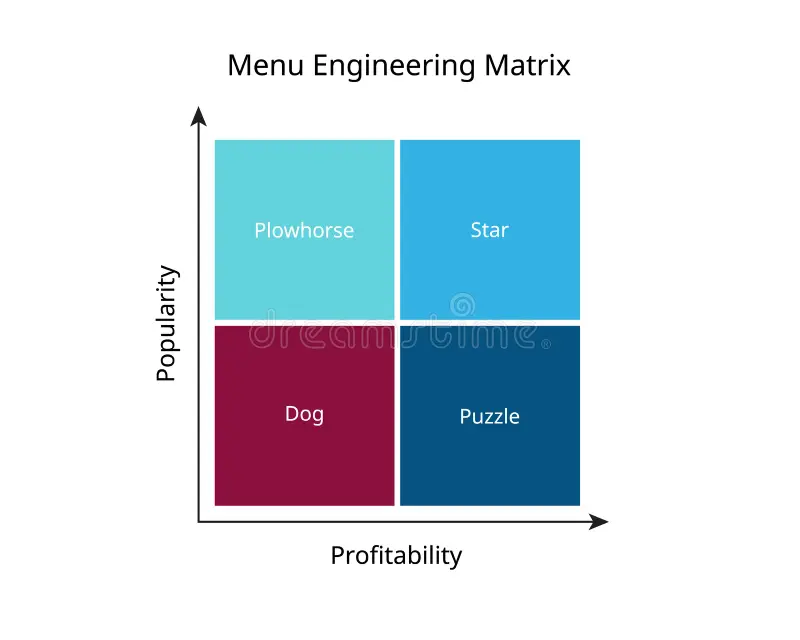
Menu engineering is the discipline of treating every item on a menu as a portfolio asset. Kasavana and Smith introduced the framework at Michigan State in 1982. Four quadrants:
Stars (high popularity, high profit margin): protect and feature prominently Plowhorses (high popularity, low margin): re-engineer the recipe or quietly reprice Puzzles (low popularity, high margin): re-merchandise, reposition, or drop Dogs (low popularity, low margin): kill
For forty years, operators have known the framework and ignored it. In bull years it didn't matter. A 5 to 8 percent comp lift could absorb a sloppy menu. The same sloppy menu in a 1.3 percent real growth year is a slow leak in the P&L.
Three forces are pushing menu engineering from optional to essential in 2026.
Ingredient volatility. Food costs are still 35 percent above pre pandemic levels in many categories, and the swings are unpredictable from month to month. An item costed and priced in January is mispriced by May. Annual menu engineering cycles can't keep up with monthly cost movements.
Consumer price sensitivity. The same guest who absorbed a 12 percent price increase in 2022 is comparison shopping the check in 2026. Every line item on the menu is being judged. The plowhorse that always carried the check (the burger, the pasta, the chicken sandwich) is the line item under the most pressure.
Labor structure. Full service median labor is now 36.5 percent of sales, and profitable operators are running closer to 34 percent. The math gets defended on prime cost, which means COGS movements have to be answered with menu movements within the same operating week, not the same operating quarter.
Where operators get menu engineering wrong
Three patterns show up in operators who know the framework but can't make it work.
Recipe costing on an annual cadence. The plate cost on file is from the last menu refresh, six to twelve months ago. By the time the operator sits down to redesign the menu, half the cost data is wrong. The matrix gets built on stale numbers. Plowhorses get classified as stars and vice versa.
Menu changes locked to print cycles. The decision to reprice an item or kill a dog gets made in March. The new menu prints in June. By June, three of the items have already been 86'd by suppliers, two more need repricing, and the freshly printed menu is already partially out of date. The print cycle is the cap on iteration speed, and it's set to "way too slow."
No POS to menu feedback loop. The operator can see what sold in the POS. The operator cannot easily see how a different layout, a different price, a different photo, or a different category position would have changed the sales mix. Without that experimental loop, menu engineering is a guessing game with consequences.
The 2026 menu engineering playbook
1. Cost every recipe monthly, not annually
Ingredient volatility makes annual recipe costing useless. Build a monthly review where the kitchen lead spends two hours updating plate costs against current invoices. Items that have drifted by more than 3 percent get flagged for repricing or recipe adjustment. This single discipline rebuilds the foundation that the rest of the playbook stands on.
2. Run the four quadrant matrix every quarter, not annually
Pull POS data for the last 90 days. Plot every item by popularity and margin. Identify the stars, plowhorses, puzzles, and dogs. Most operators will be surprised. The dish the chef thinks is a star is often a plowhorse. The dish nobody talks about is often the puzzle that needs better merchandising. The quarterly cadence catches drift before it shows up in the P&L.
3. Reprice the plowhorses without losing them
The high traffic, low margin items are the most dangerous category on the menu. A $1 price increase on a burger that sells 200 times a week is $200 a week, $10,400 a year, per location. Most operators are afraid to touch the price because they don't have a way to test it. Run the price change on one location for two weeks. Watch the volume. If it holds, scale. If it doesn't, roll back.
4. Test price changes per location, per week
This is where the menu finally has to become software. Paper menus make small price tests impossible because the cost of printing kills the math. Digital menu platforms like Menuthere let operators run a $0.50 increase on two items in one location for one week and see exactly what happens to the mix. The decision goes from "reprice everywhere in June" to "test on Tuesday, scale on Friday." Menu engineering only works at the speed the menu can actually move.
5. Reposition value items without using the word "value"
The hardest move on the 2026 menu is signaling value without signaling cheap. The plowhorses need to feel like deals. The stars need to feel like splurges. The puzzles need to feel like discoveries. Most of that work happens in copy, photography, and placement on the menu surface, not in the kitchen. An item moved from the bottom of a section to the top can shift its sales by 15 to 25 percent without changing a thing about the food.
6. Kill the bottom quintile every quarter
The single most underused move in menu engineering. Most operators add items and never subtract. The result is a sprawling menu where the bottom 20 percent of items consume kitchen labor, prep space, and inventory budget without earning their spot. Cut them on a quarterly cadence. The remaining items get more attention, better execution, and stronger guest perception.
The bottom line
The macro for 2026 is not a recession. It's a sorting event. The brands that grew in 2025 grew because they were running their menus as portfolios. The brands that flat lined were running their menus as a quarterly print job.
The discipline isn't new. Menu engineering has been documented and taught for over forty years. What's changed is the cost of ignoring it. In a year of 1.3 percent real growth, every line item has to defend its spot. The framework finally matches the moment.
The constraint, for most operators, is no longer knowledge. It's iteration speed. A menu that can only change every quarter cannot defend margin in a market where ingredient costs and consumer behavior change every week.
Move your menu to a system that moves at the speed of your P&L.
Menuthere is the digital menu platform built for operators who want to test, reprice, kill, and feature items in real time across every location, the same week the data tells them to.
Sources: BTIG December 2025 Restaurant Forecast, Black Box Intelligence November 2025 industry data, National Restaurant Association 2026 State of the Industry, Restaurant Dive 2026 outlook coverage, Kasavana and Smith Menu Engineering Framework (Michigan State, 1982).