
The 24 Hour Window: How Restaurants Turn Abandoned WhatsApp Orders Into Repeat Customers
Seven in ten food orders are abandoned. Here's how restaurants use the WhatsApp 24 hour service window to recover them and drive repeat orders at zero commission.
Seven out of every ten online food orders that get started never get finished. Across studies the average sits near 70 percent, with food and beverage landing somewhere between 62 and 72 percent depending on who is measuring. The number has moved almost nothing in ten years.
Most operators read that as a checkout problem and go to work on the funnel. Fewer form fields. One tap payment. Faster load times. All of it helps, and all of it caps out fast, because the biggest chunk of abandonment has nothing to do with checkout design. People get distracted. A colleague calls. The kid needs something. They intended to order and simply stopped.
Which means the recoverable revenue is not sitting in your checkout flow. It's sitting in whether you have any way to reach that person twenty minutes later.
The economics nobody argues with and almost nobody acts on
Acquiring a new customer costs roughly five times more than retaining an existing one. Repeat customers spend around 67 percent more than first timers. Aggregator commissions run 20 to 30 percent per order, and they run at that rate on the hundredth order from a regular exactly as they did on the first.
Put those three facts together and the conclusion is uncomfortable. Most restaurant marketing budgets are pointed at the most expensive customer in the business, over and over, while the cheapest one gets no attention at all.
The gap isn't a knowledge gap. Every operator knows retention is cheaper. The gap is infrastructure. Retention requires a channel you own, and for most restaurants that channel does not exist. The aggregator holds the customer data. The POS holds a phone number nobody uses. The Instagram follower list is not a customer list.
Why WhatsApp changes the math
WhatsApp messages are opened at rates approaching 98 percent. Restaurant email marketing typically lands between 15 and 20 percent. That single spread is why a channel most operators think of as a support inbox is actually the highest performing retention tool available to them.
The second reason is friction. Reordering on WhatsApp is one reply. Not an app download, not a login, not a rebuilt cart. Operators running one tap reorder flows are reporting repeat order lifts in the 30 to 50 percent range.
The third reason is ownership. An order that closes inside your WhatsApp thread carries no aggregator commission. You pay full price once, on acquisition, and near zero on every order after that.
The 24 hour service window, explained properly
Here is the mechanic that most operators have never had explained to them.
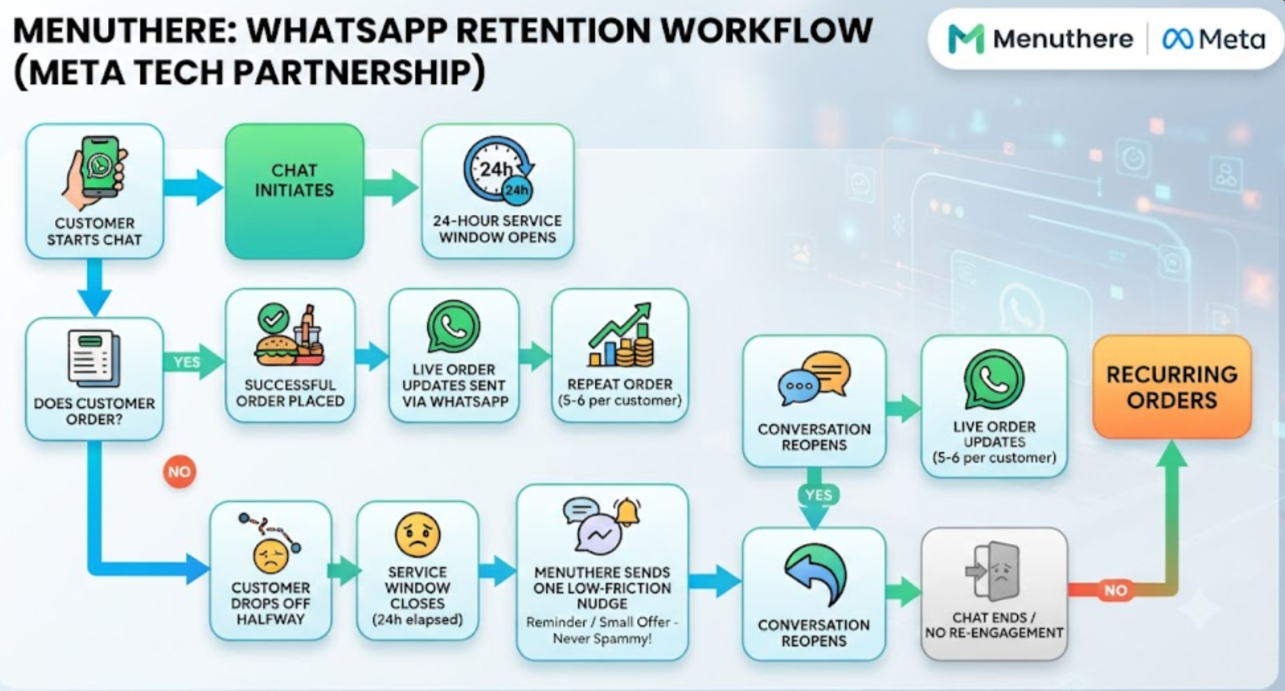
When a customer sends your business a WhatsApp message, a 24 hour service window opens. Inside that window you can reply freely and conversationally. Once it closes, you can no longer message that customer freely. You need a pre approved template message, and marketing category templates carry a per message cost.
That structure is why most brands quietly write off the customer who drops halfway. The window shuts, the thread goes cold, and the person who was thirty seconds from ordering becomes someone you will pay an aggregator to reach again.
The recovery move is small. One message after the window closes. Not a campaign, not a discount war. A reminder that the order is still there, sometimes with a modest offer attached. If the customer replies, the service window reopens and the whole conversation becomes free again, including live order updates through delivery.
One message. That's the entire mechanism.
Where operators go wrong
They treat it as a broadcast channel. The moment WhatsApp becomes a promotions blast, opt out rates climb and the channel dies. The value is in the one to one thread, not the list.
They send too many. One nudge per abandoned order. Two at the absolute outside. Frequency is what turns a useful reminder into a block.
They send it too early. Chasing someone eleven minutes after they got distracted reads as surveillance. After the window is the right timing, and it also happens to be the moment the customer has forgotten they were mid order.
They don't track it separately. Recovered orders get folded into general online order volume, the channel looks unremarkable, and nobody defends the budget.
The playbook
1. Make the first message easy to send
The customer has to message you before any of this exists. That means a WhatsApp entry point everywhere the customer already looks: table QR, packaging insert, Google Business Profile, Instagram bio, delivery bag sticker.
2. Capture the intent, not just the order
Log what was in the abandoned cart. A nudge that says "your order is still here" performs. A nudge that says "your chicken biryani and two rotis are still here" performs considerably better.
3. Send exactly one nudge after the window closes
Keep it short and low pressure. State that the order is saved. Add a small incentive only if the ticket justifies it. Make replying the single obvious action.
4. Keep the menu live inside the thread
This is where most WhatsApp retention attempts fall apart. The nudge works, the customer replies, and then they're handed a PDF from four months ago with three sold out items on it. The menu has to be current, priced correctly, and daypart aware at the moment the thread reopens. That's the layer Menuthere handles: a digital menu that stays accurate everywhere it appears, including inside the conversation.
5. Keep the thread open after the sale
Order confirmed. Kitchen started. Out for delivery. Each of those is free inside the service window, and each one trains the customer that this thread is where their food lives.
6. Measure recovered orders as their own line
Track abandoned orders, nudges sent, replies, recovered orders, and repeat orders per recovered customer. If you cannot show the last number, you cannot argue for the channel.
The bottom line
The restaurants pulling ahead on retention have not built better loyalty programs. Points programs have been available for twenty years and most of them sit unused in a customer's wallet.
What they've built is a thread that stays open. The customer messages once, and from then on ordering is a reply rather than a decision. Discovery still costs what it costs. Everything after discovery costs almost nothing.
Seventy percent of started orders are abandoned. The infrastructure to recover a meaningful share of them is one message and an accurate menu. That is not a technology problem. It's a decision about who owns the customer.
Ready to make your menu the start of a conversation instead of the end of one? Menuthere gives restaurants a live digital menu that stays accurate across QR, delivery, and chat, so every thread you open can close as an order.
Sources: Baymard Institute cart abandonment research, Statista online food ordering data, industry WhatsApp Business API benchmarks, restaurant retention cost studies.