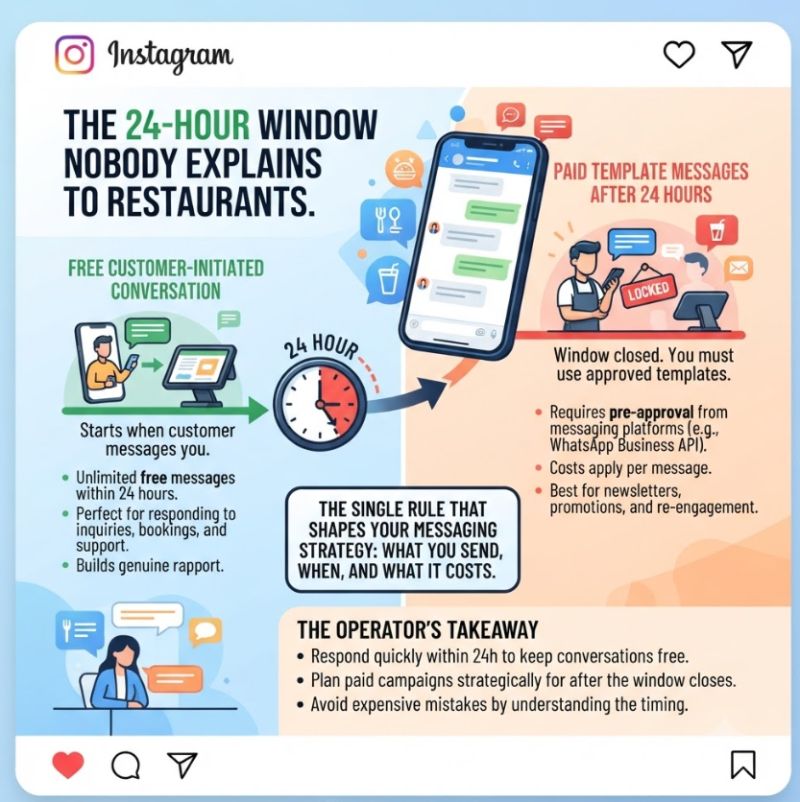
Almost every restaurant that starts using WhatsApp properly learns the rules the same way. From the first invoice.
There is one mechanism underneath all of it, and once you understand it, everything else about WhatsApp pricing becomes obvious. Nobody explains it to operators, so here it is.
The rule, in plain English
When a customer sends your business a message, a 24 hour window opens.
Inside that window you can reply freely. Plain text, images, files, anything. No template, no approval, no charge. Meta calls these service messages. They became free in November 2024, but since 1 October 2026 each business number gets 1,000 free service messages a month, and Meta charges from the 1,001st.
The window resets every time the customer messages you again. So an active conversation stays open, and your replies come out of that monthly allowance of 1,000 free service messages.
When the window closes, everything changes. You can no longer send a free form message at all. The only thing you can send is a pre approved template, and you pay for each one, at a rate set by the message category and the customer's country.
That is the whole mechanism. Customer talks first, you can reply without a template. Silence for 24 hours, and every message costs money and needs prior approval.
What this means for a restaurant, concretely
Take a normal order.
A customer messages you at 8:12pm. The window opens.
Order confirmed. Being prepared. Out for delivery. Delivered. All four of those go out inside the window, and since 1 October 2026 each one is a paid utility message, even though the customer opened the window by ordering.
This is the part worth noticing. The entire status update sequence that makes WhatsApp ordering feel good to a customer costs you nothing, precisely because the customer started the conversation.
Now take the other case.
The same customer ordered on Tuesday and has not messaged since Wednesday. It is now Saturday and you want to tell them about the weekend special.
That window closed days ago. You cannot simply message them. You need a template that was submitted and approved in advance, and because it promotes something, it is a marketing template, which is the most expensive category and is charged on every delivered message; the only exception is the free entry point window after a Click to WhatsApp ad.
Same customer. Same phone. Completely different cost and completely different rules, decided entirely by who spoke last and how long ago.
The four categories, and why the label matters more than the message
Meta sorts every business message into four categories, and the category decides what you pay.
Service. Your replies inside a customer initiated window. The first 1,000 a month per number are free, then charged.
Utility. Transactional updates tied to something the customer did. Order confirmations, delivery updates, payment confirmations. Cheapest template category. Since 1 October 2026 it is charged inside the service window too; it is free only inside a free entry point window.
Authentication. OTPs and verification codes. In India this is priced at the same rate as utility.
Marketing. Promotions, offers, re-engagement, anything with promotional intent. Most expensive, charged on every delivered message except inside a free entry point window, and no volume discounts.
Here is the detail that costs operators money: the category is fixed on the template when it is approved, not decided at the moment you send it.
So if you build a delivery update template and drop a discount code into it, that template is now marketing. Not partly marketing. Marketing. Meta draws the line at promotional intent, and a template that mixes a transactional update with an offer gets classified at the higher rate.
A shipping update is utility. The same shipping update encouraging the customer to order again is marketing, in the same thread, to the same person, at several times the price.
Three mistakes that show up on the invoice
Treating it as a broadcast list. Every broadcast is marketing by definition, charged on every delivered message, to every number, whether or not they were ever going to read it. A thousand recipients is a thousand charges. And the downside is worse than the cost, because a customer who blocks you is gone permanently, which is not true of email.
Mixing promotion into transactional templates. This is the most common and the most avoidable. Keep your order updates clean. If you want to promote something, do it as a separate template, knowingly, at the marketing rate.
Not knowing when the window shut. Staff reply to a customer thirty hours later and cannot understand why the message will not send or why it suddenly needs an approved template. The window closes 24 hours after the customer's last message, not 24 hours after yours.
The free entry point most restaurants have never used
There is a specific exception worth knowing about.
When a customer taps a Click to WhatsApp ad and messages you from the WhatsApp app on their phone, Meta opens a free entry point window that may remain open for up to 7 days, and inside it Meta does not charge for marketing, utility, authentication or service messages.
For a restaurant running any paid social at all, that changes the arithmetic of the ad. You are not just buying a click. You are buying up to a week of free messaging with somebody who raised their hand.
Almost nobody in Indian restaurant marketing structures campaigns around this.
What changes on 1 October 2026
This matters and it is close, so it deserves a clear flag.
Meta's own pricing page confirms the change: since 1 October 2026, utility templates sent inside the 24 hour customer service window are charged, and service replies are free only for the first 1,000 a month per number.
If that holds as described, it changes the economics of everything above. So the status update sequence is now a per message cost, and the value of the service window has shrunk considerably.
I want to be honest about the confidence level here. Some pricing guides still describe the service window as free; they were written before the change. This is one source describing an announced change, not a settled fact I can verify independently.
So treat it as a question to put to your provider rather than as something to plan around blindly. Ask your BSP directly what changes for your account on 1 October, and what your per message rates will be for utility and service in India after that date. If they cannot answer clearly, that itself is useful information about your provider.
What to actually do
Design your flows to live inside the window. Every message that matters operationally, confirmations, preparation updates, delivery status, arrives while the window is open because the customer opened it by ordering. That is not a coincidence, it is how the system is meant to be used.
Keep transactional templates clean. No offers, no codes, no re-engagement language. Protect the utility classification.
Treat marketing templates as a budget line, not a habit. Every one is charged on every delivery. Decide what it is worth per thousand recipients before you write it, not afterwards.
Ask your provider for the category breakdown on your invoice. Marketing, utility, authentication, service. If you cannot see that split, you cannot manage the cost, and most of the surprise in a WhatsApp bill is a category surprise rather than a volume surprise.
Structure paid social around the free entry point while it exists. A Click to WhatsApp ad buying you up to 7 days of free messaging is a materially different proposition from a click to a landing page.
And check the 1 October position with your provider this month rather than next.
The bigger point
Look at what Meta has priced at zero and what it has priced at full rate.
Replying to a customer who contacted you: free for the first 1,000 service messages a month per number, then charged. Sending an update tied to something the customer actually did: a paid utility message, the cheapest template category. Broadcasting a promotion to people who did not ask: charged, every time, with no discounts.
That is not an accident of pricing. It is a set of incentives, and it is telling you exactly how the channel is meant to be used.
The restaurants that will find WhatsApp cheap are the ones having conversations. The ones that will find it expensive are the ones treating it as a cheaper SMS gateway.
The pricing model has already made that argument better than any article could.
Take orders where the conversation is already open. Menuthere turns your WhatsApp number into an ordering channel: the customer sends Hi, gets your menu, orders in a few taps, and the status updates go back into the same chat. No app, no signup, no OTP.
Sources: Blueticks 2026 (message categories, service window mechanics, November 2024 removal of the free conversation cap), SetSmart 2026 (per message pricing, category rates, India authentication rate), EngageLab 2026 (July 2025 pricing transition, free entry point windows), SleekFlow 2026 (template approval, category classification, announced 1 October 2026 change), Chatarmin 2026 (country based pricing).
Note: WhatsApp pricing and policy change frequently, and rates vary by provider markup. Confirm current terms with your BSP before making decisions based on this article.