
WhatsApp Ordering System for Restaurants: From "Hi" to Delivered, Without an App
A WhatsApp ordering system for restaurants can carry the full order loop: capture, accept, dispatch, deliver. Here is how it works and why most setups only build half of it.
On a Rs 500 delivery order in an Indian metro, the restaurant sees somewhere between Rs 303 and Rs 375 land in the bank. Base commissions run roughly 18 to 28 percent depending on city, cuisine and how hard the last renewal was negotiated. Stack GST on the commission, payment gateway charges, the platform fee that jumped to Rs 17.58 in March 2026, ad spend and discount funding, and the effective deduction settles in the 25 to 35 percent band.
None of that is news to anyone running a kitchen. What changed in 2026 is that operators finally started moving. In a survey of 450 restaurant operators reported by Restaurant Business Online in January 2026, 53 percent said they plan to reduce or end their use of third party delivery platforms. Only 32 percent said they would carry on exactly as they are. Close to 60 percent are now tying loyalty rewards to direct orders specifically to pull volume off the marketplaces.
And yet most of those restaurants are still on Swiggy and Zomato next quarter. The reason is not inertia and it is not the commission line. It is that the industry has spent five years selling restaurants a direct ordering page when what a restaurant actually needs is a direct fulfilment loop.
What you are actually renting from an aggregator
An aggregator does not sell you orders. It sells you four things bundled into one monthly deduction.
Discovery, first. A hungry person opens the app without a restaurant in mind and your listing is one of the options. Second, an ordering interface that handles menu, customisation, cart and checkout. Third, a payment rail that settles money without you touching it. Fourth, a rider network that shows up at your counter without a phone call.
Almost every direct ordering product on the market replaces the second one. A branded page, a nice cart, a checkout button. Then the order arrives as an email or a dashboard ping and the operator is on their own for the other three.
That is where direct ordering quietly dies. Not at the order. At everything after it.
The back half problem
Picture the customer who just placed a direct order on your site at 8:40 on a Friday.
They do not know if the kitchen saw it. Nobody has told them it was accepted. There is no screen showing that a rider was assigned. At 9:05 they call the restaurant. The cashier is mid rush and puts them on hold. The food arrives at 9:20, perfectly good, and the customer has spent forty minutes not knowing whether it was coming.
Next Friday that customer opens Swiggy. Not because Swiggy is cheaper for them and not because your food is worse. Because Swiggy told them where their food was.
The aggregators did not win on discovery. Discovery is the cheap part and every operator with an Instagram account already has some of it. They won on status. They built the only channel that talks to the customer after the money is taken, and restaurants have been trying to compete with it using a confirmation email.
Why WhatsApp is the only channel in India that can carry both halves
India has somewhere between 500 and 615 million WhatsApp users depending on whose count you trust, and penetration among smartphone owners sits near the top of any market globally. Business messages on the platform see open rates reported in the 95 to 98 percent range. Nothing else in the Indian stack comes close, and there is no install step, no account creation, no password reset flow, no push notification permission prompt.
The technical detail that matters most is one almost nobody outside the plumbing talks about. When a customer sends the first message, WhatsApp opens a 24 hour customer service window. Inside that window the business can send free form messages: text, images, documents, buttons, whatever the moment calls for, with no pre approved template required and no per template cost. Once the window closes, the business can only reach that customer through approved templates.
Which is why a well built ordering link should expire at 23 hours, not 24 or 48.
Set it that way and the entire order lifecycle, from the confirmation with the bill breakdown through accepted, dispatched, out for delivery and completed, lands inside the free window that the customer opened themselves. The restaurant is not spamming anyone. The customer started the conversation. Every message after that is a reply.
That single constraint is the whole reason WhatsApp ordering works commercially where SMS and email did not.
The full loop, step by step
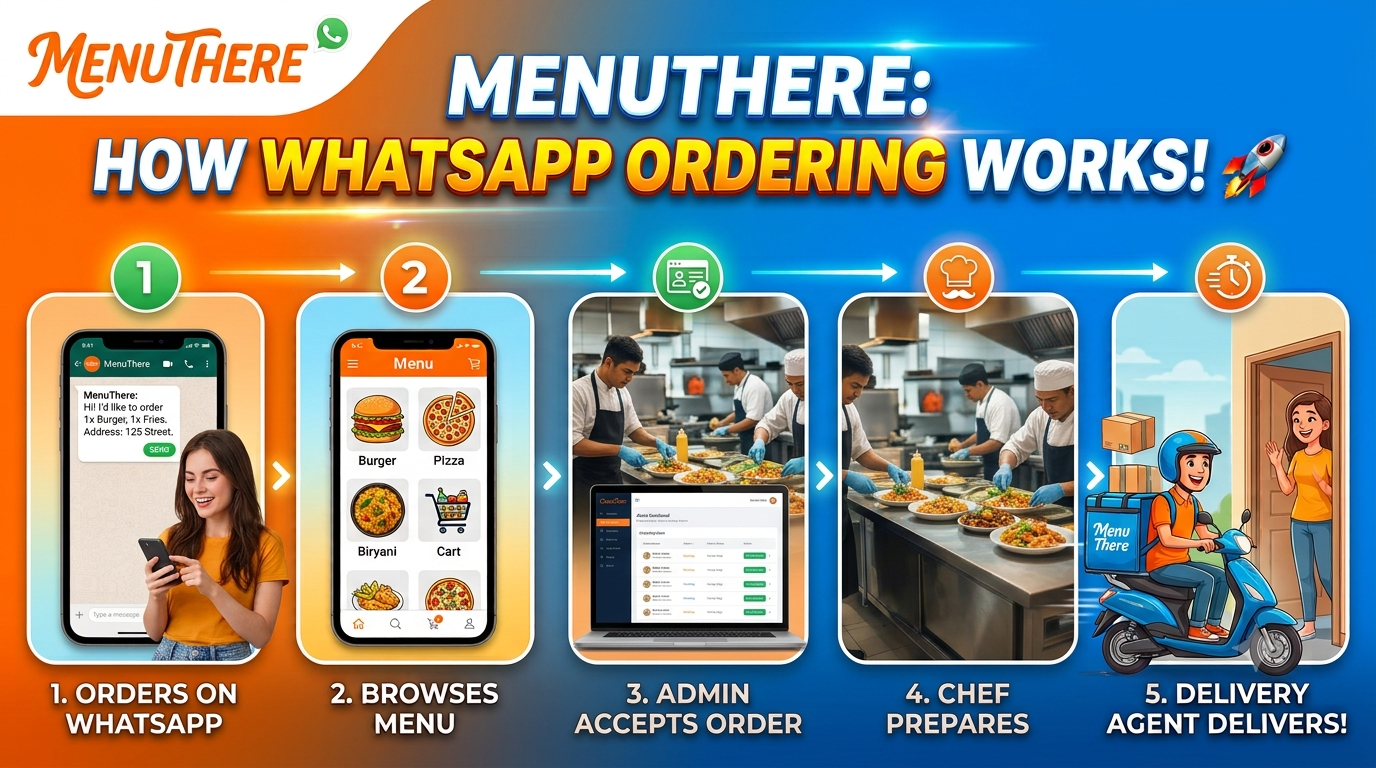
Here is what an end to end WhatsApp ordering system looks like when all three sides are actually built.
The customer sends "hi." That is the entire onboarding. No download, no signup, no OTP wall before they have seen a single dish.
The restaurant replies with an ordering link, valid 23 hours. The link opens the restaurant's own storefront, on the restaurant's own domain, with the restaurant's own branding. No competitor listing sits three pixels below your paneer.
The customer picks the order type first. Delivery, takeaway or dine in. One channel, three revenue streams. Most direct ordering tools force you to run separate flows for each, which is why most operators only ever set up one.
They browse the full menu with photos, customisations and recommendations. This is the surface where average order value is actually made or lost. Aggregators have spent hundreds of crores optimising the "add a Coke" moment because it is worth that much. A direct channel that ships a flat PDF menu is leaving that money on the table on purpose.
They set name and address and place the order. A WhatsApp message lands immediately with the full bill breakdown, not just a thank you.
The order hits the admin dashboard. The operator accepts. The kitchen gets the ticket. When the food is ready the operator dispatches, either to an in house rider or by handing the leg to Porter or Rapido, whichever is cheaper in that pincode at that hour.
Every one of those state changes fires a message back into the same thread. Accepted. Dispatched. On the way. Delivered. The customer never has to ask.
The WhatsApp ordering playbook
1. Make "hi" the only thing you ask for
Every field you add before the menu costs you orders. Name, address, phone, payment preference: all of it can wait until after the customer has decided they want your food. The order of operations is menu first, details last, and it is worth more than any discount you could run.
2. Put the order type toggle above the menu
Delivery, takeaway and dine in have different price sensitivities, different packaging costs and different margins. Running all three through one link means a customer who came for delivery on a rainy Tuesday can be captured for dine in on Saturday without you building anything new.
3. Sell on the item page, not the cart page
Customisations and recommendations at the item level are where attach rate lives. A customer adding a biryani should see the raita and the gulab jamun right there, in context, before they have mentally closed the order. Cart page upsells convert at a fraction of the rate.
4. Close the loop or do not bother opening it
This is the item most operators skip and it is the one that decides whether the channel survives. An ordering link that takes an order but cannot dispatch a rider and cannot message a status update is not a channel, it is a form. Menuthere runs the full loop in one system: the WhatsApp thread, the branded storefront, the admin dashboard with accept and dispatch, in house delivery boy assignment, third party handoff to Porter or Rapido, and automated status messages back into the same conversation the customer started.
5. Route the last mile per order, not per contract
You do not need a fleet. You need the ability to choose, order by order, between your own rider and an on demand partner. Short hop with a bike free at the counter goes in house. Six kilometres in the rain goes to a 3PL. That flexibility is worth more than any single delivery contract.
6. Treat the phone number list as the balance sheet item it is
Every direct order gives you a number, a name, an address and an order history that no platform can revoke. That list is the only asset in this entire discussion that compounds. Aggregator volume is rented. A customer who has said "hi" to your number once will say it again.
The bottom line
The commission conversation has become a distraction. Rapido launched Ownly across Bengaluru in March 2026 with zero commission for restaurants and roughly 20,000 partners onboarded, and it is a genuinely good deal for the operators on it. It is also still someone else's channel, someone else's customer list and someone else's decision about what happens to the terms in eighteen months.
The channel you own is the one where the customer messages you directly, sees your menu on your domain, and hears from you at every step until the food is at the door. In India that channel already exists on 500 million phones and it does not need to be installed.
The restaurants that will still be independent in three years are not the ones negotiating two points off a commission rate. They are the ones who own the thread.
Ready to take orders on WhatsApp?
Menuthere gives your restaurant the full loop: a WhatsApp ordering line, a branded storefront on your own domain, and an admin dashboard that accepts, dispatches and updates the customer automatically.
Sources: Restaurant Business Online operator survey (January 2026), NRAI and CCI filings, Meta WhatsApp Business Platform documentation on the 24 hour customer service window, Medianama and Free Press Journal reporting on Rapido Ownly (March 2026), IMARC Group India online food delivery market data.