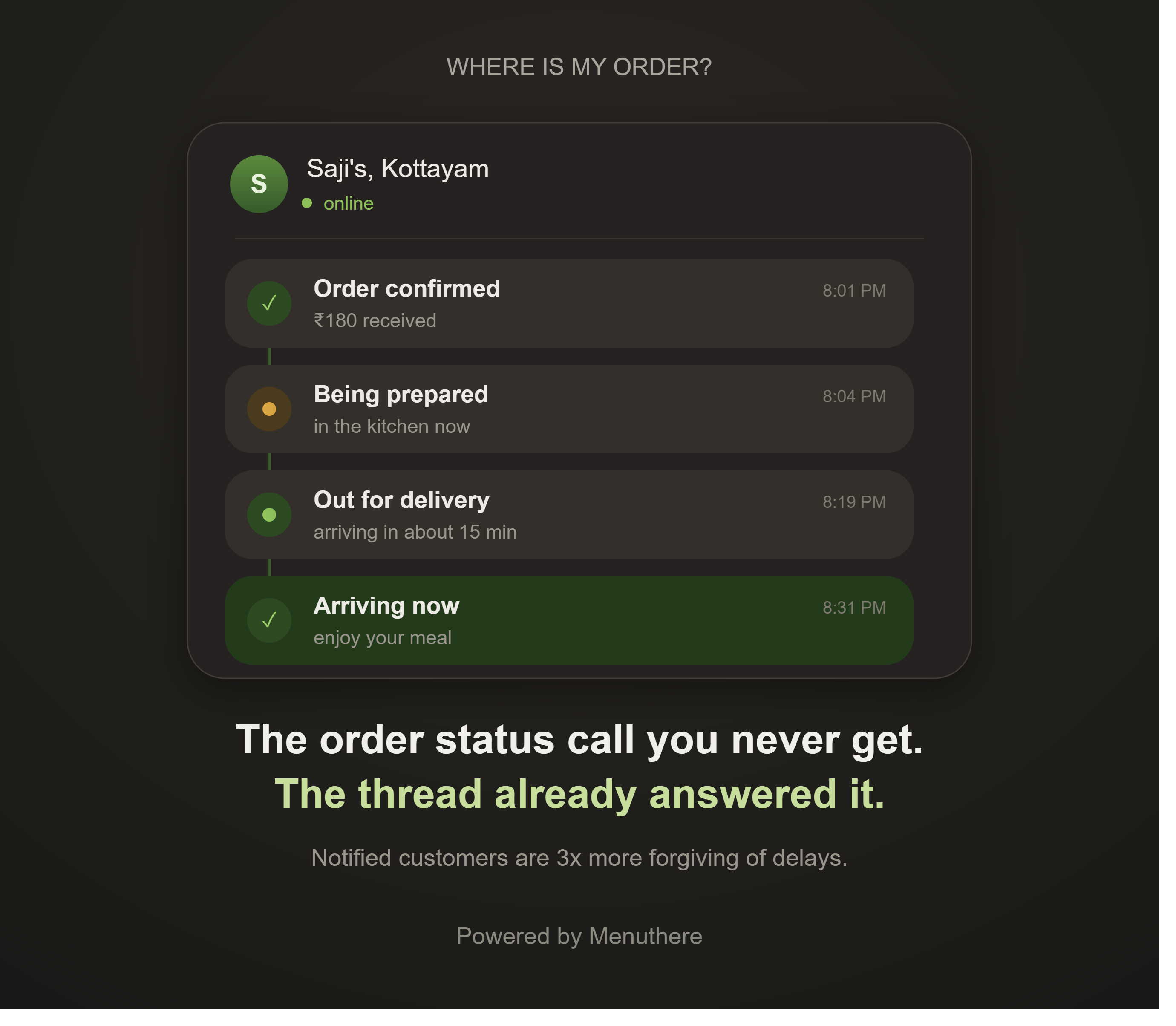
The most stressful minutes of any order are the silent ones. The customer tapped order, felt the little hit of anticipation, and then nothing. Is it confirmed? Are they actually cooking it? Has it left yet? Where is it now? That silence has a sound, and for a restaurant it is the sound of your phone ringing at 8pm, when the kitchen is slammed and there is nobody free to pick it up.
That call has a name, it is entirely predictable, and it is almost entirely preventable. The fix is not a faster kitchen. It is a talking one. When the order's status lives in the same WhatsApp thread the customer ordered in, the anxious question gets answered before it is ever asked, and the phone stops ringing with it.
The question has a name, and it is expensive
In commerce this question is so common it has an acronym: WISMO, "where is my order." It is the most frequent and most emotionally charged thing a customer asks after buying, and the numbers are startling. Order status inquiries make up somewhere between 25 and 40 percent of all customer support contacts, and that climbs to 50 or 60 percent during busy periods. More than 90 percent of customers actively track their order after buying, checking on it four or five times.
For a restaurant, those support tickets are not emails in a queue. They are phone calls, and they arrive at the single worst moment: peak service, when every hand is busy and the phone cannot be answered. The status call is the lunch and dinner rush call you already dread, and it is the same anxious question over and over, landing exactly when you are least able to take it.
The problem is the silence, not the wait
Here is the insight that changes how you fix it. The biggest trigger for the question is not a slow order. It is a silent one. When a customer hears nothing after ordering, anxiety fills the void, and they invent the worst: it never went through, they forgot, it is lost. So they call to find out, not because the order is actually late, but because no one told them it was fine.
This means the cure is not always speed. A customer will happily wait if they know what is happening. What they cannot stand is guessing. The restaurant that narrates the order removes the anxiety even when the food takes exactly as long as it always did. You do not have to be faster. You have to stop going quiet.
Put the status where the order already lives
The solution is almost obvious once you name the problem. The customer ordered in a WhatsApp thread, so the status belongs in the same thread. A short run of updates lands in the chat they already have open: order confirmed, being prepared, out for delivery about fifteen minutes away, arriving now. Each one shows up before the worry builds, so the question is answered before it is asked.
There is no separate app to open, no tracking page to hunt for, no number to call. The order simply narrates itself in the conversation, and the customer is carried from tap to table without a single silent gap. For them it is reassurance. For you it is a phone that has stopped ringing.
When it is late, honesty is the feature
Orders run late. Kitchens get slammed, riders hit traffic, that is real life. The remarkable part is what happens when you just say so. Customers are about three times more forgiving of a delay when they are told about it proactively than when they discover it on their own. A simple "running about ten minutes late, so sorry" turns a customer who was about to be furious into one who is content to wait.
Sit with that, because it is the whole argument. The same delay produces a loyal customer or a lost one depending on nothing but whether you spoke first. Silence turns an on time order into a stressful experience and a late order into a one star review and a customer who never comes back. A proactive, honest update turns a late order into a forgiven one. The communication, not the speed, is what people actually remember.
The operational relief
Now look at what this does to your floor. Every status update you send is a phone call you do not receive. At the exact peak when those anxious calls used to flood in and go unanswered, the thread is quietly narrating every live order at once, automatically, while your staff cook and serve. You have not added work. You have removed the most repetitive, lowest value, worst timed interruption in the building.
As one operations leader put it about this exact problem, if your phone is full of people asking where their order is, you do not have a staffing problem, you have a gap in your post order communication. Fill the gap and the calls simply stop coming, which is worth more at 8pm on a Saturday than an extra pair of hands on the phone.
This is the loyalty window, and on the apps you do not own it
Step back and the strategic picture is sharp. The stretch between ordering and receiving is where loyalty is actually formed or destroyed, and around 70 percent of customers say they will not order again after a bad delivery experience. It is the most important window in the whole transaction, and it is the one most restaurants leave silent.
On an aggregator, that window belongs to the platform. The status lives in their app, and when the order is late the customer calls you anyway, except now you have no visibility either, because the rider is theirs, not yours. You absorb the blame and get none of the relationship. When the order and its updates live in your own WhatsApp thread, the reassurance is yours to give, and the loyalty it builds is yours to keep. Owning the post order conversation is owning the moment that decides whether they come back.
Do it honestly, not with fake precision
One caution, because this can be done badly. The value is in honest, well timed updates, not in a made up countdown. A fake timer that keeps resetting from ten minutes to ten minutes is worse than no timer, because it teaches the customer not to trust you. Trigger updates at real milestones, give an honest range rather than a false exact minute, and flag a delay the moment you know about it, not after the customer has already noticed. Peace of mind comes from being told the truth on time. It does not come from a spinning estimate that lies politely.
The playbook
1. Update the order in the same thread
Keep the status where the order was placed, in the WhatsApp conversation the customer already has open. No new app, no separate tracking page.
2. Message the milestones
Send a short, clear update at each real moment: confirmed, being prepared, out for delivery or ready, arriving. A handful of messages covers the whole journey.
3. Flag delays proactively and honestly
The instant you know an order is running late, say so. The proactive, honest heads up is what makes customers three times more forgiving.
4. Give an honest range, not a fake countdown
Say "about fifteen minutes," not a precise minute you cannot hit. A range you keep beats an exact number you miss.
5. Do not overdo it
A few clear updates reassure. A constant stream annoys. Mark the real milestones and stay quiet in between.
6. Let the thread replace the status call
Lean on it hardest at peak, when the calls used to pile up unanswered. Every proactive update is a call your team does not have to take.
7. Own the post order window
Treat the gap between order and delivery as the loyalty moment it is. On your own channel, that reassurance and that loyalty belong to you.
The bottom line
"Where is my order?" is the most predictable question in the business, and the most preventable. It is not really a question about time, it is a question about silence, and the answer is not a faster kitchen but a talking one. Narrate the order in the same thread it was placed, tell the truth the moment something slips, and the anxious call never gets made, because the worry never gets a chance to form.
Your customers do not need you to be perfect. They need you to keep them in the loop. Do that in the thread they already have open, and you turn your most dreaded peak time call into a customer who feels looked after, and quietly comes back.
Let the order speak for itself. Menuthere turns your QR menu into a WhatsApp channel where every order narrates its own status, confirmed to arriving, in the same chat, so the anxious call never comes and your team can cook.
Sources: 2026 WISMO and post-purchase research from Salesforce, Decagon, ShippyPro, Claimlane and Alhena on the share of support contacts driven by order status, customer tracking behaviour, proactive notification deflection rates, and the finding that customers are markedly more forgiving of delays when notified proactively.