Catering and Party Orders Belong in a Conversation, Not a Cart
The biggest order your restaurant takes this month will not come through an app. Here is why catering and party orders belong in a WhatsApp conversation, and how much a cart costs you.
The biggest order your restaurant takes this month will not come through an app. Here is why catering and party orders belong in a WhatsApp conversation, and how much a cart costs you.
Previous article
That lunch line looks like demand. Half of it is lost revenue. Here is how order ahead on WhatsApp turns the queue into ready bags, and recovers the customers who walk away.
Next article
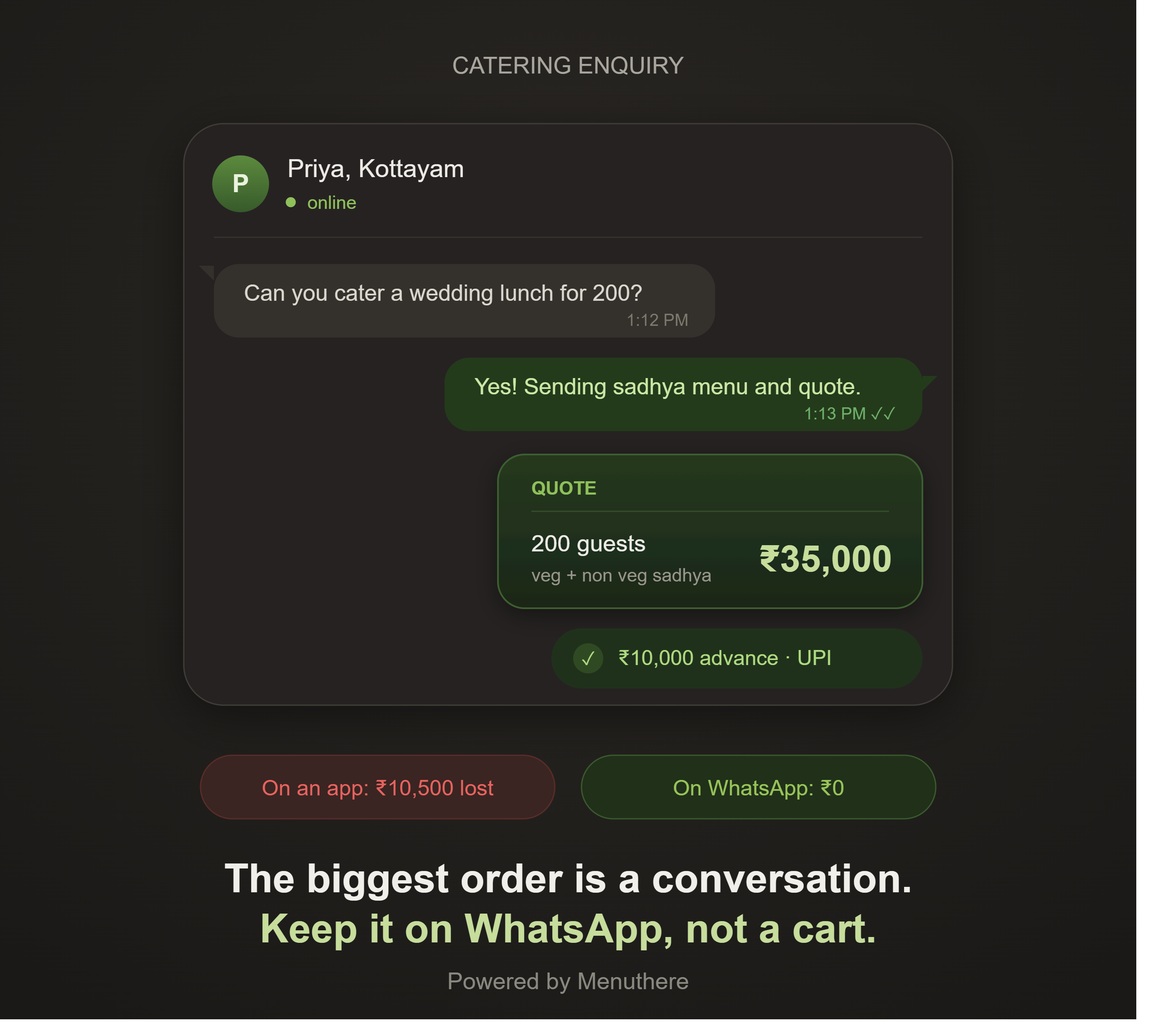
The biggest order your restaurant will take this month will not come through an app. It is a wedding, an office annual day, a house warming, a birthday for forty people. And it will begin with a question no cart was ever built to answer: "can you cater for us?"
That single question opens a conversation, not a transaction. How many guests, veg or non veg, any Jain or no onion no garlic requests, what date, what time, delivery or setup, and can you send a quote. This is the most valuable order a restaurant gets, and it is fundamentally a discussion that unfolds over days. Which is exactly why it does not belong in a cart, and exactly why it belongs on WhatsApp.
A delivery app is built on one rigid assumption: a fixed menu, fixed portions, ordered now, delivered soon. Catering breaks every part of that. The menu is customised to the event. The portions are negotiated by headcount that keeps changing until the last week. The delivery is scheduled for a specific hour on a specific future date, often booked two to four weeks ahead for a large function so the kitchen can plan menu, staffing and logistics. There is a quote to agree, a deposit to take, and a dozen small details to confirm.
None of that fits in a cart, because a cart cannot ask a question or hold a conversation. It can only take a fixed order and process a payment. Catering is the opposite: it is a back and forth, a customisation, a building of trust across several messages before a single rupee changes hands. Trying to force it into an app is like trying to plan a wedding through a vending machine.
Because it does not fit the app, catering usually falls through the cracks of a restaurant's systems. The inquiry comes as a phone call during a lunch rush, or a walk in on a busy evening, and it gets handled ad hoc by whoever happens to answer. There is no record, no thread, no follow up. The details live in someone's memory or on a scrap of paper. If the person who took the call is off the next day, the order can simply vanish.
Think about how strange that is. The single most valuable order a restaurant can win, worth ten or fifty ordinary orders, is the one handled with the least structure and the highest chance of being lost. The plumbing that captures a ₹300 delivery is solid. The plumbing that captures a ₹30,000 function is a sticky note.
Aggregators have noticed how big these orders are, and some are now building large order fleets to chase them. But they chase them on the same terms as everything else, a commission of 20 to 30 percent of the order value. On a normal delivery that is painful. On a catering order it is savage.
Do the maths on a single function. A ₹30,000 catering order at 30 percent hands ₹9,000 to a platform, on one order, for a job that is already high effort and often thin margin. The bigger the basket, the more the percentage hurts, and catering is the biggest basket there is. Routing your largest, most labour intensive orders through a commission model is the most expensive possible way to grow the most valuable part of your business.
Now picture the same inquiry on WhatsApp. The customer messages "can you cater a birthday for forty?" and a real conversation begins. You ask the headcount and the split, you send a menu with photos of past events, you propose a custom quote, you adjust when they add ten guests, you confirm the date and the timing, you take a deposit by UPI to lock it in, and on the day you coordinate delivery in the same thread. Every detail is written down, in one place, with a record both sides can see.
This is not a workaround. It is the natural home for the order, because catering is a conversation and WhatsApp is where conversations already happen. The medium finally matches the transaction. The customer talks to a person, the restaurant keeps a clean record, and nobody has to force a nuanced, multi day negotiation into a checkout that cannot hold it.
Here is the deeper reason a conversation wins. Nobody hands over ₹50,000 for their daughter's wedding lunch to a cart. A big function is a high stakes decision, and people only commit that kind of money to someone they trust. They want to ask their questions and get real answers, see what your food actually looks like at scale, and feel that a human being has taken ownership of their event.
A conversation builds exactly that. Every answered question, every photo, every clear line on the quote adds confidence, until the customer feels safe enough to commit. An app can process a payment, but it cannot reassure a nervous host that their party will go well. Catering is sold on trust, and trust is built in dialogue, not in a cart.
Catering customers are the most valuable relationships a restaurant can have. A single function is worth many ordinary orders, and the customer rarely stops at one. The family that trusts you with a birthday comes back for the anniversary, the house warming, the next wedding. The office that caters one event well is the office that caters every month, and contract catering, once the client is happy, tends to renew year after year.
So winning a catering conversation is not winning one big order. It is winning a customer worth dozens of regular ones, on a channel where you keep their number and their event history. Handle it well on WhatsApp and next Onam, next annual day, next birthday, you are one message away from the order instead of hoping they call. The order that used to evaporate becomes a relationship you own.
Invite catering inquiries onto WhatsApp explicitly, on your menu, your posts, and your profile. The easier it is to start the conversation, the more of these high value orders you capture.
Ask the real questions, headcount, dietary needs, date, setup, and let the order take shape through dialogue. This is where trust starts.
Show past events, propose a custom menu, and put a clean quote in the thread. Seeing the food and the number builds the confidence to commit.
Lock the booking with a UPI deposit. It confirms the order, protects your prep, and signals to both sides that it is real.
Keep the headcount, the menu, the date, the time, and the total in the thread, so there is one clear record and no confusion on the day.
Store the customer and the occasion, and reach out before the next one. A saved catering customer is a recurring one if you remember them.
Keep your largest, highest effort orders on a channel you own. A 30 percent cut hurts most exactly where the basket is biggest.
The biggest, most profitable, most loyal order a restaurant can win is also the one that fits an app the worst, because it is a conversation and an app is a cart. Handled casually on a scrap of paper, it gets lost. Handled through a commission, it gets taxed hardest of all. Handled as a real conversation on WhatsApp, it becomes what it should be: a high value order, a trusting customer, and a relationship you keep.
Your delivery already belongs in a chat. Your catering belongs there even more, because catering was always a conversation. Let people ask, answer them like a person, and win the whale.
Win the biggest orders in a conversation. Menuthere turns your QR menu into a WhatsApp channel where catering and party inquiries become quotes, deposits, and booked events, with the customer saved for the next one.
Sources: 2026 India catering market data from Research and Markets, Ken Research, magicpin and NRAI on corporate catering lead times, bulk order minimums, contract renewal, and market growth, and Technavio and Mordor Intelligence on aggregator large order services and 20 to 30 percent commission rates.
For as long as restaurants have existed, ordering meant saying what you want. Voice note ordering gives that back, and reaches every customer an app quietly excludes.
WhatsApp ordering
Most operators know this number. It gets quoted in every WhatsApp group in the industry. What gets discussed far less is the second cost, the one that never appears on the invoice.
WhatsApp ordering
You built a structured ordering flow. The customer thinks they are talking to a restaurant. They are not wrong, because it is a chat. Here is how to design for that.