The Split Shift Is a Menu Problem, Not a Staffing Problem
Your demand has two peaks because of what you chose to sell. The split shift is downstream of menu design, and India's new labour codes just raised the price of it.
Every operator can tell you why they run a split shift.
Demand has two peaks. Lunch and dinner. Staffing straight through means paying people to stand around from three to seven, which is money you do not have. So you split the shift, everyone goes home in the afternoon, and you accept that this is simply how restaurants work.
The reasoning is sound. The premise is not.
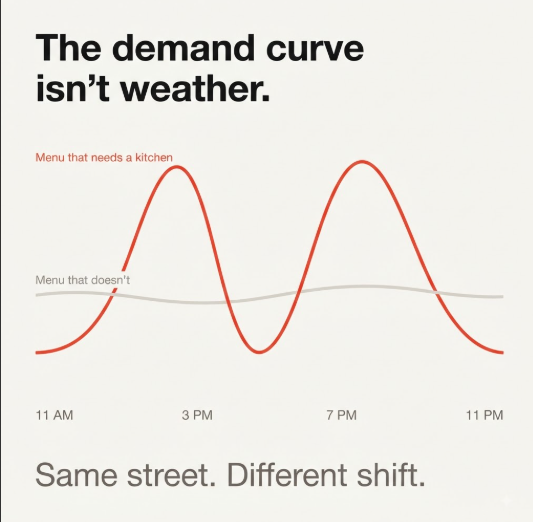
Your demand has two peaks because of what you decided to sell. A menu made up entirely of peak shaped products produces a peak shaped day. The demand curve is not weather. It is an output of a decision you made when you wrote the menu, and the shift structure is downstream of that decision, not the cause of it.
Which makes the split shift a product problem wearing a labour problem's clothes.
The price of it just went up
This would be an interesting argument in any year. In 2026 it is an urgent one, because the cost of running split shifts in India has changed materially.
<cite index="23-1">Effective 21 November 2025, India consolidated 29 labour laws into four unified Labour Codes</cite>, with <cite index="25-1">final central rules notified on 8 May 2026, and Karnataka, Maharashtra and Kerala among the states that have notified their own rules while others are still in process</cite>.
Three provisions matter here.
Spread over is capped. <cite index="19-1">Under the OSH Code, the spread over must not exceed 12 hours in a day, where spread over means the total duration from the start of work to the end of work including all rest intervals, lunch breaks and tea breaks. An employee who starts at 9am must leave by 9pm at the latest, regardless of how many breaks were taken</cite>.
Sit with that for a second against a normal restaurant roster. A common Indian split runs 11am to 3:30pm, then 6:30pm to 11:30pm. That is a spread over of twelve and a half hours. It sits outside the ceiling.
Attrition costs more. <cite index="23-1">The 50 percent wage rule requires basic pay to make up at least half of total CTC, which increases statutory costs such as PF and gratuity by 5 to 15 percent for most employers</cite>, and <cite index="23-1">full and final settlement must now be completed within 48 hours of an exit rather than in the following payroll cycle</cite>. Every departure is now a faster, larger cash event.
Overtime is expensive. <cite index="23-1">Work beyond 9 hours in a day or 48 in a week is overtime, payable at twice the normal wage rate</cite>.
I am not a lawyer, state implementation is uneven, and you should check your own roster against your state's notified rules with someone qualified. But the direction is not ambiguous. The structure the industry has treated as free is now priced, and churn is priced alongside it.
The break is not a break
Before the economics, the plain description, because the framing matters.
A three hour afternoon gap in a metro is not rest. If your commute is forty five minutes each way, going home is not an option, so the employee sits in the staff area, or a nearby park, or the back of the restaurant. They cannot rest properly, cannot earn elsewhere, and cannot be anywhere they would choose to be.
It is a twelve and a half hour day paid as eight. Everyone in the industry knows this and almost nobody writes it down, because there has never been an alternative that did not look more expensive.
The self inflicted hiring shortage
Here is the part that should concern anyone trying to hire right now.
<cite index="18-1">In a TD Bank survey of restaurant franchise leaders, 54 percent cited a shrinking labour pool as their biggest concern in attracting and retaining talent for the year ahead</cite>. In India the structural gap is worse: <cite index="11-1">a Ministry of Tourism study estimated the supply of skilled and professionally trained manpower at around 9 percent of total requirement, against industry attrition of 20 to 25 percent</cite>. Globally, <cite index="14-1">restaurant attrition runs above 70 percent annually</cite>.
Now consider who a split shift excludes before you have even placed an advert.
Anyone with caregiving responsibilities, which disproportionately means women. Anyone studying, since the afternoon is when classes happen. Anyone whose commute is long enough that the break becomes captivity. Anyone who needs a second income, because the fragment of afternoon is unsellable to another employer.
You are competing for staff in a market you deliberately made smaller, in a year when everybody is complaining that the market is too small.
The split shift does not respond to the labour shortage. It manufactures a private one.
The cost that never appears on the P&L
The split shift is defended as labour efficiency, and in the narrowest sense it delivers. You do not pay wages for the hours nobody is buying.
What you pay instead does not have a line item.
Higher attrition, and therefore continuous recruitment. Training that never compounds, because the person you trained left before they got good. New staff on the floor during service, which the guest notices even if nobody logs it. Institutional knowledge that leaves every few months. And eventually a wage premium, because the roster you offer is worse than the one down the road, and everybody in the local labour market knows it.
None of that is called "split shift cost." All of it is.
As one Indian multi outlet operator put it when discussing attrition analysis by location, <cite index="15-1">high turnover is rarely a market problem, it is a management problem</cite>.
The industry is halfway to this insight
Something interesting is already happening in Indian menu thinking. <cite index="12-1">Restaurant menus are shifting from maximising choice to maximising kitchen productivity, with operators weighing prep time, labour, capacity and throughput alongside food cost and popularity</cite>, and the emerging metric is contribution per kitchen minute rather than contribution per dish.
That is the right instinct, and it is unfinished.
Contribution per kitchen minute asks how much labour a dish consumes. It does not ask when. And the when is what builds your roster. A menu does not just consume kitchen minutes, it decides the shape of the day: where demand clusters, where it disappears, and therefore how many people you need at four o'clock and how many at nine.
Extend contribution per kitchen minute along the time axis and you arrive at the argument in this piece. The menu is a staffing document that nobody reads as one.
The proof is on your own street
If this were only theory, the market would not demonstrate it so cleanly.
A chai café and a full service restaurant sit fifty metres apart. The café runs straight shifts. The restaurant runs splits and struggles to hire.
The difference is not HR policy, employer branding or pay. It is that the café sells something with no range time in it. Beverages, held snacks, bakery. Their product can be produced continuously by one person at a counter, so their demand is continuous, so their shifts are continuous.
The chai chain did not solve a labour problem. It never created one, because of what it chose to sell.
The trap, and the actual fix
The obvious response is to fill the afternoon. Keep the kitchen open, extend the lunch menu, run a service through the middle of the day.
That is worse than the split shift, and it is worth saying clearly.
The afternoon is when the kitchen preps for dinner and when staff take the rest that makes a long day survivable. Fill those hours with kitchen work and you have not removed the split, you have removed the break while keeping the twelve hour day, and you have compromised dinner execution, which is where your check average lives.
The fix is narrower and it comes from the product side.
Fill the trough with something that needs no kitchen. Beverages. Fried items from a single held station. Bakery. Assembled rather than cooked. If it needs the tandoor, the range or a senior cook, it does not belong in the afternoon offer.
Then redesign the shift as a different job, not the same job stretched. You do not need a full brigade from three to seven. You need one or two people at a counter, working a straight shift, selling a small offer, while the kitchen preps undisturbed behind them.
That is the move that converts two half shifts across four people into one straight shift for one person, and it only becomes possible once the product in those hours stops requiring a kitchen.
The playbook
1. Check your spread over
Take your actual rosters, not your intended ones, and calculate the time from each person's start to their finish including breaks. Compare that against your state's notified rules with someone qualified. This is the least interesting item on the list and the most urgent.
2. Put labour cost per hour next to revenue per hour
Almost no independent operator has this chart, and it is the most clarifying thing you can build in an afternoon. Two columns, hour by hour. You will find hours where you are paying and not selling, and hours where you are selling and understaffed. The gap between those two curves is the entire argument, in your own numbers rather than an article's.
3. Ask what the trough could sell with zero range time
Not what would sell well. What would sell well and can be produced by one person at a counter without touching the main line. That constraint is the design brief, not a limitation on it.
4. Price your churn properly, now that it costs more
Recruitment, training, ramp time, service quality, and now higher statutory costs per head and a 48 hour settlement window. Put a number on a single departure. Then ask how much of your attrition traces to the roster rather than the pay.
5. Count who your roster excludes
List the categories of worker your current shift pattern rules out. Caregivers, students, long commuters, anyone needing a second job. That list is the portion of the local labour pool you are voluntarily not competing for.
6. Give menu decisions a "when" column
Every dish already carries a food cost and, increasingly, a kitchen minute cost. Add the hour it can actually be produced in. A menu whose items all require the full line is a menu that has already committed you to a split shift, whatever your HR policy says. Menuthere lets you run a separate daypart menu with its own items and pricing that switches automatically, so the afternoon offer can exist without anyone changing anything at three o'clock.
The bottom line
The industry has spent two years treating staffing as an HR problem to be solved with pay, benefits, culture and better job adverts. Those things help at the margin.
But the roster is not an independent variable. It is the shape of your demand curve translated into people, and the demand curve is the shape of your menu translated into hours.
You decided your shift structure a long time before you wrote the roster. You decided it when you chose a menu where everything requires the full kitchen, so nothing can be sold in the middle of the day, so there is nothing to staff for between three and seven.
The split shift is not how restaurants work. It is how restaurants with this kind of menu work.
Give the middle of your day something to sell. Menuthere lets you run daypart menus that switch on their own, across every channel you own.
Note: this article summarises publicly reported provisions of India's Labour Codes and is not legal advice. State implementation varies and continues to change. Check your rosters against your state's notified rules with a qualified advisor.
Sources: SalaryBox (OSH Code spread over and working hour rules), TopSource Worldwide (Labour Code consolidation, 50 percent wage rule, full and final settlement, overtime), Vishaal Consultancy (final central rules notification and state status), TD Bank survey via Nation's Restaurant News (labour pool concerns), Restaurant India (Indian manpower shortfall and attrition, menu productivity thinking, attrition commentary), Netchex (global restaurant attrition rates).