Daypart Aware Pairings: Why the Same Dish Needs Different Recommendations at 1pm and 9pm
Late night is the fastest growing daypart, but most menus run dinner recommendations all day. Here is how daypart aware pairings lift average order value.
Late night is the fastest growing daypart, but most menus run dinner recommendations all day. Here is how daypart aware pairings lift average order value.
Previous article
Combo meals are a discount you pre-pay to guests who were buying both items anyway. Here is why a pairing map lifts average order value without giving up margin.
Next article
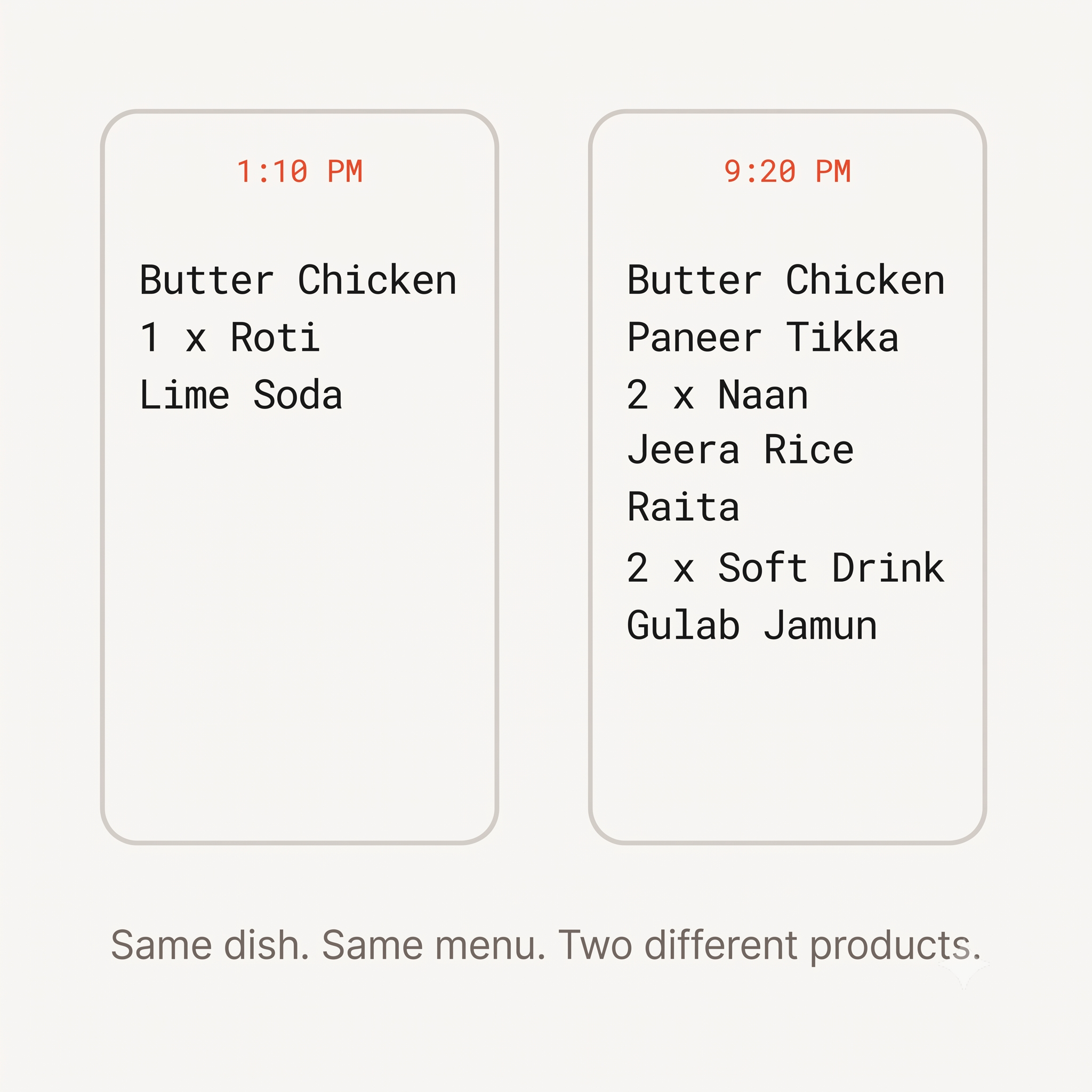
Two guests order the same butter chicken today.
The first orders at 1:10pm. She is alone, she has a meeting at two, and she wants one bread, something cold, and the bill fast. Suggest a starter and a dessert to her and you have not upsold anything.
You have added friction to a transaction that was already time constrained, and you have slowed your own table turn.
The second orders at 9:20pm. Four people, no clock, the evening is the point. This table will take a starter, two breads, a second round of drinks, and dessert if somebody offers. Suggest a single roti and a lime soda and you have left most of the check on the table.
Same dish. Same menu. Two completely different meals.
Almost every restaurant in the country shows both of those guests the identical suggestions, because the pairing logic was written once and never told what time it is.
This is not a small optimisation. The distribution of restaurant demand across the day has shifted structurally in the last four years, and the shift is well documented.
<cite index="65-1">Late night dining is the standout growth story at limited service restaurants, with sales climbing more than 10 percent annually since 2021, outpacing every other daypart, while dinner and lunch momentum has cooled and breakfast spending growth now lags behind everything else</cite>. Santiago & Company's indexed view puts the gap in sharper relief: <cite index="67-1">late night is up roughly 46 percent cumulatively since 2021, the strongest of any daypart, against dinner at about 11 percent and lunch at about 7 percent, with breakfast down</cite>. McDonald's CEO has described <cite index="67-1">breakfast as the weakest daypart, the easiest occasion for a stressed consumer to skip or move back home</cite>.
The middle of the day has quietly become the largest single block. <cite index="66-1">The afternoon daypart now drives 32 percent of daily fast food traffic, the biggest share of any window</cite>, sitting in the run up to the evening peak that most operators still treat as dead time between two real meals.
In India the same redistribution is happening with local shape. <cite index="82-1">Late night delivery orders between 11pm and 6am have grown over 25 to 35 percent annually in major urban markets, with desserts consistently among the fastest growing categories at those hours</cite>. Swiggy's industry study found that <cite index="85-1">mid meal occasions like brunch and evening snacks are becoming more popular, and that delivery has created consumption at entirely new times of day</cite>, which lands on top of a food culture that already runs four meals rather than three, with a chai and snack occasion between four and six in the evening.
Now put that next to the traffic picture. <cite index="67-1">In May 2026 the National Restaurant Association reported that 50 percent of operators saw higher same store sales year over year while 45 percent reported lower customer traffic, the 15th time in 16 months operators reported a net traffic decline</cite>.
Read those two facts together, because they are the whole argument. Sales are holding up on check, not on footfall. Mix is doing the work. And the fastest growing daypart in the business is being served recommendations that were written for dinner.
Here is the conceptual error sitting underneath most menu merchandising.
Operators think of a pairing as a property of the dish. Butter chicken goes with naan. Biryani goes with raita. Dosa goes with filter coffee. Those statements feel like facts about food, so they get encoded once and treated as permanent.
They are not facts about food. They are facts about occasions.
The dish is the constant. The occasion is the variable, and the occasion changes everything that matters commercially:
Party size. A solo lunch and a table of five want different quantities of the same accompaniment. One roti versus four, one drink versus a round.
Time pressure. The midday guest is buying speed. Anything that adds minutes reads as an obstacle, no matter how well it is priced. The evening guest is buying an occasion, where extra time is the product rather than a cost.
Craving profile. Late night skews sweet and impulsive, which is exactly why desserts are among the fastest growing late night categories in India. That same dessert prompt at 1:30pm converts at a fraction of the rate.
Who is deciding. A solo order is one decision. A table of five is a negotiation, which is why sharing suggestions work at night and land as noise at noon.
What the kitchen can actually do. A bread that takes twelve minutes is a fine suggestion at nine and a bad one at one.
None of that is encoded in a static pairing map. All of it is knowable from the clock.
There is a reason operators skip this, and it is worth naming directly.
Personalisation has been marketed to restaurants as an artificial intelligence problem. It arrives in decks full of machine learning, guest identity, purchase history, propensity models, and a data science hire. Most independents and small groups look at that and reasonably conclude it is not their fight this year.
But the single most predictive variable in restaurant ordering behaviour is not identity. It is time of day. And time of day is free.
It requires no login, no loyalty enrolment, no guest history, no consent flow, no model training, and no vendor. Your system already knows it. It is knowable for the first time guest and the regular equally. It works on the walk in who will never tell you their name.
An operator who segments recommendations by four or five dayparts captures most of the available lift from personalisation without touching a single piece of guest data. The sophisticated version of this comes later. The clock version is available on Monday.
They run the dinner map all day. The most common failure. Recommendations get built during a menu project, and menu projects happen with dinner in mind, because dinner is where the pride is. Then that logic runs at 1pm against a guest with 35 minutes.
They run the lunch map at night. Less common, more expensive. A lean, speed oriented suggestion set applied to a table that came out for an evening. Every unsuggested starter and dessert is margin that walked out.
They treat late night as dinner but later. It is not. Different party composition, different craving profile, higher impulse, dessert heavy, and increasingly delivery led. Serving it dinner's logic is why the fastest growing daypart converts worst.
They ignore the afternoon completely. The largest single share of daily traffic, and in India a genuine cultural occasion between four and six, and most menus treat those hours as leftover lunch with leftover lunch recommendations.
They daypart the menu but not the recommendations. This is the subtle one. Plenty of operators already switch menus by daypart. They have a breakfast menu, a lunch special, an evening card. And underneath all of them sits one static recommendation layer that never changes. The thing that touches every single order is the thing nobody dayparts.
Do not inherit the industry's four dayparts. Look at your own hourly order counts and find the natural breaks in your business. Most Indian operators will find five rather than three: breakfast, lunch, the four to seven snack and chai window, dinner, and late night. A café will cut it differently. A bar differently again. The right number of dayparts is the number your data shows, not the number the textbook lists.
You may already have run the basket analysis for your pairing map. Run it again with one extra column: hour of day. Aggregate co occurrence describes an average day that never actually happens, a blend of the 1pm guest and the 9pm guest that resembles neither. The hourly cut is where the real behaviour lives, and it usually contradicts at least two things you were certain about.
This is the step operators skip. Lunch is optimising for speed and beverage attach, because the drink is the only add that costs the guest no time. Dinner is optimising for basket depth, starters and second breads and a closer. Late night is optimising for dessert and impulse. The afternoon is optimising for something harder and more valuable: creating an occasion that would not otherwise have existed. Different objectives produce different suggestions even when the dish is identical.
Two suggestions at dinner is service. Two suggestions at a rushed lunch is an obstacle. Treat prompt count as a daypart setting in its own right. One at lunch, two at dinner, one high intent prompt late at night when decision fatigue is real and the guest wants to be told.
The pairing engine should read context beyond the hour: skip anything the kitchen has 86'd, skip the twelve minute bread during the lunch rush, skip the dessert prompt if a dessert is already in the cart. This is the layer Menuthere handles, so daypart rules live inside your menu configuration and switch automatically across dine in QR, takeaway and your own delivery ordering, without anyone remembering to flip anything at four o'clock.
The most useful report in this whole exercise is a grid: pairs down the side, dayparts across the top, accept rate in the cells. A pair converting at 22 percent at dinner and 4 percent at lunch is not a bad pair. It is a correctly built pair filed in the wrong hour. Most operators who run this grid for the first time find that a third of their suggestions are simply mistimed rather than wrong.
The restaurant business spent the last two years trying to solve a traffic problem with price. The traffic did not come back. What actually held the line was check, which is another way of saying mix, which is another way of saying what guests were persuaded to add.
Meanwhile the day itself was being redrawn underneath everyone. Late night grew nearly 46 percent while breakfast shrank. The afternoon quietly became the largest block of traffic in the business. New occasions appeared that did not exist in 2019.
Your menu is the only asset that touches every one of those hours, and in most restaurants it behaves identically in all of them. It recommends a dessert to someone racing back to work and stays silent when a table of five settles in for the night.
You do not need a data science team to fix that. You need the pairing map you already built to know what time it is.
Teach your menu to read the clock. Menuthere lets you set different pairings and recommendations for every daypart, switching automatically across every channel you own.
Sources: McKinsey (US consumer restaurant trends 2026), Santiago & Company (daypart index and 2026 trends), National Restaurant Association via ClearCogs demand outlook, Restolabs 2026 Order Analytics (daypart and afternoon traffic share), Restaurant India (late night delivery and dessert growth), Swiggy industry study (mid meal occasions and new consumption windows).
The 4pm to 7pm window is India's fourth meal, and most restaurants sell nothing in it. Here is how to build an afternoon menu that needs no kitchen.
Menu strategy
Owners add dishes to grow the order value. It usually does the opposite.
Menu strategy
Most restaurants think of the menu as something that happens after a customer has chosen them. They sit down, you hand it over, they read it.