The Combo Is Dead: Why a Pairing Map Beats Bundled Discounts on Your Digital Menu
Combo meals are a discount you pre-pay to guests who were buying both items anyway. Here is why a pairing map lifts average order value without giving up margin.
Combo meals are a discount you pre-pay to guests who were buying both items anyway. Here is why a pairing map lifts average order value without giving up margin.
Previous article
Food pairing recommendations on a digital menu lift average order value by 15 to 30 percent. Here is the attach rate playbook for restaurant operators.
Next article
Here is a question worth asking before your next menu revision.
Of the guests who bought your veg biryani combo last month, how many would have ordered the biryani, the raita and the drink separately anyway, at full price?
Nobody in the building knows the answer. But it is the only number that determines whether the combo made you money or quietly cost you money at scale.
In trade promotion analysis, this is called subsidised volume: sales that happened during a promotion but would have happened without it. One worked example from CPG data put the figure at <cite index="64-1">roughly two thirds of promoted sales that would have sold anyway, without any promotion at all</cite>. The promotion did not create those orders. It just made them cheaper.
That is the uncomfortable truth about the combo meal. It is a discount you pre-committed to, applied automatically to the guests who needed the least convincing.
The combo is not a strategy. It is a workaround for a constraint that no longer exists.
On a printed menu, there was exactly one way to tell a guest that two items belong together: pre-print them as a fixed set, give the set a name, and attach a price low enough that the guest noticed the box on the page. The discount was never really the mechanism. It was the attention budget. It was what you paid to make a relationship visible on a sheet of paper that could not change based on what the guest had already chosen.
Print could not be conditional. Software can.
A digital menu can say "porotta or naan with that?" only to the person who just added butter chicken, at 9pm, when the kitchen actually has both. It costs nothing to display. It requires no discount to be noticed, because it appears at the exact moment the question is relevant.
Most operators moved their menu to a screen and kept paying the discount anyway.
The last two years have been the largest live experiment in bundled value the restaurant industry has ever run, and the results are in.
Datassential's tracking found that fast casual chains <cite index="46-1">increased combo offerings by 79 percent while average pricing on those combos fell 2 percent year over year, using combo meals as traffic drivers rather than margin builders</cite>. McDonald's leaned back into Extra Value Meals after its CEO said publicly that <cite index="47-1">combo meals priced above 10 dollars were damaging value perception</cite>, and the company went as far as <cite index="49-1">co investing in the discounts and providing corporate marketing support to franchisees to offset the hit to their margins</cite>.
It did not fix traffic. <cite index="50-1">QSR traffic fell 1.6 percent year over year in May 2026, the steepest decline since January, concentrated among middle and lower income guests, with 38 percent of Americans reporting they spend less at restaurants than a year ago</cite>. Meanwhile <cite index="48-1">roughly four in ten operators reported an unprofitable year in 2025</cite>.
The verdict from QSR Magazine mid 2026 was blunt: <cite index="54-1">the chains separating from the pack in unit growth, same store sales and loyalty are not the ones who cut the deepest, but the ones who built value into the menu itself rather than stapling it on through a promotion</cite>. The industry outlook commentary put the operator lesson plainly: <cite index="48-1">chasing traffic through discounting erodes margin and trains guests to wait for deals</cite>.
Whataburger has been held up as the counterexample precisely because it refused the reflex, <cite index="52-1">holding discounts to around 4 percent and steering value toward off menu junior items rather than cutting prices on core menu items and risking long term price anchoring</cite>.
That is the whole argument in one sentence. Discounting is what you pay when you cannot be relevant.
1. It subsidises the wrong guest. The person who always orders bread with curry gets it cheaper. The person who would not have added bread is not persuaded, because the combo does not match what they actually ordered. You paid margin to the converted and got nothing from the undecided.
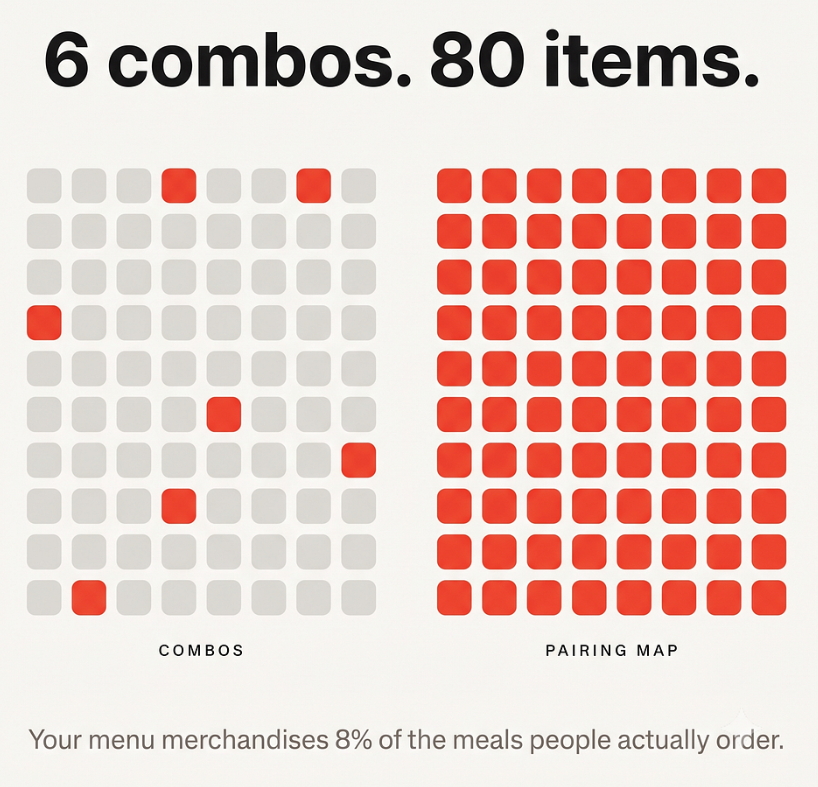
2. It covers almost nothing. Take a menu with 80 items and six combos. Those six combos address maybe eight percent of the meal shapes your guests actually assemble. The other 92 percent of orders get no guidance at all. You built a merchandising system for your three most predictable dishes and left the rest of the menu silent.
3. It is frozen. A combo is a decision made once, in a meeting, and then locked into the menu for a year or more. It cannot tell that the same curry pairs differently at 1pm than at 9pm. It cannot notice that nobody has ordered it since March. It cannot react to an item being 86'd. It is a photograph of a system that should be a live feed.
4. It forces items the guest did not want. A fixed bundle is take it or leave it. If the combo includes a cola and the guest wants a lime soda, they either accept something they will not finish or abandon the bundle entirely. Either outcome is worse than simply asking what they want alongside their main.
5. It anchors your prices down permanently. This is the one that compounds. Once a guest learns your biryani is available at combo price, full price becomes the penalty for not paying attention. You have not created value perception. You have created a waiting game.
In India there is a sixth problem that makes the maths brutal. On aggregator channels, <cite index="41-1">restaurants hand over 25 to 35 percent of order value in commissions, fees and taxes, which can turn a Rs 500 order into as little as Rs 325</cite>. Run a combo discount on top of that and the contribution left on a delivered bundle can approach zero.
A pairing map is not a menu section. It is a layer underneath the menu that connects every item to the two or three items that complete it, and surfaces them at the moment of selection, at full price.
The combo says: buy these three things together and I will take 15 percent off. The pairing map says: people who ordered this dish eat it with these two. Want them?
One of those costs you margin on every single redemption. The other costs you nothing and works on all 80 items.
For each active combo, pull the order data from before that combo existed and calculate how often those same items already appeared in the same ticket. If they co occurred at a high rate before you introduced the discount, the combo is buying you volume you already had. That number, not redemption count, is the honest scorecard.
This is not an argument for zero bundles. Bundles are genuinely good at one job: trial. When you need a guest to try an item nobody orders, a bundle is a legitimate way to buy that first taste, and the cost is an acquisition cost with a clear purpose. Keep those. Kill the ones that discount your two bestsellers to people who were buying both anyway.
The instinct when combos underperform is to add more combos. Resist it. Instead, map every main to three slots: a carb, a cooler and a closer. Bread or rice. Raita, buttermilk or a soft drink. Dessert or coffee. You do not need to fill all three for every dish. You do need every dish to have an answer, which is what a map gives you and a bundle never will.
The reason this works without a discount is that a well timed pairing is not a sales pitch, it is a service. Suggesting a bread when a curry enters the cart removes work for the guest instead of asking something of them. Once you accept that, the discount reveals itself as what it always was: compensation for showing the guest something at the wrong moment.
The pairing map should read context. Different pairings at lunch and dinner. No suggestion for an item that is out of stock. No second dessert prompt if a dessert is already in the cart. Two suggestions maximum, because more suggestions do not mean more attach, they mean more overload. This is the layer Menuthere's pairing and recommendation setup handles, so the map lives inside your menu configuration and fires automatically across dine in QR, takeaway and your own delivery ordering, without a discount attached to any of it.
Track shown, added, and rupees added, per pair. Kill the dead pairs. Promote the live ones. Then compare that number against the margin you were giving away on the combos it replaced. Most operators find the pairing map generates more contribution than the bundle did, on far more of the menu, at zero discount cost.
The combo meal was a clever answer to a real constraint. Paper could not be conditional, so operators bought attention with margin. That trade made sense for forty years.
It stopped making sense the day the menu became software, and the industry has spent the last two years relearning that lesson at scale: more combos, lower combo pricing, weaker traffic, thinner margins, and guests who have been trained to wait.
You do not need to discount things that go together. You just need to say that they go together, at the moment the guest is deciding, on every item on your menu instead of six of them.
Combos discount the relationship. Pairing maps simply state it. Only one of those has a cost per order.
Stop paying for relevance. Menuthere lets you build a pairing map across your full menu, so the right suggestion appears at the right moment on every channel you own, at full price.
Sources: Datassential State of Value (combo offering and pricing trends), QSR Magazine (value as a menu decision, June 2026), CNBC (McDonald's Extra Value Meals and franchisee subsidy), Modern Restaurant Management 2026 Mid Year Outlook, The Hospitality Hangout (QSR traffic and value war data), Food On Demand (analyst commentary on Whataburger), CPG Data Insights (subsidised sales methodology), MenuManager (India aggregator commission breakdown).
Late night is the fastest growing daypart, but most menus run dinner recommendations all day. Here is how daypart aware pairings lift average order value.
Menu strategy
Around one third of diners order the very first item they see in a category.
Menu strategy
Your demand has two peaks because of what you chose to sell. The split shift is downstream of menu design, and India's new labour codes just raised the price of it.