The Afternoon Is Your Largest Daypart and You Don't Have a Menu For It
The 4pm to 7pm window is India's fourth meal, and most restaurants sell nothing in it. Here is how to build an afternoon menu that needs no kitchen.
The 4pm to 7pm window is India's fourth meal, and most restaurants sell nothing in it. Here is how to build an afternoon menu that needs no kitchen.
Previous article
Late night is the fastest growing daypart, but most menus run dinner recommendations all day. Here is how daypart aware pairings lift average order value.
Next article
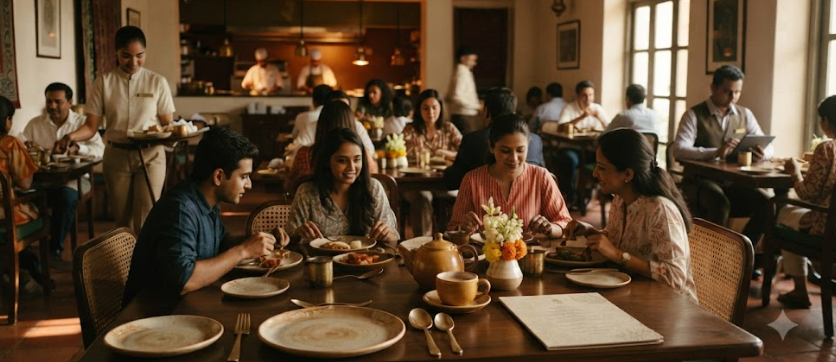
Walk into most Indian restaurants at half past four and you will find the same scene. Two staff folding napkins. A manager on his phone. Air conditioning running over an empty room. A kitchen prepping for a dinner service that starts in three hours.
Now price that room.
A mid sized outlet paying Rs 1.5 lakh a month in rent is spending roughly Rs 5,000 a day on space. Open twelve hours, that is about Rs 417 an hour, which means the 3pm to 7pm block costs around Rs 1,667 a day in rent alone, or Rs 50,000 a month. Add the staff who are on shift, the electricity, the air conditioning, the licences and the software subscriptions, and most operators are spending close to a lakh a month to keep an empty room comfortable.
That block is not dead time. It is time you have already paid full price for.
The industry has treated the middle of the day as the trough between lunch and dinner for so long that most operators never checked whether that was still true. It is not.
<cite index="66-1">The afternoon daypart now drives 32 percent of daily fast food traffic, the largest single share of any window</cite>. Not the smallest. The largest.
Underneath that sits a structural change in how people eat. Circana's global research describes snacking as having become <cite index="94-1">a fourth meal, with consumers using snacks as meal accompaniments, meal replacements or mini meals through the day, more people snacking three or more times daily, and afternoon snacking in particular now nearly universal</cite>. In the US, <cite index="96-1">55 percent of shoppers eat three or more snacks a day, up nine percentage points since 2021</cite>, and <cite index="93-1">Technomic data shows 51 percent of consumers now replace full meals with snacks</cite>.
The commercial signal is even sharper than the behavioural one. <cite index="98-1">While overall restaurant traffic is down, snacking occasions in restaurants are up by nearly 7 percent according to Technomic</cite>. In a market where footfall has been declining for over a year, one occasion is growing. It is the one most menus have nothing built for.
Circana also expects <cite index="92-1">beverage only visits to rise 2.3 percent by 2028, and reports that more than a third of restaurant consumers are already ordering smaller portion sizes than normal</cite>. Smaller portions, beverage led, between meals. That is a precise description of a daypart, and it is not lunch or dinner.
This is where the Indian market diverges from every Western daypart framework, and where the opportunity gets considerably larger.
Most Indian households do not run three meals. They run four. Breakfast, lunch, a chai and snack occasion somewhere between four and six, and a late dinner. That fourth occasion is not a trend, a habit shift or a Gen Z behaviour. It is older than every restaurant chain in the country, it happens every single day, and it is social rather than nutritional. People do not break at 4:30 because they are hungry. They break because it is the accepted moment to stop working and talk to someone.
Swiggy's industry study confirmed the commercial version of it, finding that <cite index="85-1">mid meal occasions like brunch and evening snacks are becoming more popular, creating a need for restaurants to be open during off peak hours with innovative snack options</cite>.
Now look at who is actually serving that occasion.
<cite index="107-1">The organised chai café market in India is worth around Rs 873 crore and grew 15.47 percent over twelve months</cite>. <cite index="103-1">Chai Sutta Bar has scaled to more than 600 outlets across over 370 cities. Chaayos operates over 200 cafés. These tea led and coffee led brands are expanding on affordable, youth oriented formats</cite>. <cite index="104-1">Chai Point sells close to a million cups of freshly brewed tea a day across more than 170 stores, alongside sandwiches, pakoras and comfort food</cite>. <cite index="102-1">Third Wave Coffee runs more than 220 cafés with roughly 90 percent of stores EBITDA positive and 100 more planned</cite>.
An entire category of chains has been built, funded and scaled around the hours your dining room is empty.
They are not competing with your lunch. They are not competing with your dinner. They took the occasion you decided was a break between services, and built a business on it.
Here is the part that should interest anyone reading a P&L rather than a menu.
Rent does not prorate by daypart. Neither does your electricity connection, your licences, your insurance, your POS subscription or the salary of anyone on shift. Those costs are absorbed by lunch and dinner regardless of whether you sell a single item at 4:30.
Which means afternoon revenue arrives with the overhead already paid. You are carrying incremental food cost and very little else. A samosa and a chai at Rs 120 with Rs 35 of food cost is not an 8 percent net margin transaction the way a dinner cover is. Once your fixed costs are covered by the other two services, most of that Rs 85 falls to contribution.
This is the opposite of how operators usually think about the afternoon. The instinct is that these hours are low value because the ticket is small. The ticket is small. The margin structure is the best in your day.
And the items themselves are the highest gross margin things you sell. Tea, coffee, cold drinks, fried snacks, bakery. Low food cost, minimal labour, no protein, no gravy, no wastage risk.
Almost every operator who has tried this has tried it the same way: keep the kitchen open and run the lunch menu into the evening.
It does not work, and the reason is not effort or marketing. It is product shape.
Nobody wants a thali at 4:30. The afternoon guest is not looking for a smaller meal, they are looking for a different category of thing entirely. Small, shareable, arriving in five minutes, priced as an impulse rather than a decision, and anchored on a drink. Running your lunch menu through the afternoon offers that guest nothing except an inappropriate amount of food.
There is also a real operational objection, and it deserves to be taken seriously rather than waved away. The afternoon is when the kitchen preps for dinner. It is when staff take the break that makes a split shift survivable. Opening a full service afternoon can absolutely damage your dinner execution, and dinner is where your check average lives. An operator who says "I cannot run another service in those hours" is not being lazy. They are being correct.
Which points directly at the answer.
This is the design constraint that makes the whole thing work, and it is why chai chains won this occasion rather than restaurants.
The afternoon offer has to be executable by one person at the counter, with zero range time, while the kitchen continues prepping dinner undisturbed. Beverages, which need a machine and a person. Fried items held or dropped in one fryer. Bakery and sweets that need no cooking at all. Assembled items rather than cooked ones.
If your afternoon menu requires the tandoor, the range or your senior kitchen staff, you have not built an afternoon menu. You have built a dinner service that starts too early and will quietly degrade the one that matters.
Pull hourly order counts for the last 90 days and look for where volume collapses and when it recovers. For most Indian full service restaurants it is roughly 3pm to 7pm, but yours might start at 2:30 or recover at 6:15. A café in an office district and a family restaurant in a residential neighbourhood have completely different afternoons. Do not inherit somebody else's window.
Start from a hard rule: nothing on this menu touches the main range. Then fill it. Six to eight items maximum, one beverage family, two or three fried or held snacks, one bakery or sweet item. If a dish cannot be produced by the counter in five minutes without pulling a cook off dinner prep, it does not belong here regardless of how well it sells at night.
At lunch and dinner, food is the anchor and the drink is the attach. In the afternoon that relationship flips. Nobody leaves the office at 4:30 for a samosa. They go for chai and the samosa comes with it. Your merchandising has to lead with the beverage and attach the food, which is the exact opposite of how every food first menu in the country is structured. Get this backwards and the afternoon menu will underperform even if every item on it is right.
This is a sub Rs 150 decision made alone, in about four seconds, without consulting anyone. That is not a reason to discount. It is a reason to design small portions that hold full margin. The chai chains are not cheap because they cut price. They are cheap because the portion, the packaging and the labour were designed for the occasion from the start.
The afternoon offer should appear on its own at three, and retire at seven, without a manager remembering to change anything. Ideally the recommendations flip too, leading with beverages during the window and returning to food led pairings at dinner. This is what Menuthere's daypart menu and pairing switching handles, so the right menu and the right suggestions appear automatically across dine in QR, takeaway and your own delivery ordering, at the right hour, every day.
Be realistic about what success looks like. The afternoon will probably never be 20 percent of your topline, and if you measure it that way you will kill it in month two. Measure the contribution instead, against fixed costs you were paying anyway. A window that adds Rs 3,000 a day at 70 percent contribution is roughly Rs 63,000 a month of margin on rent you had already committed to. That is the honest way to score it.
The restaurant industry has spent two years trying to solve a traffic problem. Discounts, aggregator listings, value bundles, ads. All of it aimed at getting more people through the door during the two windows everyone already competes in most fiercely.
Meanwhile the largest single block of daily traffic sits in the middle of the day, snacking occasions are the one growing occasion in a declining market, and in India the fourth meal is a daily cultural fact that requires no consumer education at all.
You are already paying rent on those hours. You are already paying staff. The lights are already on. Chai Sutta Bar built 600 outlets on the occasion happening in your empty dining room.
You do not need more customers to sell in the afternoon. You need something to sell them.
Give your afternoon a menu. Menuthere lets you run a separate daypart menu with its own pairings that switches automatically, across every channel you own.
Sources: Restolabs 2026 Order Analytics (afternoon traffic share), Circana Global Snack Unwrap 2026 and foodservice trend research (snacking occasions, beverage only visits, portion sizes), Technomic via Nation's Restaurant News (meal replacement snacking, restaurant snacking occasions), Swiggy industry study (mid meal occasions), The India Watch (chai café market size and growth), Restaurant India and Franchise India (Chai Point, Third Wave Coffee outlet data), Global Enterprise Rating (café chain expansion 2026).
Most restaurants have never seen their own Google menu. It is often a customer's photo of a 2019 laminated card. Here is why that now costs you orders.
Menu strategy
Owners add dishes to grow the order value. It usually does the opposite.
Menu strategy
Most restaurants think of the menu as something that happens after a customer has chosen them. They sit down, you hand it over, they read it.