Your Most Important Menu Page Isn't on Your Website. It's on Google, and You Didn't Write It.
Most restaurants have never seen their own Google menu. It is often a customer's photo of a 2019 laminated card. Here is why that now costs you orders.
Most restaurants have never seen their own Google menu. It is often a customer's photo of a 2019 laminated card. Here is why that now costs you orders.
Previous article
The 4pm to 7pm window is India's fourth meal, and most restaurants sell nothing in it. Here is how to build an afternoon menu that needs no kitchen.
Next article
A stockout costs you the order, the refund, the rating and sometimes the rest of the night. And a frozen menu quietly eats your margin between reprints.
Open an incognito window on your phone. Search your restaurant's name. Tap the Menu tab.
Most operators have never done this, and the result is usually the same. A photograph, taken at an angle, half in shadow, of a laminated card. Three dishes on it were discontinued. The prices predate your last two increases. And you did not upload it.
That is not an accident or a glitch. It is how the system works. If you do not supply a menu to your Business Profile, Google fills the gap with what it has, which is photos your customers took. Google's own guidance for operators includes <cite index="33-1">flagging an outdated or inaccurate customer menu photo for review and uploading a current official one in its place</cite>.
Which means the most-read page of your menu was written by a stranger, and you have never read it.
The reason this matters far more in 2026 than it did in 2019 is that search stopped sending people to websites.
<cite index="18-1">Google searches ended without a click 68.01 percent of the time in the US during the first four months of 2026, according to SparkToro research using Similarweb clickstream data, up from 60.45 percent in 2024</cite>. For local intent the number is worse: <cite index="19-1">near me searches produce up to 78 percent zero click outcomes, and Google Maps, Local Packs and Business Profiles have effectively become micro sites in their own right</cite>.
Restaurants sit at the sharp end of this. <cite index="20-1">The restaurant category has seen roughly 680 percent growth in AI Overview appearances, one of the steepest of any sector</cite>.
Read that carefully, because it reframes the entire problem. The listing is not a pointer to your real storefront. For most prospective guests it is the only page they will ever see. They will read your menu, look at your photos, check your hours, scan two reviews and decide, without ever loading anything you built.
And because none of that happens on your website, none of it shows up in your analytics. There is no bounce rate on a page you have never looked at. Which is precisely why this gets neglected: it is the one part of your digital presence that is completely invisible from the inside.
This week Google expanded Ask Maps in India, and it changes the stakes again.
<cite index="39-1">Ask Maps is an AI feature inside Google Maps that lets people ask questions in natural language rather than typing short keywords, and the India expansion added food ordering, hotel discovery, Hindi language support and personalised recommendations</cite>. <cite index="41-1">Users can now order food directly from within Maps by stating what they want to eat, with the app finding open restaurants along their route that serve it</cite>. The Gemini powered version handles queries like <cite index="42-1">a restaurant that is open late, has vegetarian options, allows dogs on the patio and has parking, which requires the Business Profile to contain comprehensive and accurate information</cite>.
Restaurant India's guidance on AI Overviews puts the consequence plainly: <cite index="34-1">discovery is no longer about ranking first, it is about being selected as a trusted source inside the AI answer itself, which combines reviews, menus, images and website content into a single response</cite>.
So consider what happens when someone driving home in Kochi asks Maps for good biryani that is open now on their route.
To answer, the model reads listings. It reads items, prices, hours, attributes, review text. If your menu on Google is a photograph of a laminated card, there is nothing there to read. You are not ranked badly. You are not in the answer at all, because you were never legible to the thing writing it.
This is the part worth sitting with. For twenty years, being invisible online meant ranking on page two. Now it means being unreadable to a model. Those are different failure modes and they need different fixes.
India has a further wrinkle. <cite index="37-1">The country has the world's second highest volume of voice searches, and Indian users routinely search in Hinglish, Hindi, Tamil, Telugu, Marathi and other regional languages, often within the same query</cite>. A profile with no item level text gives those queries nothing to match against in any language.
Here is the commercial framing.
Restaurants in India hand over 25 to 35 percent of order value to aggregators, largely in exchange for discovery. Then many of them spend further on aggregator ads to be discovered within the platform they are already paying a commission to.
Meanwhile the Google listing is free, higher intent, geographically closer, and can send the guest directly to a channel you own. <cite index="22-1">BrightLocal's research found that businesses with a fully completed Google Business Profile appear 2.7 times more often in knowledge panels</cite>.
There is a specific line item worth checking today. The ordering link on your Business Profile is a field you control. On a great many restaurant listings, that field points at an aggregator, which means Google is delivering a customer who searched for you by name, at zero acquisition cost, into a channel that will take a third of the ticket. That is one of the most expensive default settings in the business, and changing it takes about sixty seconds.
Operators do not neglect this because they do not care. They neglect it because of how the work is shaped.
Your menu currently exists in four or five places. The printed card. The POS. Your website. The aggregator listings. The Google Business Profile. Change one price and you have created four opportunities to be wrong.
Any process that depends on a manager remembering to log into a fifth system at eleven at night, after service, to update a price nobody in the building will ever see, is not a process. It is a hope. It will fail, not might fail, and it will fail silently, which is the worst kind, because nothing breaks. The listing just quietly drifts further from reality every month while continuing to be the first thing every new guest reads.
This is why menu accuracy on Google is an operations problem wearing a marketing costume. <cite index="26-1">If your Google menu lists an item your kitchen no longer serves, your staff handles the refund, the complaint or the bad review. If prices are outdated, customers feel misled. If your direct ordering page lists different items than your Google menu, orders get abandoned</cite>.
The fix is not more diligence. The fix is fewer copies of the truth.
Search your own restaurant in incognito, open the Business Profile in both Search and Maps, tap through to the Menu tab and note every source that appears: official items, linked PDFs, customer photos, third party providers. Compare it against what you actually served last night. Most operators find at least one dish they stopped making, one wrong price and one photo they have never seen.
If what appears is a customer photograph, flag it and upload an official one. Then go further and add actual structured items rather than only an image, because a photo is not readable by search or by an AI assistant. It is a picture of a menu, not a menu.
<cite index="26-1">A PDF is hard to read on mobile, difficult to update and less useful for a customer trying to decide quickly</cite>. It is also close to useless to the systems now summarising your restaurant into an answer. Items, descriptions and prices as text is the format that gets parsed, quoted and recommended.
"Paneer Tikka, Rs 320" tells a hungry person very little and tells Gemini nothing at all. The attributes people actually search on need to exist as words somewhere in your listing: vegetarian, jain, no onion no garlic, egg free, spice level, portion size, whether it travels well. If a query can be asked in natural language, it can only be answered from text you supplied.
Check what the Order Online button on your profile does. If it opens an aggregator, you are paying a commission on traffic Google gave you for free.
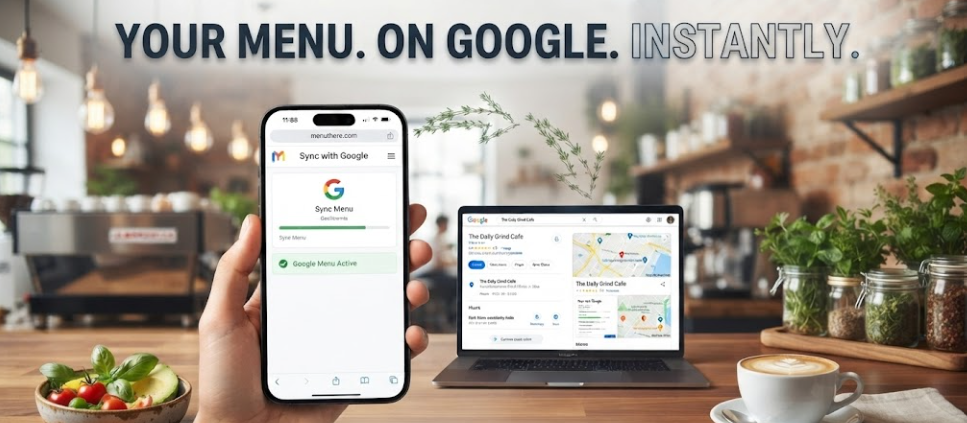
Every additional copy of your menu is a copy that will eventually be wrong, and the one that goes wrong will be the one you look at least, which is Google. Menuthere syncs your menu directly to your Google Business Profile alongside your QR menu, ordering site and delivery storefront, so a price change made once is correct everywhere, including on the page most of your guests actually read.
<cite index="33-1">Google allows meal specific menus when the full offering is available and the pages connect clearly, which is useful for brunch, happy hour and other dayparts that change</cite>. If your evening card differs from your lunch card, the listing can reflect that.
Every restaurant marketing conversation in the last three years has been about acquisition. Aggregator rankings, ad spend, discount funding, influencer meals, reels.
Meanwhile the single most viewed page in your entire digital presence is a listing you have never audited, showing a menu you did not write, with prices from an economy that no longer exists, pointing at an ordering button that pays somebody else.
It costs nothing to fix. It takes an hour to fix properly. And it is now the input to every AI answer deciding whether you get recommended to the person asking Maps, in Hindi, from a car, where to eat tonight.
Your website is not your storefront any more. Your listing is. Go and read it.
Keep your menu right where people actually read it. Menuthere syncs your live menu to Google, your QR menu, your ordering site and your delivery storefront at once, so one update is correct everywhere.
Sources: SparkToro and Similarweb via Search Engine Land (zero click search 2026), Similarweb mobile trend data via Click Vision (local intent zero click), Deep Marketing (AI Overview category growth), Techgenyz and Comparos (Google Ask Maps India expansion), Ariel Digital via Search Engine Journal (Ask Maps conversational queries), Restaurant India (AI Overviews for restaurants), BrightLocal via Searchlab (Business Profile completeness), Kodetimize (India voice and multilingual search), Orders.co and MenuSmart (Google Business Profile menu operations).
Menu strategy
Owners add dishes to grow the order value. It usually does the opposite.
Menu strategy
Most restaurants think of the menu as something that happens after a customer has chosen them. They sit down, you hand it over, they read it.