
Menu Engineering in 2026: Why Quarterly Reviews Are Already Obsolete
Menu engineering used to be quarterly. In 2026, supplier costs shift weekly and your menu has to keep up. Here's the playbook for real-time margin management.
Most independent restaurants are running their 2026 menus on 2025 cost data. Beef is up. Tariffs are scrambling supply chains. Half the suppliers in any given category have changed pack sizes or prices in the last 90 days. And the menu sitting on the table, or behind the counter, has not moved in months.
This is the silent profitability killer of the year. Operators are watching their margins drift not because their menus are badly designed, but because their menus are static while their costs are not. The fix is not a better Excel template. The fix is a different operating model.
Menu engineering in 2026 is shifting from a periodic exercise into a real-time discipline. The restaurants that win this year will be the ones who can spot a Star turning into a Plow horse within a week, reposition it on the menu the same day, and measure the lift before their next supplier invoice lands.
The 2026 reality: cost inputs that move faster than your menu
The numbers tell a tight story. 71% of restaurant operators plan to raise menu prices in 2026, up from 57% last year, when more restaurants held back following price hikes in 2024 and 2023. Operators are not raising prices because they want to. They are raising prices because they have to. Food costs are expected to increase in 2026, especially for beef, and managing supply chains will be particularly challenging as tariffs hit various imports.
At the same time, consumers have less room to absorb those increases. Only about one-third of the brands that Black Box Intelligence tracks saw positive comp sales in 2025, and even fewer saw traffic growth. Raising prices into a softening demand environment is dangerous. The operators getting away with it are the ones who are surgical about which items take the increase, which items hold, and which items get repositioned.
That surgical work is menu engineering. And it is no longer something you can do once a quarter.
Why quarterly menu engineering does not work anymore
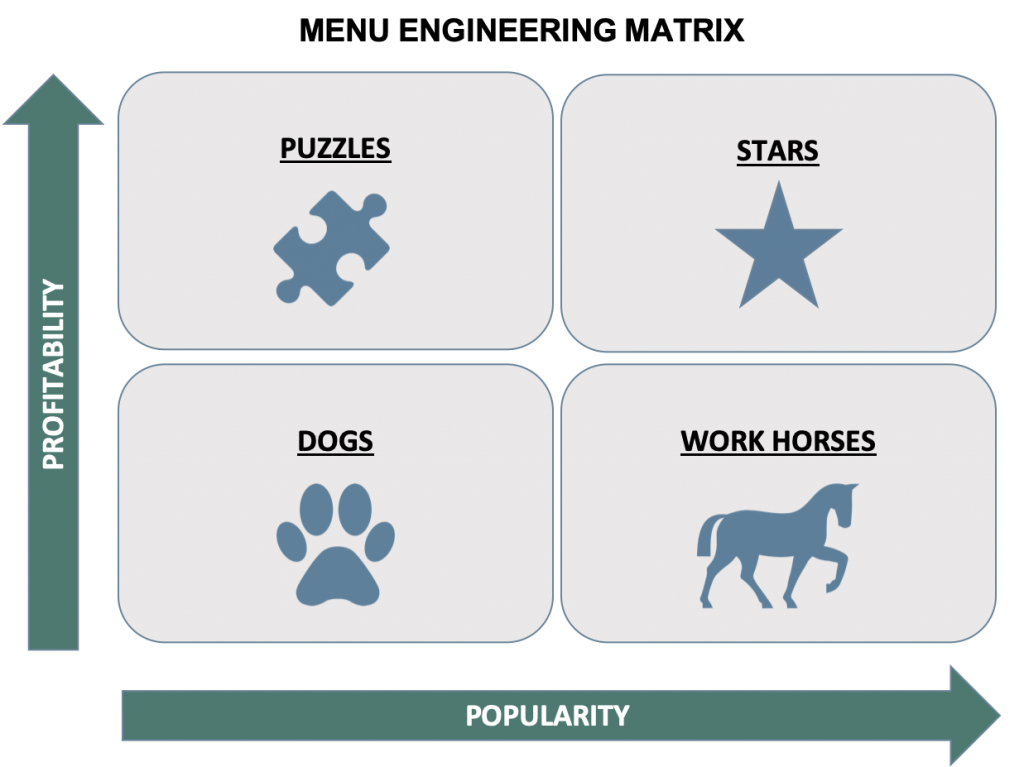
Traditional menu engineering rests on a simple framework. You gather 8 to 12 weeks of POS data, calculate contribution margin (selling price minus food cost) for each item, and plot every dish on a 2x2 matrix:
Stars: high margin, high popularity. Promote and protect.
Plow horses: low margin, high popularity. Adjust portion or pricing.
Puzzles: high margin, low popularity. Reposition, rephrase, or push.
Dogs: low margin, low popularity. Cut or rework.
The framework still holds. AI doesn't replace frameworks like contribution margin or popularity analysis. It strengthens them. By keeping cost inputs accurate and up to date, AI ensures those models reflect reality rather than outdated averages.
The problem is not the matrix. The problem is the cadence. Supplier pricing, pack sizes, and substitutions change too frequently for quarterly reviews to keep up. A dish you classified as a Star in January can quietly become a Plow horse by March because the supplier shifted from a 5kg pack to a 4.5kg pack at the same price, or because a key ingredient just absorbed a 12% tariff. By the time you do your next quarterly review, you have already taken eight weeks of margin damage.
The deeper issue is that classification alone does not move the needle. Knowing a dish is a Puzzle does nothing for the P&L. Repositioning it on the menu, rewriting its description, moving it into the eye-tracking sweet spot, or attaching it as an upsell does. And every one of those actions requires the menu itself to be editable in hours, not in print runs.
Where most operators get stuck
Three patterns show up over and over in restaurants that know they should be doing menu engineering and still are not:
The print bottleneck. Operators do the analysis, identify the changes, and then stall because reprinting menus is expensive and slow. The insight dies in a Google Doc.
The data lag. POS data lives in one system, recipe costs live in a spreadsheet, and supplier invoices live in WhatsApp screenshots. By the time anyone reconciles them into a contribution margin number, the data is two months old.
The single-menu trap. Restaurants run one menu for everyone, all day. So even when they identify that a dish is a Puzzle that performs well at dinner but kills margin at lunch (because the lunch crowd substitutes), they have no way to surface it conditionally.
These are not strategy problems. They are operating-layer problems. The operator already knows what to do. They just cannot execute fast enough.
The 2026 menu engineering playbook
Here is the working model for operators who want to move from quarterly reviews to real-time margin management.
1. Calculate contribution margin per item, not food cost percentage
Food cost percentage is a vanity metric. A 35% food cost dish that contributes ₹150 to your bottom line is more valuable than a 22% food cost dish that contributes ₹40. Using contribution margin (price minus food cost) instead of just food cost helps you identify which dishes really help pay the bills. Pull your last 8 weeks of POS data, multiply units sold by contribution margin, and rank.
2. Plot the matrix and act on each quadrant differently
Stars get the prime real estate, photos, and server recommendations. Plowhorses need adjustment in portion, cost, or price. Puzzles need better copy, visibility, or cross-selling. Dogs go to specials first, then off the menu if they still don't move. The mistake most operators make is treating the matrix as descriptive instead of prescriptive. Each quadrant has a specific action. Skip the action and you have just made a chart.
3. Position high-margin items where eyes actually go
Most customers first look at the middle of the page, then the top right, then the top left and downward from there. In menu psychology parlance, this is referred to as the golden triangle, the area where smart restaurants feature items with the highest profit margins. If your Stars are in the bottom-left of your menu, you are leaving money on the table on every cover. 71% of restaurant guests make their ordering decisions based on menu design and placement. Position is not a cosmetic choice. It is a contribution margin lever.
4. Build menus that update without a reprint
This is where most operators run aground. The analysis tells you to reposition a dish, raise a price, or 86 a Dog. Print menus turn that into a two-week project. A digital menu turns it into a two-minute project. This is the operating layer Menuthere was built to fix. Item ordering, pricing, photos, descriptions, and availability all update from one dashboard, push live to every guest's phone via QR, and let you run the menu engineering loop weekly instead of quarterly. The analysis is only as valuable as the speed at which you can act on it.
5. Run different menus for different dayparts
Lunch and dinner do not have the same matrix. A dish that is a Star at 8pm can be a Dog at 1pm because the lunch crowd anchors on different items. Most operators run one menu all day because switching is operationally painful. Daypart-specific menus let you put each dish in front of the audience that actually orders it profitably, and bury the ones that do not.
6. Test, measure, and iterate weekly
Run small experiments on price, layout, or description and measure results. Test one pricing or layout change for two weeks, review results, and repeat monthly. The point is not to be busy. The point is to compound small wins. A 2% lift on average ticket from one description rewrite, sustained across 200 covers a day, is more revenue than most marketing campaigns deliver in a quarter.
The bottom line
The old menu engineering playbook assumed your costs were stable enough to review quarterly and your menu was static enough to reprint annually. Neither assumption holds in 2026. Beef costs are moving monthly. Tariffs are reshaping ingredient pricing in real time. Consumer price sensitivity is at the highest it has been in five years.
The restaurants that will protect their margins through this cycle are not the ones with the cleverest menu design. They are the ones who have closed the loop between data, decision, and execution. They see the cost shift, they update the menu, they measure the response, and they do it again next week.
The framework is the same as it has always been. The cadence is the part that has changed. Quarterly was fine when the world stood still. The world is not standing still anymore.
Run the loop weekly with Menuthere. A digital QR menu that updates pricing, item position, photos, and dayparts in minutes, with built-in analytics on what each dish actually contributes.
Sources: McKinsey 2026 Restaurant Industry Outlook, Restaurant Dive, Popmenu 2026 Trends Report, Supy AI Menu Engineering Report, NetSuite Menu Engineering Guide, Foodhub for Business Menu Engineering 2026.