The Most Expensive Item on Your Menu Is the One You're Out Of
A stockout costs you the order, the refund, the rating and sometimes the rest of the night. And a frozen menu quietly eats your margin between reprints.
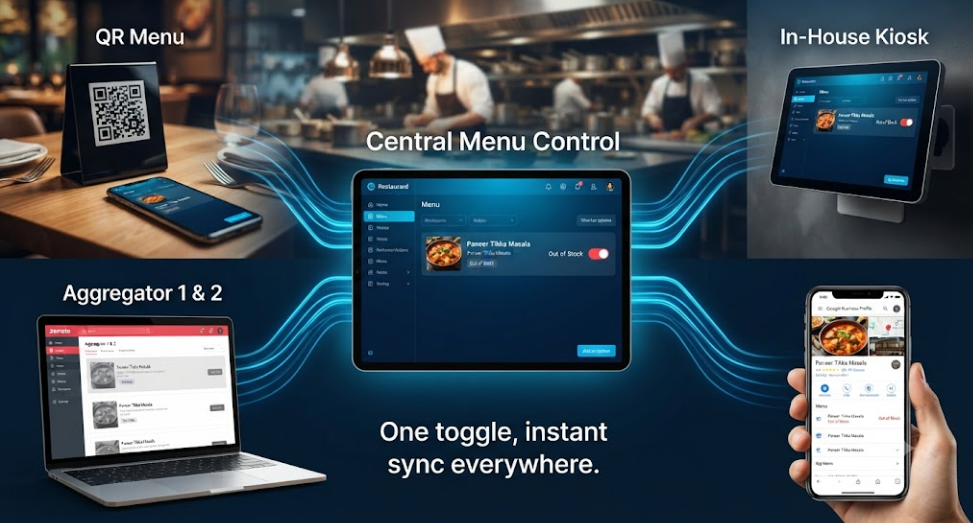
At 9:15pm the paneer runs out.
The kitchen knows immediately. The floor staff know within a minute. And for the next three hours, your QR menu, your ordering website, your Google listing and two aggregator storefronts all continue to advertise Paneer Tikka at Rs 260 to everyone who looks.
Every one of those people is being made a promise you cannot keep.
Most operators file this under service recovery. Apologise, offer an alternative, move on. That framing badly understates what it costs, because the price of a stockout is not the price of the dish.
What a single unavailable item actually costs
On a delivery channel, the sequence is mechanical. The order arrives, the kitchen cannot fill it, somebody cancels. The customer gets a refund. The rating takes a hit. And then the part almost nobody accounts for.
Otter's analysis of delivery cancellations found that <cite index="34-1">the average order cancellation rate for restaurants is 2.97 percent, that cancellation rates directly correlate with restaurant ratings, and that most delivery apps automatically pause stores that experience two cancellations or non acceptances in a row, resulting in increased downtime and reduced order volume</cite>. Their Mexico market study put the revenue impact at <cite index="34-1">between 2.28 and 3.88 percent of weekly delivery orders lost to cancellations</cite>.
Read the pause mechanic again, because that is where the real money goes. Two cancellations back to back and the platform can take you offline. The paneer that ran out at 9:15 does not cost you Rs 260. It costs you Rs 260, a refund, a rating point, and potentially your visibility for the rest of the dinner rush, which is the only part of the day where delivery volume actually matters.
The regulatory direction is making this more expensive rather than less. California's AB 578 took effect on 1 January 2026 and <cite index="27-1">requires delivery platforms to issue full cash refunds to the original payment method for incorrect or undelivered orders, including all taxes, fees and gratuities, replacing the previous practice of issuing app credits</cite>. Credits kept the money inside the ecosystem. Cash refunds do not. Where that model spreads, the cost of a failed order stops being a rounding error on somebody else's balance sheet.
On dine in the loss is quieter but not smaller. A guest who has already decided on a dish and then cannot have it does not simply substitute. They reset, order something they wanted less, and the entire experience starts from a small disappointment. Nobody writes that down anywhere.
Why it keeps happening in restaurants that are otherwise well run
Because marking something unavailable is not one action. It is four or five.
The kitchen 86s an item on a whiteboard. Somebody then has to remember to update the ordering website, the aggregator dashboards, the Google listing, and the QR menu, during service, at the busiest hour of the night, for a dish nobody is going to be able to order anyway.
That work has no deadline, no visible consequence and no owner. Predictably, it does not happen. The whiteboard is accurate within seconds. Every channel that actually takes orders stays wrong for hours.
This is not a discipline problem. It is a design problem. Any process that requires a manager to update five systems mid rush will fail, and it will fail silently, which is the expensive kind.
The second half of the same problem: your prices
The same frozen menu costs you money in a quieter way, and this one compounds every single day.
Costs move weekly. Menus move annually. The gap between those two frequencies is pure margin leak, and because nothing visibly breaks, nobody notices. You simply make less.
The arithmetic is brutal for a low margin business. <cite index="35-1">A restaurant running 32 percent food cost that sees a 6 percent rise in ingredient costs across its core recipe components watches its food cost percentage climb toward 34 to 35 percent without any change in menu prices, portion sizes or sales volume</cite>. That is two to three points of margin, in a business where <cite index="36-1">net profit margins often run 5 to 15 percent</cite>. You can lose a third of your net profit without a single thing going wrong that anyone can see.
India has just run a live demonstration of this. <cite index="36-1">LPG costs surged roughly 60 percent from March levels over two months, with NRAI president Sagar Daryani noting that LPG typically accounts for around 10 percent of food costs and was now expected to take 12 to 15 percent, leaving operators with no option but to raise prices and facing an expected period of negative gross margins for two to three weeks</cite>. Over a longer horizon, <cite index="36-1">wheat and dairy have risen about 12 percent over the past two years</cite>, against <cite index="35-1">food inflation running at 4.38 percent in June 2026</cite>.
In that shock, the operators who could reprice within a day lost a fortnight of margin. The ones waiting on a reprint or a designer lost a quarter.
The consultant's version of this is even starker. One advisor described <cite index="38-1">a Mumbai restaurant whose actual cost inflation was 9.3 percent while it had raised prices only 4 percent over 14 months</cite>. Nothing in that restaurant was visibly broken. It was simply losing money on every plate, slowly, for over a year.
The part nobody connects: the cost of changing prices dictates your pricing strategy
Here is the insight that ties both halves together, and it is the reason this is a structural problem rather than a lazy one.
Because changing a printed menu is expensive, operators batch their changes. Because they batch, the eventual increase is large. Because it is large, guests notice it and some of them leave.
The data on this is unambiguous. <cite index="38-1">Customers tolerate increases up to about 5 percent with minimal impact on visit frequency, and two 4 percent increases over twelve months retain 89 percent of regular customers while a single 8 percent increase can lose more than 30 percent of regulars</cite>.
So the printing constraint does not just cost you the margin you failed to capture between reprints. It actively forces you into the worst available pricing pattern. Rare and large, when the evidence says small and frequent.
The same constraint blocks surgical repricing. The right move during input cost inflation is differentiated: <cite index="38-1">high cost proteins and complex dishes up 6 to 8 percent, standard entrees 4 to 5 percent, signature and entry level items only 2 to 3 percent</cite>, since <cite index="42-1">desserts and sides run 20 to 25 percent food cost while mutton and fish dishes run 31 to 34 percent</cite>. You cannot reprint a menu for one line item. So you move everything or you move nothing, and both are wrong.
The physical medium produced the strategy. Then the industry started calling the strategy best practice.
The playbook
1. Make 86ing one action that hits every channel
The test is five seconds during a rush. If marking an item unavailable takes longer than that, or requires opening a second system, it will not happen when it matters. It has to be a single toggle that removes the dish from the QR menu, the ordering site, the app and the delivery storefront simultaneously.
2. Start counting your stockouts
Almost no restaurant can tell you how many items it ran out of last week. It is probably the most under measured failure mode in the business. Start a simple log for one month: item, time, channel. The pattern will tell you which three dishes cause most of your cancellations, and those three are usually a prep quantity problem rather than a demand problem.
3. Move price review from annual to monthly
<cite index="37-1">With costs fluctuating, prices should be reviewed at least quarterly, and small frequent adjustments are better received than large infrequent hikes</cite>. Monthly is better still if the cost of changing a price is effectively zero, which on a digital menu it is.
4. Reprice by margin, not across the board
Pull your food cost percentage per item and move the items where cost actually rose. A flat percentage increase across the whole menu is the blunt instrument you use when your medium cannot support anything finer. It raises the price of your highest margin items, which are the ones guests are most price sensitive about, while under correcting on the proteins that caused the problem.
5. Reprice small and often, deliberately
Two modest increases beat one large one on retention, which means frequency is not just an operational convenience. It is the pricing strategy. Treat it as a monthly governance rhythm rather than an annual event you dread.
6. Reduce the number of places your menu lives
Every extra copy of your menu is a copy that will go stale, and the one that goes stale is always the one you look at least. Menuthere manages items, prices, categories, photos and variants from one dashboard with instant in stock and out of stock toggling, syncing across your ordering website, app and QR codes, into Petpooja, and out to your Google Business Profile. One change, correct everywhere, live the moment you save.
The bottom line
A printed menu is a document. A digital menu is a promise being made continuously, to every person who looks at it, on every channel, all day.
Treated as a document, the failures look small. One dish unavailable. One price a bit behind. Neither triggers an alarm.
Treated as a promise, the same failures read correctly. Every stale line is a commitment you cannot honour, and the market now enforces those commitments automatically: refunds, ratings, algorithmic pauses, and a margin that quietly erodes between reprints while everything appears to be running fine.
The most expensive item on your menu is the one you're out of. The second most expensive is the one you're still selling at last year's price.
Change it once. Have it right everywhere. Menuthere gives you real time menu and price control across your website, app, QR codes, POS and Google listing.
Sources: Otter via BusinessWire (delivery cancellation rates, ratings correlation and platform pausing), Smith Allen Group and TheStreet (California AB 578 refund law), RetailPOS (India food inflation and food cost percentage impact), Whalesbook (LPG cost surge, NRAI commentary, Indian restaurant margins), DineCard (price increase frequency and customer retention), Aedan Rose (menu pricing review cadence), DineOpen (per category food cost benchmarks).