WhatsApp Is Already Your Ordering Channel. You're Just Running It Manually.
Every Indian restaurant already takes orders on WhatsApp, staffed by a person retyping messages into a POS. The channel is not new. The automation is.
Every Indian restaurant already takes orders on WhatsApp, staffed by a person retyping messages into a POS. The channel is not new. The automation is.
Previous article
A stockout costs you the order, the refund, the rating and sometimes the rest of the night. And a frozen menu quietly eats your margin between reprints.
Next article
A biryani and a wedding cake take the same four kilometre ride. One gives up Rs 75 in commission, the other Rs 625. Here is why bakeries pay most.
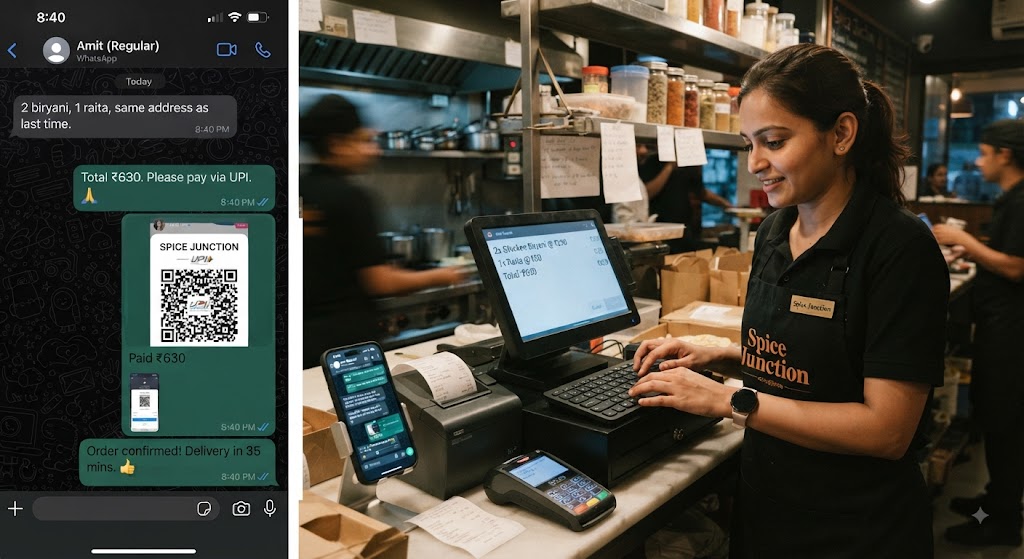
A regular messages your restaurant at 8:40pm. "2 biryani, 1 raita, same address as last time."
Somebody at the counter reads it. Opens the POS. Types in two biryani and a raita. Looks up the previous address. Messages back a total. Sends a UPI QR. Waits. Checks the payment screenshot. Types "confirmed, 35 mins." Twenty minutes later types "on the way."
That is an ordering system.
It has a menu, which is a JPEG somebody sent in 2023. A cart, which is the message thread. A checkout, which is a UPI screenshot. Order tracking, which is a human being typing "on the way." A customer database, which is your chat list.
It is a complete, functioning, zero commission direct ordering platform. It is just built out of a person.
The channel is not new. The automation is.
The scale is not really in dispute. <cite index="23-1">India has over 500 million WhatsApp users, the single largest concentration of active messaging users for any platform in any country in the world</cite>, and <cite index="22-1">India leads global WhatsApp Business adoption with more than 15 million businesses on the platform</cite>. Some restaurant sector estimates now put Indian usage closer to <cite index="35-1">800 million, which is why it functions as the most familiar and frictionless ordering channel available, with no app download required</cite>.
But the number that actually explains the behaviour is a structural one. <cite index="23-1">Unlike Western markets where email is the primary digital communication channel, India skipped email for personal communication entirely, and WhatsApp became the default layer for virtually all personal and increasingly business communication</cite>.
That single fact reorders the whole channel strategy. In a market that never adopted email, the thing that replaced it is not a marketing channel bolted onto the side of the business. It is the communication layer, and every other digital channel you use is a guest in someone else's house.
Line up the ordering channels by what the customer has to do before they can spend money with you.
An aggregator app. Already installed, which is the entire advantage. In exchange you pay <cite index="30-1">18 to 28 percent commission</cite> forever, you never learn who the customer is, and the platform owns the relationship you created by cooking well.
Your own app. The best economics available and the hardest sell in the list. You are asking a person to dedicate storage, a home screen slot and an install to a single restaurant. Most people will not do that for anywhere they eat less than weekly.
Your ordering website. No install, which is good. But they have to find it, remember it, or scan something, and then in most implementations create an account or enter an OTP before they can check out.
WhatsApp. Zero install. Zero signup. Zero password. Zero app switching. It is already open on the phone, and if they have ordered from you once, your number is already in their contacts.
Every step you remove from that sequence is conversion you keep. WhatsApp starts at zero steps, which is why the flows built on it perform: the customer sends a message, which is a thing they were going to do anyway.
Here is the part that most operators underrate, and it has nothing to do with taking orders.
WhatsApp is the only channel where a restaurant can start the conversation and actually be seen.
Email is not a live channel for Indian consumers, and <cite index="23-1">WhatsApp messages are opened 85 to 95 percent of the time against 15 to 25 percent for email</cite>. SMS is filtered, ignored and largely reserved for OTPs. Push notifications require an installed app, which is the exact barrier you were avoiding. Instagram lets you post to everyone and reach no one in particular.
So WhatsApp is not just a cheaper ordering channel. It is the only owned retention channel that exists in this market.
One honest caveat, because the industry quotes this badly. As one Indian analysis put it plainly, <cite index="27-1">the 98 percent open rate is real and also the most misused statistic in Indian marketing: a WhatsApp message appears as a notification on a locked screen while an email lands in Promotions, so of course it gets opened, and that tells you nothing about whether anyone acted. Those figures come from opted in lists, and on a scraped or purchased list reply rates collapse into low single digits while block rates spike, which is a compliance problem before it is a performance problem</cite>.
Treat the open rate as a ceiling, not a promise. And treat the block button as permanent, because it is.
On a Rs 500 order, an aggregator at 25 percent takes Rs 125.
A WhatsApp business conversation, depending on category and volume, runs in the range of <cite index="30-1">Rs 0.10 to Rs 0.72</cite>.
That is not a 20 percent saving. It is a difference of two orders of magnitude in the cost of processing an order.
But the honest framing matters more than the dramatic one, so here it is: aggregators do discovery and WhatsApp does not. Somebody who has never heard of you will not message you on WhatsApp. That first order genuinely has to come from somewhere, and for most restaurants it comes from an aggregator, from Google, or from walking past.
WhatsApp is not an acquisition channel. It is a retention channel, and the mistake operators make is trying to use it as the former, which is how you end up broadcasting to a purchased list and getting blocked.
The correct strategy is unglamorous and works: let the aggregator have the first order. Take the second through the fiftieth yourself.
There is a nice piece of evidence for exactly this. Petpooja documented <cite index="31-1">a cloud kitchen in Vastrapur, Ahmedabad that printed its WhatsApp menu link on every delivery bag, and within five months roughly 30 percent of repeat customers had shifted to the link, with no discount offered</cite>.
No campaign. No discount funding. A printed link on a bag, aimed at people who had already decided they liked the food.
Every WhatsApp order leaves you a verified mobile number, attached to an order history, on a channel you are permitted to message.
Every aggregator order leaves you nothing. Not a name, not a number, not a way to reach the person again. You cooked the meal, you took the review risk, and the platform kept the relationship.
Restaurants may be the only retail category in India that serves tens of thousands of customers a year and cannot name forty of them.
That is the quiet compounding argument for this channel. The commission saving is immediate and obvious. The customer list is the thing that is actually worth something in three years, and WhatsApp is close to the only way an independent restaurant builds one without running a loyalty programme nobody enrols in.
Before deciding whether to automate this, measure it. Scroll back through last week's chats and count the orders you took by hand, and roughly how many minutes of counter staff time they consumed between 8 and 10pm. Most operators are surprised twice: by the volume, and by the fact that it was highest exactly when nobody had time for it.
Discovery is a service you are currently buying, and it works. Fight for the repeat instead, where you have an actual advantage: they already know your food, and the switching cost is one message.
The Ahmedabad example is the whole strategy in one line. Print the link where the food arrives, when the person is at their most positively disposed toward you. Table tents, bill folders, packaging stickers, the QR on the counter. No media spend required.
The entire advantage here is friction, so protect it obsessively. No app. No signup. No OTP. No account creation before checkout. This is exactly what Menuthere's WhatsApp ordering is built around: the customer sends "Hi" to your number and gets an instant auto login link to your menu, with no download, no signup and no OTP, then orders in a few taps and receives live status updates back in the same chat.
This is the step most WhatsApp setups skip, and skipping it defeats the point. If the automated order arrives as a message that someone still has to retype into the till, you have automated the customer's half and left your staff doing data entry during the rush. Menuthere pushes orders straight into Petpooja, so the ticket reaches the kitchen without anyone touching a keyboard.
Opt in only. Low frequency. Messages that are useful rather than promotional: order status, a genuinely relevant reorder prompt, a reservation confirmation. The channel's value comes entirely from the fact that people still read it, and that is a resource you can spend down permanently in about three careless broadcasts.
Most restaurant technology asks a guest to change their behaviour. Install this. Register here. Remember this URL. Enter the code we texted you.
WhatsApp ordering asks for none of that, because the behaviour already exists. Your customers already message you. Your staff already take those orders. The only thing missing is the part where the system does the typing, the payment, the status updates and the record keeping instead of a person doing it during your busiest hour.
You do not need to build an ordering channel. You need to stop running the one you have by hand.
Turn your WhatsApp number into your easiest ordering channel. Customers send "Hi" and order in a few taps. No app, no login, no OTP, no commission.
Sources: Boomimart (India WhatsApp user base, email substitution, open rate comparison), Searchlab (WhatsApp Business global and India adoption, conversation pricing), WhatSender (India open rate caveats and list quality), WA.Expert (aggregator commission range and per conversation costs), Ownchat (India user base and restaurant use cases), Petpooja blog (Ahmedabad cloud kitchen repeat customer shift).
QR menus
The fastest way to serve faster is not hiring another server. It is removing the wait that happens before the order is even placed.
WhatsApp ordering
Most operators know this number. It gets quoted in every WhatsApp group in the industry. What gets discussed far less is the second cost, the one that never appears on the invoice.