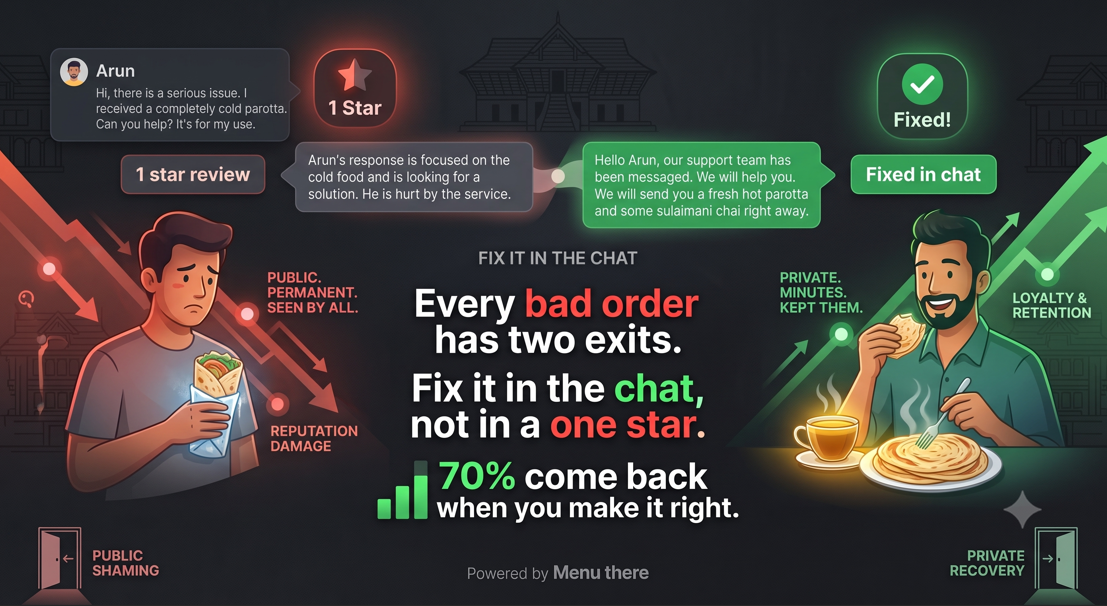
Something will go wrong. The parotta arrives cold, an item is missing from the bag, the order runs half an hour late. That is not really in question, because in a busy kitchen mistakes are inevitable. The question that actually matters is where the customer takes their disappointment.
There are two doors. Behind one is a public one star review that lives forever and quietly warns off every future customer who checks before ordering. Behind the other is a short message to you, in a chat, that you can fix in minutes and often turn into a customer who is more loyal than before it went wrong. Which door the customer walks through depends almost entirely on whether you gave them a door to you at all.
A one star is a complaint that could not reach you
Here is the thing most restaurants miss about bad reviews. The vast majority of people would rather have their problem fixed than broadcast it to strangers. A public one star is rarely pure rage. Very often it is simply the only outlet the customer had. They were let down, they had no quick way to reach the restaurant, so they reached for the one channel that would listen: the review box.
On an aggregator this is baked in. The unhappy customer has no direct line to you. Their complaint goes to a faceless platform queue, or, more likely, straight to a public rating, because that is the only button in front of them. Give that same customer a fast, human door to the restaurant, and most of them will walk through it instead of Google, because what they wanted all along was a fix, not an audience.
The complaint is a gift, and silence is the real danger
It is worth reframing the complaint itself. A customer who tells you something is wrong is handing you a second chance. That is valuable, because the far bigger threat is the customer who says nothing. Most unhappy customers never complain to the business at all. They just quietly stop coming, and a meaningful share of them tell fifteen other people exactly why, where you can neither hear it nor fix it.
So a reachable chat that makes it easy to complain is not a liability, it is a gift. A problem you hear about is one you can still solve. Silent churn is the problem you never even learn you had, until the covers thin out and you cannot say why. Surfacing the complaint is the first win. Fixing it is the second.
The service recovery paradox
Now the surprising part. Handle the problem well and you can end up better off than if nothing had gone wrong at all. This is a well documented effect called the service recovery paradox: a customer whose issue is resolved quickly, fairly, and warmly often becomes more loyal than a customer who never had a problem, because they have now seen your commitment to them in action. Anyone can look good when everything runs smoothly. You earn real trust in how you behave when it does not.
The numbers back it. Around 70 percent of customers whose complaint is resolved effectively will do business with you again, and a well handled recovery can turn a lukewarm customer into an active advocate. A good save does not merely stop the bleeding. It can deepen the relationship past where it was before.
What good recovery actually looks like
Recovery works when three things are present: speed, fairness, and humanity. Speed, because you saw the message and acted before the annoyance hardened into anger. Fairness, because the fix genuinely matches the problem, a remake for a cold dish, a refund or a credit for a missing item, something that feels proportionate rather than grudging. And humanity, because the apology comes from a real person in a warm, specific way, not a canned line that makes the customer feel processed.
WhatsApp delivers all three almost by nature. It is instant, so you catch the problem while it is still fixable. It is personal, a message from your restaurant, in the thread where they ordered, with their order right there in front of you. And it is human, a conversation rather than a ticket. On the apps, recovery is the opposite: slow, impersonal, and routed through a platform that does not know the customer and does not particularly care to.
Where the complaint lands decides your reputation
This connects straight to the reputation that actually drives your business. A one star review is public, permanent, and read by the large majority of people who check Google before deciding where to eat, and for an independent restaurant each lost star translates into real, measurable revenue. A complaint handled in a chat is private, fixable, and invisible to every future customer. The exact same disappointment produces two wildly different outcomes, and the only variable is which channel the customer reached for.
That is the whole case in one line. The restaurant that owns the conversation gets to quietly resolve, in private, the very thing an app would have published for the world. You are not just saving one customer. You are protecting the public rating that brings you the next hundred.
The maths, and why this is high return
Look at it as a CEO would. Remaking one cold dish costs you a few rupees of food and a few minutes of a cook's time. A public one star costs you the future customers it turns away, on the exact channel that drives your discovery, plus the cost of acquiring someone to replace the customer you just lost, and winning a new customer is far more expensive than keeping an existing one. Set those two numbers side by side and service recovery is one of the highest return activities in the whole business. It converts a reputation liability into a retention win, and sometimes into an advocate who sends you their friends.
The honest boundary
This needs one firm caveat, because it can be twisted into something it is not. Service recovery is about genuinely fixing the problem, not about hiding it. Do not steer unhappy customers away from leaving a review, do not offer anything in exchange for silence or for taking a review down, and do not stop asking all your customers for honest feedback. Gaming your rating that way breaks platform rules and, worse, breaks trust.
The legitimate mechanic is simple and clean: be reachable, respond fast, and actually solve the problem, so the customer is genuinely satisfied. Fewer one stars is the natural byproduct of real resolution, not a trick you played. And remember that recovery is a safety net, not a strategy. The goal is to fail less often, not to get impressive at apologising, and you should never manufacture a save. Fix the root cause so the same dish never goes out cold again, and you will need the net less and less.
The playbook
1. Give every customer a fast, human door to you
Make it easy and obvious to reach the restaurant directly on WhatsApp. The complaint you can fix is the one that comes to you first, not to Google.
2. Catch the unhappy message fast
Watch for the message that signals a problem and get a real person on it quickly. Speed is the single biggest factor in whether recovery works.
3. Fix it fairly
Match the remedy to the problem: a fresh remake, a refund, or a credit for next time. The fix should feel proportionate and genuine, not grudging.
4. Apologise like a human
Reply personally and specifically, by name, about their actual order. A warm, human apology recovers what a templated one cannot.
5. Do it in the thread
Handle it in the same conversation where they ordered, with their order and history in view, so the response is fast, informed, and personal.
6. Fix the root cause
Treat every complaint as a signal. If dishes keep arriving cold, the answer is not a better apology, it is a fix in the kitchen so it stops happening.
7. Keep asking everyone for honest reviews
Never gate or suppress. Recover genuinely, and keep inviting all customers to leave honest feedback. Real fixes and honest reviews are not in conflict.
The bottom line
Every bad order has two exits. One is a one star review that is public, permanent, and read by everyone who considers you next. The other is a quiet message you can answer in minutes, turning a let down customer into a kept, and often more loyal, one. The disappointment is the same. The channel it travels through decides everything.
You cannot promise nothing will ever go wrong. You can promise your customers a fast, human way to reach you when it does. Give them that door, walk through it with speed and honesty, and you will fix in a chat what would otherwise have been written in a star, again and again, for everyone to see.
Fix it in the chat. Menuthere turns your QR menu into a WhatsApp channel where an unhappy customer reaches you directly, so you can make it right in minutes, and keep the customer instead of collecting the review.
Sources: 2026 customer complaint and service recovery research from Opiniator, CustomerHero, AmplifAI and the Journal of Brand Management, and Esteban Kolsky's data on complaint behaviour, the silent majority of unhappy customers, and the service recovery paradox.