Just Send a Voice Note: The Most Natural Way to Order Food Is to Say It
For as long as restaurants have existed, ordering meant saying what you want. Voice note ordering gives that back, and reaches every customer an app quietly excludes.
For as long as restaurants have existed, ordering meant saying what you want. Voice note ordering gives that back, and reaches every customer an app quietly excludes.
Previous article
The biggest order your restaurant takes this month will not come through an app. Here is why catering and party orders belong in a WhatsApp conversation, and how much a cart costs you.
Next article
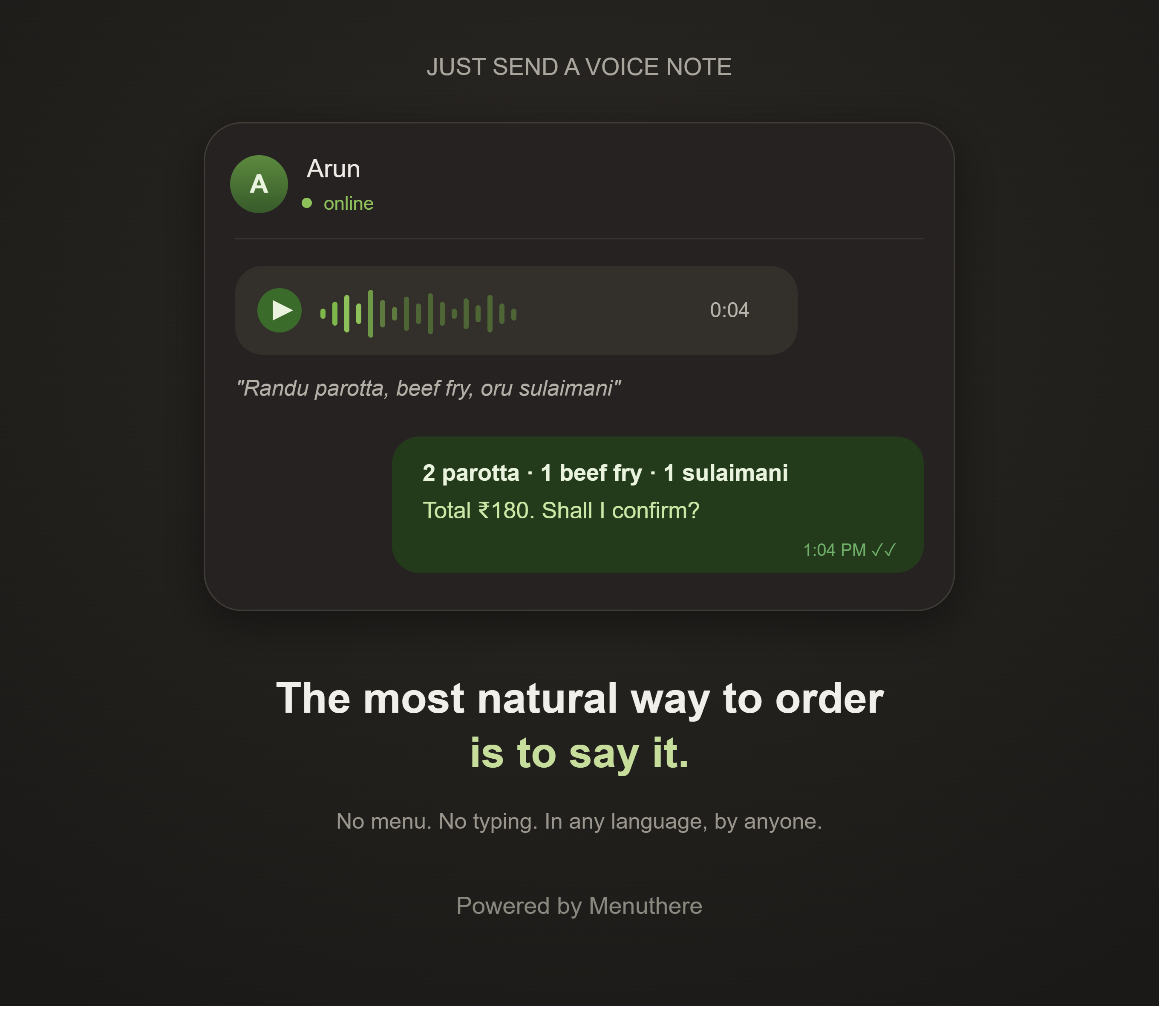
For as long as restaurants have existed, ordering food has meant one thing: saying what you want. You said it across a counter, down a phone line, to a waiter with a notepad. Then apps arrived and asked you to do something new and oddly unnatural, tap through screens, hunt for a dish inside a category tree, poke a quantity stepper, hunt again for the checkout. Somewhere in that shift, the simplest human act in the whole exchange got replaced with data entry.
A voice note gives it back. The customer presses record, says "randu parotta, beef fry, oru sulaimani," and sends. That is the entire order. No menu to navigate, no form to fill, no English to type. It is the oldest way to order food, and on WhatsApp it is also the newest, because it fits the way people already use the app better than anything a cart can offer.
This is not a novelty feature looking for a use. It is meeting a habit that already exists at enormous scale. India sends more than a billion WhatsApp voice notes every single day, and around 62 percent of Indian users send at least one every week. Voice notes are especially dominant in exactly the places where typing is slow or hard, and their use is still climbing year on year.
In other words, your customers already run large parts of their lives through voice notes. They send them to family, to friends, to shopkeepers, to colleagues. Asking them to order dinner with one is not teaching a new behaviour, it is extending a daily one to your restaurant. The habit is built. You just have to let it point at your kitchen.
For a regular who knows exactly what they want, voice is not a little easier than an app, it is a different order of speed. Saying "two parotta, beef fry, one sulaimani" takes about four seconds. The same order in an app is a minute of work: open it, wait, browse, find the dish, add it, set the quantity, find the next dish, add it, open the cart, check out. For the customer who orders their usual three times a week, that gap repeats forever.
Speech also carries nuance that a form fights you on. "Extra spicy, less oil, pack the chutney separate, and my usual chai" is one relaxed breath when spoken, and five fiddly fields and a notes box when typed, if the app even allows it. The most human parts of an order, the little preferences that make it theirs, are the parts a menu handles worst and a voice note handles best.
Here is where voice stops being a convenience and becomes a market. A menu app, however well designed, quietly shuts out a large number of people. Anyone who reads slowly or not at all. Anyone who is not comfortable typing, especially in English. Older customers who find app navigation genuinely baffling. People with low vision. Anyone whose hands are full because they are cooking, driving, or holding a child. Every one of those people is locked out of a tap only ordering screen, and every one of them can say "two parotta, beef fry" without a second thought.
This is not a small, edge case group. Seniors are among the fastest growing users of WhatsApp voice, and the share of Indians who prefer speaking to typing is vast. When an app forces every order through a keyboard and a menu tree, it is not just adding friction, it is excluding a huge slice of the paying public. Voice ordering is the most inclusive interface a restaurant can offer, and in India that inclusion is not charity, it is a large, underserved audience that the apps have simply been leaving on the table. The restaurant that lets people order by voice can serve customers its competitors cannot even reach.
There is a language layer to this too. Typing Malayalam on a phone is a chore, so people default to English or to clumsy transliteration, and a rigid English menu makes it worse by only accepting the exact listed name of a dish. Speaking Malayalam is effortless. A voice note carries the mother tongue, the dialect, the Manglish mix, and the local, affectionate name for a dish, none of which a fixed form will accept. The customer orders in the language they actually think in, and the restaurant meets them there.
The beauty of this is that the hard part is not the customer's. Their side is three motions: press, speak, send. On the restaurant's side, the voice note is heard and the order is read back in the same thread for confirmation, "2 parotta, 1 beef fry, 1 sulaimani, that is ₹180, shall I confirm?" Whether a staff member listens and keys it in during a quiet moment or software transcribes it automatically, the customer's effort is identical and the confirmation step keeps the order accurate.
It is worth being straight about that step. Automatic transcription of Malayalam and mixed speech is improving fast but is not flawless, especially with background noise or heavy dialect. So the read back is not a nicety, it is the safeguard, and a human in the loop is what keeps a four second voice note from turning into a wrong order. Done this way, voice is both effortless for the customer and reliable for the kitchen.
Aggregator ordering is tap only, menu driven, and English first by design. There is no "just say what you want" button on a delivery app, and there cannot be, because the whole model is a catalogue to scroll, not a conversation to have. Voice ordering can only live where conversation already lives, and that place is WhatsApp. This is one more thing that is not a feature you bolt onto an app, but a capability that exists only on a channel built for talking.
And because the voice note comes from a real phone number you keep, the voice order behaves like every other WhatsApp order: the customer is saved, the usual is remembered, and the relationship is yours. The most natural way to order turns out to also be an owned one.
Make it explicit that a voice note is a valid way to order, not just text. The whole point is to remove the menu and the keyboard for anyone who would rather just say it.
Read the order back in the thread before cooking. The confirmation is what makes a fast, casual voice note safe to act on.
Let people order the way they talk, in the mother tongue, the dialect, or the Manglish mix. Do not force the English name of a dish.
For regulars, "the usual, please" as a voice note should just work. Save the order so a returning customer barely has to say a full sentence.
Put "just send us a voice note" on your table tents, your posts, and your profile. People will not use what they do not know they can do.
Until transcription is truly reliable for local speech, have a person verify. Accuracy protects the experience and your reputation.
Remember what this really is: the way to serve every customer an app excludes. That is a growth strategy, not a nice to have.
The app era quietly convinced the industry that ordering food should feel like filling in a form. It should not. The most natural, fastest, most inclusive way to order a meal is the way people have always done it, by saying what they want. A voice note brings that back, on the one app where a billion of them already fly around India every day.
It is faster for the regular, kinder to the elder, effortless in Malayalam, and open to everyone who can speak, which is everyone. Let your customers press, speak, and send, and you will serve people your competitors never could.
Let them just say it. Menuthere turns your QR menu into a WhatsApp channel where a voice note is a valid order, confirmed back in the same chat, so anyone can order in seconds, in any language.
Sources: 2026 WhatsApp usage data from TechRT, Jesty and Infobip on daily voice note volume in India, weekly voice note usage, the popularity of voice notes in low-literacy regions, and rising voice adoption among older users.
You can translate your menu into Malayalam and still make every customer order in English. The real win is letting the whole conversation happen in their mother tongue.
Menu strategy
Ask the internet how often a restaurant should update its menu and you get a remarkably consistent answer.
WhatsApp ordering
Most operators know this number. It gets quoted in every WhatsApp group in the industry. What gets discussed far less is the second cost, the one that never appears on the invoice.