Your Customer Waited Nine Minutes for the Bill
They loved the food. Then they spent nine minutes trying to catch someone's eye. Memory is built from endings, and the bill is the ending you never designed.
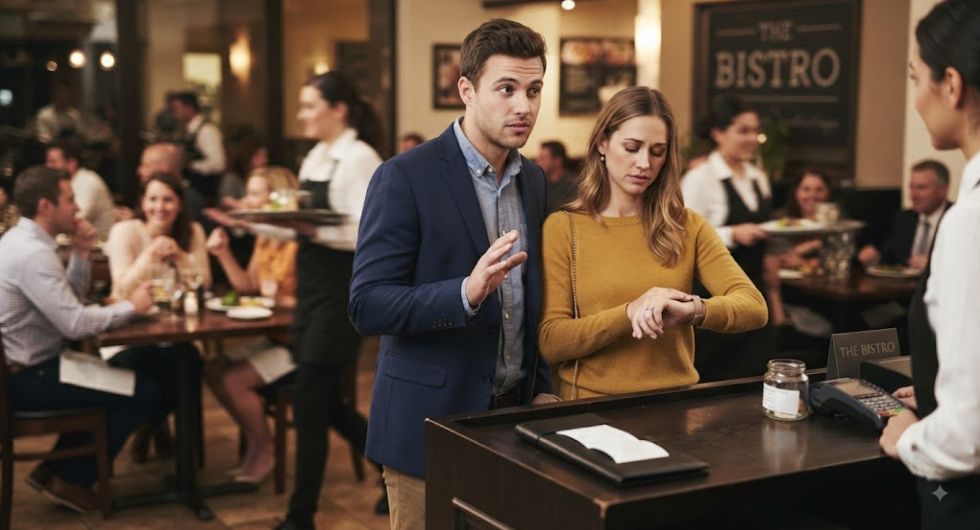
The food was excellent. Everyone said so at the table.
Then dinner ended, and the last nine minutes went like this. Three minutes trying to catch someone's eye. A wave that got missed. A slightly louder wave. Someone eventually comes, takes the request, walks to the counter, queues behind two other staff doing the same thing, prints, comes back. Card goes down. Card goes away. Three more minutes. Card comes back with a receipt nobody wants.
Ask that guest a week later what the evening was like and they will not describe the food first.
They will describe standing near the counter, holding a card, waiting.
Endings carry more weight than they should
This is one of the most robust findings in behavioural psychology, and restaurants ignore it almost completely.
People do not remember experiences as an average of everything that happened. They remember them by the most intense moment and by how they ended. It is called the peak end rule, and it means the last five minutes of anything are weighted far out of proportion to their length.
Your kitchen spends ninety minutes building the peak. Your floor spends nine minutes overwriting it.
And the ending is uniquely bad for this, because it is the only part of the evening with no product attached to it. Every other moment of the meal, something is being given to the guest. Food arrives. Water gets refilled. Plates get cleared. At the end, nothing arrives. The guest wants something and cannot get it, and the only tool they have is waving.
That is the last emotional note of your restaurant. Wanting something and not being able to get it.
It is not your staff being slow
Worth saying clearly, because the instinct is to solve this by telling the floor team to move faster.
Look at the actual sequence for one table. The guest signals. Someone notices. They come over. They walk to the POS. They queue, because at 9:15 three other tables asked at the same time. They print. They walk back. They collect the card. They walk to the counter again. They walk back with the card and the receipt.
That is four crossings of the floor per table, plus a queue at a machine.
Now the part that makes it structurally hard: the bill rush and the service rush are the same twenty minutes. Tables that sat down together want to leave together. That is precisely when your staff are carrying mains to the tables that just sat down. There is no version of this where a busy floor handles it smoothly, because the demand for bills peaks exactly when the capacity to deliver them is lowest.
You cannot train your way out of a queueing problem.
What those nine minutes cost you
A review that describes the wrong thing. The meal was a five. The review says four, and mentions slow service, even though the food came out in twelve minutes. The guest is describing the end, not the middle, because that is what they remember.
Table time. Nine minutes of a table generating nothing. Twenty tables across an evening is three hours of table time. At peak, that is the difference between seating a walk in and watching them leave.
Staff time in the wrong place. Four floor crossings per table, at the busiest moment of the night, doing administration rather than hospitality.
The fix is that the guest should control the ending
The technology part is simple. A QR code on the table or the bill lets the guest see the total and pay from their own phone, whenever they decide they are ready. No eye contact required. No trips across the floor. No queue at the POS.
When the Big Mamma group deployed this, the results were straightforward: <cite index="37-1">80 percent of customers chose to pay by QR code, saving around 15 minutes of wait time on average and improving table turnover</cite>.
But I want to frame the goal correctly, because "faster checkout" is the wrong way to think about it and leads to a worse restaurant.
The problem is not that the ending is slow. The problem is that the guest does not control when it happens. Some tables want to sit for another twenty minutes with the last of the coffee, and rushing them is its own kind of bad hospitality. Other tables have a film at nine.
Give them the option and both get what they want. The lingering table lingers, comfortably, without a bill hovering. The table in a hurry leaves in forty seconds without waving at anyone.
The goal is not a faster exit. It is an exit the guest controls.
And the honest exception
For some restaurants the ending is genuinely the product. A room where the manager brings the bill, thanks you by name, and asks how the anniversary went is not experiencing friction. That is the hospitality, and automating it away would be vandalism.
The distinction is not full service versus quick service. It is whether the human interaction at the end is something you designed or something the guest is forced to initiate.
If your team chooses the moment and arrives warmly, keep it. If your guest has to wave, you have not designed an ending. You have left one to chance during the busiest twenty minutes of your night.
What to do this week
1. Time it yourself. Sit at a table at 9pm on a Saturday. Signal for the bill and start a stopwatch. Stop it when you are standing outside. Almost no owner has ever measured this, and the number is usually worse than the estimate.
2. Count the crossings. Watch one table's checkout end to end and count how many times a staff member walks between the table and the counter. Four is normal. Four times twenty tables is a lot of walking that produces nothing.
3. Look at your recent reviews for the word "slow." Then check whether those tickets were actually slow in the kitchen. Often they were not. The guest is describing the end.
4. Give them a way to pay without asking. A QR on the table, on the bill folder, on the receipt. Menuthere handles ordering and payment from the table, so a guest can settle up from their own phone at the moment they decide the evening is over, without catching anyone's eye.
5. Keep the goodbye. Removing the waiting does not mean removing the person. It frees the interaction to be warm rather than transactional, because nobody is holding a card and looking around.
The bottom line
Restaurants invest enormous care in the beginning and the middle of a meal. The greeting, the seating, the water, the recommendation, the timing of the courses, the plating.
Then the evening ends in a queue at a card machine, and that is the part the guest carries home.
Nine minutes is not a long time. It is just the last thing that happened, and the last thing that happened is what gets remembered, repeated at the office on Monday, and typed into a review three days later.
Let them leave when they're ready. Menuthere lets guests order and pay from the table on their own phone, so nobody has to wave.
Sources: Edgar Dunn (Big Mamma and Sunday pay at table results), Bread Point of Sale and FineDine (QR payment at peak service and checkout flow), Kahneman and Redelmeier on peak end evaluation of experiences.