You Have 340 Reviews and Replied to None
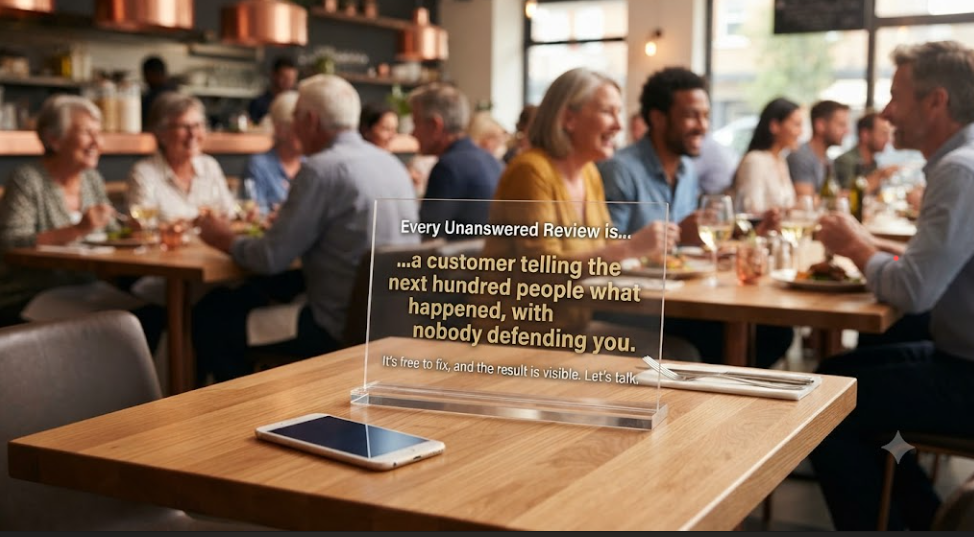
Every unanswered review is a customer telling the next hundred people what happened, with nobody giving your side. Replying is free and almost nobody does it.
Open your Google listing. Count the reviews. Now count the replies.
For most restaurants the second number is zero, or close to it.
That is three hundred and forty people who described your restaurant in public, permanently, to everybody who looks you up from now on. Some of them were delighted. Some were annoyed about a wait on a Saturday two years ago. All of them are still talking, and none of them have ever been answered.
The mistake is about who the reply is for
Most owners think of a reply as a message to the reviewer. Which makes skipping it entirely rational. That person already ate, already left, already made up their mind, and probably will not come back regardless. Why argue with someone who has gone?
That is the wrong audience.
<cite index="20-1">97 percent of people who read reviews also read the business's responses</cite>.
You are not writing to the person who complained. You are writing to the two hundred people who will read that complaint over the next year while deciding where to eat tonight. To them, your reply is the only version of your side of the story that exists.
When there is no reply, the review is simply the truth. When there is one, the reader gets to weigh two accounts and decide. That is the entire mechanism, and it costs nothing.
The negative review is the one worth answering
This is the counterintuitive part, and it is where the opportunity actually sits.
Negative reviews get read more carefully than positive ones. People scroll past the fives and stop at the ones, because they are looking for what could go wrong. That is the review carrying the most weight in the decision, and it is also the one most likely to be sitting there unanswered. One 2026 analysis found that <cite index="26-1">only 54 percent of reviews receive any response at all, and the gap is widest for negative reviews, where 68 percent go completely unanswered</cite>.
<cite index="20-1">45 percent of consumers say they are more likely to visit a business that responds to negative reviews, and 56 percent say they are influenced by what a business says in its response</cite>.
A calm, specific reply to a bad review does something a hundred five star reviews cannot. It shows a reader what happens when something goes wrong, which is the thing they are actually trying to find out.
It compounds into visibility
There is a second effect that surprises people, and it comes from the strongest study in this area.
A Harvard Business Review analysis of hotel reviews on TripAdvisor found that <cite index="23-1">when hotels started responding to reviews, they received 12 percent more reviews and their ratings increased by an average of 0.12 stars</cite>.
Note what that means. Responding did not just change the impression of existing reviews. It generated more reviews and moved the actual rating, because people who see an engaged business are more inclined to leave feedback, and because responding tends to defuse the escalation that produces one star reviews in the first place.
More reviews and a better rating then feed the listing. Practitioner estimates put <cite index="27-1">review signals at roughly 16 percent of Local Pack ranking weight, though these are expert survey figures rather than disclosed Google weights</cite>.
On the revenue side, Womply's analysis of transaction data from over 200,000 US small businesses found that <cite index="21-1">businesses replying to at least 25 percent of their reviews averaged 35 percent more revenue than comparable businesses that did not reply</cite>. That is a vendor study rather than peer reviewed work, so treat the exact figure with appropriate caution, but the direction is consistent across every dataset in this space.
The trap: a bad reply is worse than none
Now the warning, because this is the most common way operators get this wrong, and it has become more common since AI made bulk replies effortless.
<cite index="19-1">BrightLocal's 2026 survey found that 89 percent of consumers now expect business owners to respond to reviews, and 50 percent say generic, templated responses would make them less likely to choose a business</cite>.
Half of readers are actively repelled by "Thank you for your valuable feedback, we appreciate your input and hope to serve you again."
That sentence tells the reader you have a process, not that you care. Worse, when it appears identically under forty different reviews describing forty different experiences, it reads as automation, and automation in a hospitality business signals precisely the wrong thing.
The rule is simple. If your reply could be pasted under any other review without editing, do not post it.
The 340 reviews are also your best research
One more use for the pile, and almost nobody does this.
Those reviews are the largest piece of customer research you own and it cost you nothing. Not as individual complaints, which is how they get read when they get read at all, but as a dataset.
Sort them by theme. If forty of them mention waiting, that is not forty complaints, it is one operational finding with forty data points behind it. If a dish name appears repeatedly in negative reviews, that is a recipe or a consistency problem the kitchen has not noticed. If people keep praising one server, that is retention information.
You paid for none of it and nobody has read it.
And now the machines are reading them too
There is a newer reason this matters, and it is worth knowing about.
AI assistants and search summaries composing an answer about your restaurant read your listing, and reviews are the largest block of text on it. When somebody asks their phone where to eat nearby, the model is working from that text.
Your replies are the only part of that body of text that you wrote.
An unanswered wall of complaints is what gets summarised. A wall with considered owner responses next to it reads very differently, both to a person and to a system.
What to do this week
1. Do not clear the backlog. Attempting all 340 is how this dies on day two. Start with the last thirty days and everything below three stars, whenever it was written.
2. Answer negatives first, and quickly. Restaurant specific research suggests <cite index="27-1">81 percent expect a response within a week and 19 percent expect same day, with a workable standard being 24 to 48 hours on negatives and within a week for everything else</cite>.
3. Write to the reader, not the reviewer. Name the specific thing that went wrong. "You waited too long for your food on a Saturday and that is on us" tells a future reader that you know what happened. "We are sorry you had a suboptimal experience" tells them nothing.
4. Say what changed. The most persuasive reply is one that names a fix. If three reviews mention the same delay and you have since changed the roster, say so. That reply converts readers, because it demonstrates the complaint was heard by someone with authority to act.
5. Reply to good reviews too, briefly and specifically. Mention the dish they mentioned. It takes fifteen seconds and it is visible proof that a person is reading.
6. Read the whole set as data once a quarter. Themes, not incidents. Then fix the top one.
7. Make sure the listing they land on is worth the visit. A good reply brings the reader back to a profile with an outdated menu, wrong hours or a photo of a laminated card from 2019. Menuthere syncs your live menu to your Google Business Profile so that the page your reviews are attached to is actually current.
The bottom line
Every restaurant has a conversation happening about it in public, every day, for years, in a place every prospective customer visits before deciding.
Most owners are not in that conversation at all.
The cost of joining is a few minutes a day and a willingness to write like a person rather than a policy. The evidence says it raises your rating, increases your review volume, improves how you appear in local search, and changes the minds of half the people who read it.
Three hundred and forty people took the time to tell you something in public.
Nobody has said anything back.
Give people a listing worth landing on. Menuthere syncs your full menu, prices and photos to your Google Business Profile in one click.
Sources: Harvard Business Review via Reputation (Proserpio and Zervas TripAdvisor response study), BrightLocal 2026 via Buffer (consumer expectations and templated response aversion), WiserReview (response readership and influence statistics), ReplyOnTheFly (2026 response rate benchmark), Womply via MaxStars (small business transaction data), Katalyst (restaurant response time expectations and Local Pack signal estimates).