He's Come 14 Times This Year. You Couldn't Call Him If You Tried.
You'd recognize him instantly. You have no way to reach him. And when he stops coming, nothing in your restaurant will notice.
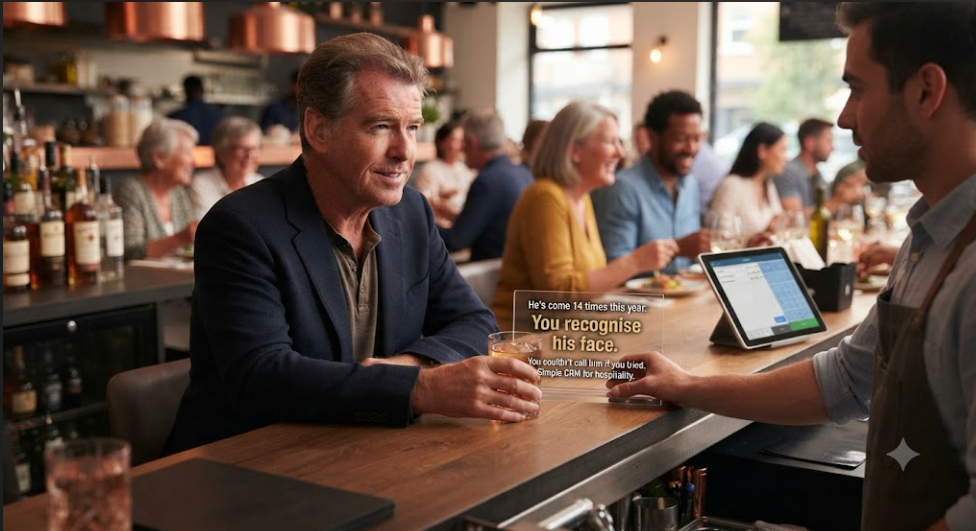
There is a man who has eaten at your restaurant fourteen times this year.
He sits at the same table when it is free. He orders the same thing most times, the fish occasionally. Your staff recognize him. Somebody probably knows he works nearby. You would know his face instantly in a crowd.
You could not contact him if your business depended on it.
He knows your name, your address, your menu, your best dish, your opening hours and possibly your Wi-Fi password.
You know his face.
Recognition is not a record
Most owners hear this and think they are fine, because they do know their regulars. And they do, in the way that matters emotionally.
But that knowledge lives in one person's head. The chef knows him. Or the senior waiter knows him. Or you know him.
Your customer database is your longest serving floor staff member, and he is leaving in eight months.
When he goes, the regular becomes a stranger again. Nobody remembers the fish. Nobody knows he comes on Thursdays. The relationship resets to zero and neither party chose that.
There is a measurable version of this gap. One 2026 analysis of guest data found that <cite index="22-1">automated systems capture 50 to 80 percent or more of guest data, against 15 to 25 percent for manual collection</cite>.
And you will not notice when he stops
This is the part that should bother you most.
He comes fourteen times, and then he does not come again.
Nothing happens. No alert. No report. No gap analysis. He simply is not there, and because a restaurant is busy and faces come and go, nobody registers his absence for a month or two. Eventually someone says "we haven't seen that gentleman in a while," and by then he has found somewhere else.
You never learn why. Maybe he moved office. Maybe he had one bad meal you could have fixed in a phone call. Maybe nothing at all, just drift.
And what you lost is bigger than fourteen visits. The same guest data analysis found that <cite index="22-1">guests with 11 or more visits average 36.5 visits</cite>.
He was not a fourteen visit customer. He was a thirty six visit customer who stopped at fourteen. You lost the twenty two he had not made yet, and nothing in your building noticed.
This is not a small segment
It would be easier to dismiss if regulars were a nice extra. They are not the extra. They are the business.
<cite index="26-1">The 2026 Toast and Resy Regulars Report found that just 7 percent of a restaurant's guests can drive up to 50 percent of its orders</cite>. National Restaurant Association data puts repeat customers at <cite index="19-1">roughly 71 percent of sales in quick service, 68 percent in fast casual, 64 percent in casual dining and 51 percent in fine dining</cite>.
Meanwhile <cite index="19-1">around 70 percent of first time diners never return</cite>, and <cite index="26-1">acquiring a new customer costs 5 to 25 times more than retaining one, while a 5 percent increase in retention can raise profits 25 to 95 percent</cite>.
Put plainly: roughly half your orders come from a small group of people you cannot contact, while you spend money advertising to strangers, most of whom will visit once.
Somebody does have his number
Here is the uncomfortable part.
If he has ever ordered from you on an aggregator, that platform knows his name, his phone number, his home address, his office address, his complete order history, how often he orders, what time he orders, what he stopped ordering, and how he responds to a discount.
You cooked every one of those meals. You took the review risk. You built the relationship through fourteen good experiences.
They own the relationship, and they can put a competitor's banner in front of him tomorrow.
That asymmetry is the actual cost of the commission, and it is far larger than the percentage.
The fix is not a loyalty programme
When operators finally decide to act on this, they usually reach for points and punch cards. I would push back on that as the first move.
Most loyalty schemes discount your best customers, which is backwards. They ask a guest to enrol, remember, and carry something, which most will not do. And they measure the wrong thing, since a stamp card tells you somebody wanted a free coffee, not that they like you.
The simpler move is this. You already collect a phone number on every delivery order, every WhatsApp order and every table booking.
You just do not keep it attached to anything.
That is the whole problem. Not a missing programme. A discarded field.
Direct ordering solves it as a side effect rather than as a feature. If the guest orders from your own site or your WhatsApp number rather than a platform, you have a verified number, an order history and a channel you are permitted to use. No enrolment, no cards, no points.
What to actually do with it, and what not to
The temptation once you have a list is to message it. Resist most of that instinct.
Use it for recognition. Knowing that a returning guest orders the fish is service. Greeting somebody by name on their fourth visit is hospitality, and it is the thing chains spend fortunes trying to imitate while independents give it away.
Use it for absence, not presence. The most useful signal in a customer list is not who came. It is who stopped. Somebody who ordered every fortnight for a year and has not ordered in six weeks is a question worth asking. That is the only alert worth building.
Do not use it for volume. A restaurant that messages its list weekly gets muted, and once muted it is muted permanently. The channel is valuable precisely because it is quiet.
The line is simple. If the message would only make sense sent to everyone, do not send it. If it would only make sense sent to this person, it is probably worth sending.
The playbook
1. Count your regulars. Pull the last twelve months and count how many distinct customers ordered more than ten times. Most owners have never seen that number and are surprised in both directions.
2. Capture the number where it is already being given. Delivery, WhatsApp, bookings, direct orders. No forms, no enrolment, no asking people at the table.
3. Attach the history to it. A number on its own is a contact. A number with an order history is a relationship you can act on.
4. Watch the gaps. Build one report: customers whose ordering interval has doubled. That is your churn list, and it is the only one that matters.
5. Own the channel the orders come through. Every order on your own platform is a customer you keep. Menuthere runs your ordering site, app and WhatsApp ordering with the customer data staying yours rather than the platform's, which is the difference between having a regular and having a stranger who happens to come back.
The bottom line
Your barber knows your name. The kirana downstairs knows your family and what you buy. The chemist remembers your prescription.
The restaurant you visit fourteen times a year knows your face and nothing else, and if you stop going tomorrow, nobody there will find out why.
That is not because restaurateurs care less. It is because the ordering channels most restaurants rely on were designed to keep that information somewhere else.
He is coming back on Thursday, probably. You still will not know his name.
Keep your customers, not just your orders. Menuthere gives you direct ordering across web, app and WhatsApp, with the customer relationship staying yours.
Sources: Toast and Resy 2026 Regulars Report via Restaurant Snapshot (guest concentration), Bloom Intelligence 2026 (visit frequency, data capture rates), National Restaurant Association via Restroworks (repeat sales by segment, first time return rates), Harvard Business Review and Bain and Company via Restaurant Snapshot (acquisition cost and retention profit impact).