You Sold It on Monday. You Get Paid Next Tuesday.
Aggregator money arrives in 7 to 14 days, minus a third, in a lump you cannot reconcile. The vegetable vendor wanted cash on Monday morning.
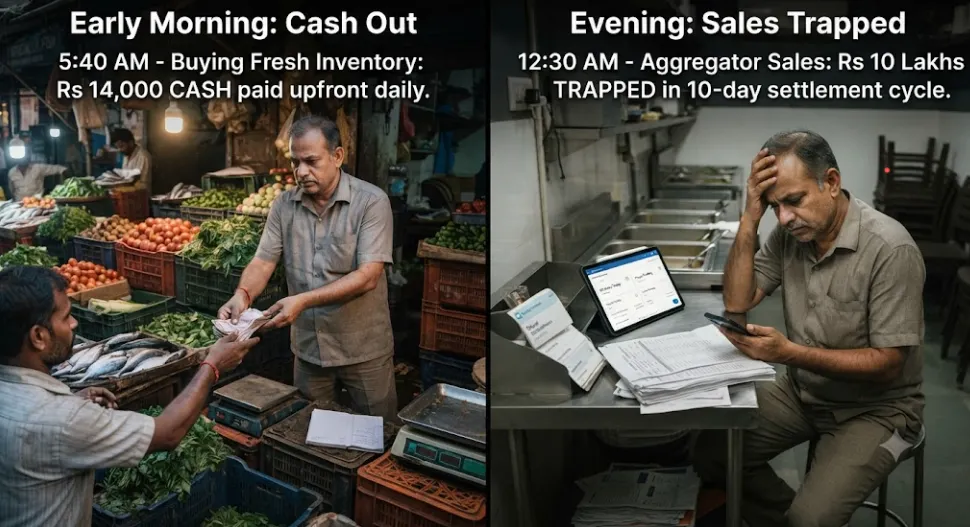
Monday morning, you are at the market. The vegetable vendor wants cash. The fish is cash. The milk man comes daily. The gas cylinder is paid on delivery. Two of the kitchen help are on daily wages.
Monday evening, you sell forty orders on Swiggy and Zomato.
That money reaches your bank the following Tuesday. Possibly the Thursday after. It arrives as one number, about a third smaller than what your customers paid, and you cannot easily tell which orders it covers.
Everybody talks about the commission. Almost nobody talks about the calendar.
The calendar is the part that kills restaurants
A commission is a known number. You can price around it, plan for it, decide whether it is worth it. It is painful and it is predictable.
A settlement delay is different, because it does not reduce your profit. It removes your cash while leaving the profit on paper. And a restaurant does not close because it was unprofitable. It closes because on the 3rd of the month there was no money for rent, even though the last three weeks were good.
Both platforms nominally run seven day cycles. <cite index="21-1">Swiggy settles Sunday to Saturday order cycles with a stated seven business day turnaround, and Zomato operates a seven business day cycle with a more transparent, order level partner portal</cite>.
Seven business days is not seven days. With weekends, it is nine to eleven calendar days. And it has been slipping. <cite index="21-1">Multiple restaurant partners in 2026 have reported settlements stretching to 10 to 14 days without formal notification</cite>.
There is a concrete cost attached. <cite index="21-1">For a cloud kitchen operating on Rs 2 to 3 lakh per month in GMV, a seven day settlement extension represents Rs 45,000 to Rs 70,000 in delayed working capital. That is a real cost, even if it is invisible on your commission statement</cite>.
You are lending them money and paying them for the privilege
Here is the arithmetic nobody runs.
If you do Rs 1 lakh a day of aggregator business on a ten day settlement cycle, roughly Rs 10 lakh of your money is sitting inside the platform at any given moment. Permanently. It never comes back, because as soon as one cycle settles the next has already accumulated.
That is an interest free loan you extend, every single day, to a company vastly better capitalised than you are. And you pay a commission for the arrangement.
Turn that around and ask what it costs you. If you are covering the gap with a working capital loan, a supplier credit line, a gold loan or a credit card, the interest on that is the actual price of the delay, and it appears in your accounts as finance cost rather than as anything to do with Swiggy or Zomato.
And growth makes it worse before it makes it better
This is the trap that catches good restaurants, and it is worth understanding precisely.
Double your aggregator volume and the amount of your money trapped in the settlement cycle doubles too.
So a restaurant growing 30 percent on aggregators can be simultaneously more profitable and more cash stressed than it was last year. The P&L improves. The bank balance gets tighter. The owner cannot understand why a good year feels so precarious.
That is how profitable businesses die, and it is almost never diagnosed correctly, because every instinct says the answer to a cash problem is more sales.
More sales on this channel is the thing causing it.
Delay is survivable. Delay plus uncertainty is not.
If the money were late but exact, you could plan around it.
It is not exact. By the time a payout reaches you it has passed through commission at <cite index="24-1">15 to 25 percent, typically 20 to 25 in metro cities, GST at 18 percent on the commission which adds another 3 to 4.5 percent effective, a payment gateway fee of 1.5 to 2 percent, packaging charges, and Gold or Pro membership subsidies that can take another 5 to 10 percent on select orders and are often buried in settlement reports</cite>. Add promotional co funding, cancellations, TDS under section 194-O, and <cite index="20-1">cash collected by delivery partners on COD orders adjusted against future payouts</cite>.
One analysis working through a standard Rs 550 order put <cite index="27-1">the expected net payout at Rs 377.25 at standard rates</cite>.
So the honest comparison is not zero percent against twenty five percent. It is roughly Rs 377 in seven to fourteen days, against Rs 550 tomorrow.
Almost nobody checks whether it was right
The uncomfortable follow on: because the number is complicated, most operators do not verify it.
As one Indian reconciliation guide put it, restaurateurs <cite index="27-1">wait for the weekly settlement to arrive, glance at the total, confirm it is roughly what it should be, and move on, which is not reconciliation but wishful accounting, and it costs Indian restaurant operators thousands and sometimes lakhs in undetected payment gaps</cite>.
If you do not know what the number should have been, you cannot know if it was wrong.
The fair version of the other side
Two things worth saying, because a piece that only attacks is not useful.
The float is partly a real operational cost. The platform collects from customers, handles refunds, absorbs fraud and reverses failed orders. Some settlement lag is genuine plumbing rather than pure advantage.
And the direction is improving. <cite index="23-1">Zomato has introduced a facility for restaurant partners to draw daily payouts, settling daily based on sales from three days prior, initially for partners receiving 100 or fewer orders</cite>. Worth checking whether you qualify for something similar.
There is also a genuine trade off in going direct that people skip. <cite index="26-1">Under Section 9(5) of the CGST Act, the aggregator is liable to pay the 5 percent GST on orders placed through it, so you do not charge or pay GST on those orders. Dine in, takeaway and orders on your own website or direct WhatsApp remain your supplies, where you charge 5 percent and pay it yourself</cite>. Direct ordering means you run two parallel GST streams and tag every order by channel. That is real administrative work, and anybody telling you direct ordering is pure upside is not being straight with you.
What to do this week
1. Calculate your locked capital. Daily aggregator sales multiplied by your actual settlement days. Not the stated cycle, the real one. Look at when the last six payouts actually landed. Most owners have never put a number on this and it is usually larger than they guess.
2. Reconcile one week properly. Pull the order level settlement report, match it against your POS, and check that every order exists in both at the same value. Do it once and you will know whether it is worth doing monthly.
3. Ask about faster payout options. They exist, they are not always advertised, and the terms depend on your order volume.
4. Move the repeat customer to a channel that pays you tomorrow. You are never going to win the first order away from an aggregator, and you should not try. But the regular who already knows your food does not need a platform to find you. On a direct order the money settles to your own bank, in full, the next working day. Menuthere runs your ordering site, app and WhatsApp ordering with payments through Cashfree settling straight to your account, so no aggregator is holding your funds.
5. Watch the gap, not the total. The number to track monthly is not revenue. It is the difference between the day you sell and the day you are paid, multiplied by your daily sales. That is the size of the loan you are extending.
The bottom line
Restaurants do not usually fail because the food was bad or the margins were thin. They fail on a Tuesday when a payment was due and the money that would have covered it was sitting in a settlement cycle.
The commission is the cost everybody argues about. The calendar is the one that decides whether you make it to next quarter.
You sold it on Monday. The vendor wanted cash on Monday. You get paid next Tuesday, minus a third, in a lump you cannot check.
Get paid tomorrow, not next week. Menuthere gives you direct ordering with payments settling straight to your bank, with no platform holding your money.
Sources: Petpooja (settlement cycles and COD adjustment), MenuHelper (2026 settlement lengthening, working capital cost, net payout baseline, reconciliation practice), DineOpen (commission and deduction structure), HelloBooks (GST Section 9(5) treatment and channel tagging), YourStory (Zomato daily payout facility).
Note: this article is general information, not tax or financial advice. Terms vary by contract and change over time.