
Taco Bell's AI Menu Boards Now Change Per Car. Here Is What That Actually Signals.
Yum Brands just disclosed AI driven menu boards at Taco Bell that change layout car by car, plus a KFC innovation pantry that moves LTOs between markets. The infrastructure thesis is now a public earnings call topic.
On April 29, 2026, on its Q1 earnings call, Yum Brands disclosed three operational moves that, taken together, mark a public turning point for the restaurant industry.
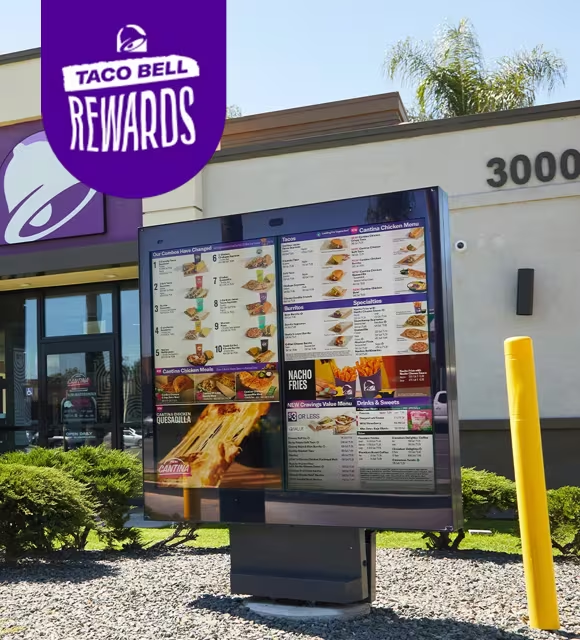
The headline move: Taco Bell tested AI driven, dynamically arranged drive thru digital menu boards. Per CFO Ranjith Roy, the boards can change layout and content on a car by car basis. The boards do not change pricing, per Taco Bell's clarification to Restaurant Dive. They change which items are surfaced, in what order, and with what visual hierarchy, based on what the AI infers from the customer in front of the board.
The second move: KFC has built what CEO Chris Turner called a "global innovation pantry," a structured system for porting successful LTOs and menu items between markets. The Pickle Mania LTO, originally launched in Canada, moved through the pantry to the UK, where it became KFC UK's most successful LTO ever.
The third move: KFC's Kwench beverage platform is rolling out across the UK, Australia, and Canada, with more markets queued. Taco Bell's Live Más Café and Saucy by KFC continue to operate as live R&D environments where new food and beverage concepts get tested before reaching the core brands.
These are three different stories on the surface. Underneath, they are one story.
What Yum actually said
The most important quote from the call came from CFO Ranjith Roy, explaining how the AI menu boards became possible.
"The seamless rollout of these new tech features has been made possible due to the physical and digital assets we have developed and deployed over the years, including the underlying integrated Byte technology and the physical investments in digital menu boards that we and our franchisees rolled out over several years."
Read that carefully. Roy is not crediting the AI for the breakthrough. He is crediting the menu infrastructure that made the AI possible. The integrated technology platform, Byte. The physical digital menu boards rolled out across thousands of stores over years. The structured menu data underneath both.
In other words, the AI is the easy part. The infrastructure that lets the AI actually do anything was the eight year project.
CEO Chris Turner made a parallel point about the KFC innovation pantry. The flavor exchange between markets is not a creative idea. It is an operational system. Pickle Mania becoming KFC UK's most successful LTO ever was not because the recipe was magical. It was because KFC could move a tested concept from one market to another with structure, speed, and the ability to localize without rebuilding from scratch.
This is what menu infrastructure looks like when it is mature. The chain stops asking "what should we put on the menu?" and starts asking "what does the menu already know how to do?"
The internal proof inside the same company
The most overlooked detail in the Yum earnings release is also the most compelling.
In Q1 2026, inside the same parent company, with the same supply chain, the same back office, and the same capital structure:
Taco Bell same store sales: up 8 percent The Habit Burger Grill: up 5 percent KFC US system sales: down 2 percent Pizza Hut: down 4 percent
That is not a small spread. That is the same parent company running four different brands at four different points on the digital infrastructure curve, posting four different outcomes in the same quarter.
Taco Bell is the brand investing hardest in dynamic menu boards, AI ordering, the Luxe Cravings value menu, and the Live Más Café R&D platform. Taco Bell is also the brand growing fastest. Pizza Hut is the brand whose parent company has publicly said it is "considering selling," which is closing 250 underperforming stores in the first half of 2026, and which has lagged on digital and menu modernization. Pizza Hut is also the brand declining fastest.
This is the cleanest internal proof point any restaurant operator could ask for. The variable controlling the outcome is not pizza versus tacos. It is the menu and innovation infrastructure underneath.
The pattern across the last seven days
Zoom out one week and the pattern becomes harder to dismiss as coincidence.
April 28, 2026: Domino's CEO Russell Weiner and CFO Sandeep Reddy used their Q1 earnings call to say their value strategy is engineered to make competitor unit economics fail. Domino's franchisees average over $1.3 million in AUV. Pizza Hut's mature franchised stores run under $1 million. Papa Johns runs roughly $1.1 million. The closing stores at both competitors run roughly $500,000. Domino's "Best Deal Ever" promotion is not a creative idea, it is a software product running across 6,000+ stores with same week mix data feedback.
April 29, 2026: Yum Brands discloses Taco Bell's per car AI menu boards, KFC's global innovation pantry, and the Kwench beverage platform.
April 23, 2026: Centurium Capital, the firm behind Luckin's 31,000 store app only model, acquires Blue Bottle from Nestlé for under $400 million. The signal: premium and value coffee are converging on the same answer, that the menu has to live in software.
April 15, 2026: Starbucks launches its ChatGPT ordering beta. Their SVP of Digital says, on the record, that customers are no longer starting with a menu, they are starting with a feeling.
Four of the largest restaurant companies in the world. Four major moves. One thesis. The menu is software. The chains that built the infrastructure are pulling ahead. The chains that did not are closing stores.
What this means for everyone else
Most restaurant operators reading this will never have a Byte platform, a global innovation pantry, or a per car AI menu board. Yum has been building those capabilities for years. So has Domino's. So has Luckin. So is Starbucks.
That is not the relevant comparison.
The relevant comparison is what those capabilities actually deliver, and which of those capabilities are now accessible to mid market operators without a Yum sized engineering team.
The per car AI menu board is the headline. It is also the least replicable piece. What is replicable is the principle underneath it: a menu that lives as structured data, that can be re merchandised in real time, that can surface different items to different customers in different contexts, and that can move successful items between channels and dayparts without rebuilding from scratch.
That capability is the infrastructure thesis. It is not exclusive to Yum, Domino's, or Luckin anymore. It used to require building the platform in house. It does not.
A restaurant operating with a printed menu in 2026 is not just a step behind Taco Bell's AI menu boards. It is a step behind every chain that has spent the last decade quietly building the infrastructure those AI menu boards now sit on top of. The compounding gap is real. The earnings calls of the last seven days have made that public.
The good news is that the same gap is now bridgeable from the other direction. A digital menu that treats every item as structured data, every price as adjustable, every channel as independently merchandisable, and every promotion as a software product, gets a mid market operator most of the way to where Yum's infrastructure investments have taken them. Not all the way. Most of the way.
That is the gap Menuthere closes. Not by trying to build a Byte platform. By giving operators access to the underlying capability the Byte platform was always about.
When Yum's CFO says the AI menu boards were made possible by years of digital infrastructure investment, he is also saying something else. He is saying that any operator who waits another year to start building their own version of that infrastructure is another year behind a curve that is steepening, not flattening.
The largest restaurant companies in the world spent this week saying it out loud. The window to act on it is open right now.
Sources: Restaurant Dive coverage of Yum Brands Q1 2026 earnings call (April 29, 2026), featuring quotes from CFO Ranjith Roy and CEO Chris Turner. Restaurant Dive coverage of Domino's Q1 2026 earnings call (April 28, 2026). Yum Brands Q1 2026 earnings release. Food Dive coverage of the Centurium Capital and Blue Bottle deal (April 23, 2026). Starbucks newsroom and Axios coverage of the ChatGPT ordering beta (April 15, 2026).