
The Discount Trap: Why You Are Paying to Discount Your Own Food
That "Flat ₹125 off" was not the platform's gift to your customer. You paid for it. Here is how the discount trap shrinks profit while volume grows.
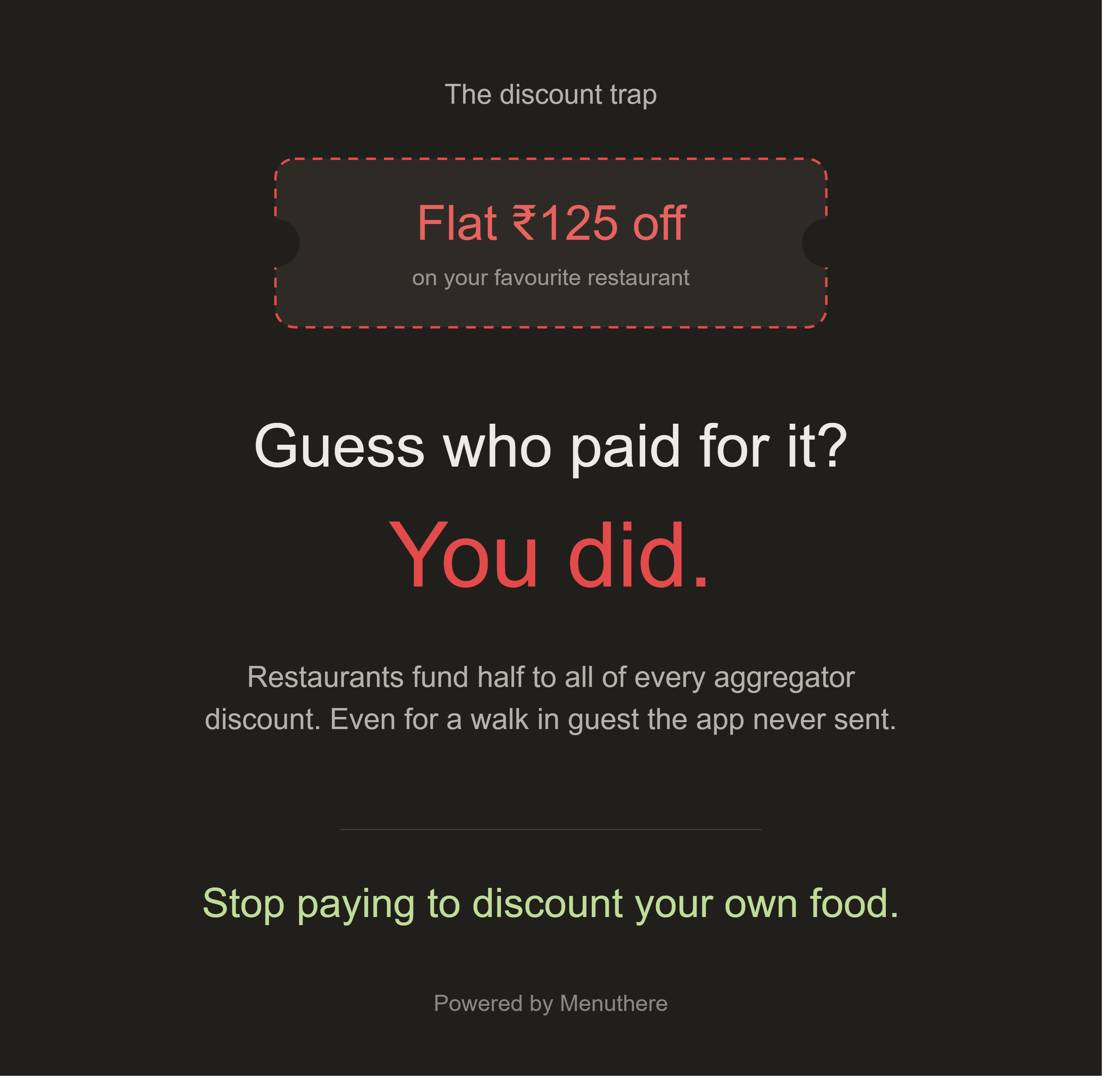
Open the app and there it is next to your restaurant's name. "Flat ₹125 off." It feels like a gift the platform is handing your customer to bring them to your door. It is not a gift, and the platform is not paying for it. You are.
This is the quiet engine behind a feeling every operator knows but few can explain. The orders go up. The kitchen is slammed. The monthly sales chart looks fantastic. And the money in the bank at the end of it all keeps shrinking. Welcome to the discount trap.
The trap has three jaws
The reason it is a trap and not just a cost is that all three jaws close at once, and each one makes the others harder to escape.
Jaw one: you fund the discount
The discount on your listing largely comes out of your margin, not the platform's. Industry reporting puts the restaurant's share of these promotions anywhere from half to the entire discount. On the dine in side it is even more explicit. The National Restaurant Association of India has warned its members that programs like Zomato Pay and Swiggy Diner require restaurants to compulsorily offer discounts in the range of 15 to 40 percent just to take part, and to pay a transaction commission of 4 to 12 percent on top, when a normal payment gateway would charge only 1 to 1.5 percent.
So the ₹125 your customer saved did not come from the platform's pocket. It came from yours, and you paid a commission for the privilege of giving it away.
Jaw two: you cannot simply opt out
The obvious response is to stop discounting. The trap is built to punish exactly that. Platform algorithms favour restaurants that run discounts and platform campaigns, so the listing that refuses to play quietly slides down the search results. Less visibility means fewer orders, which pressures you straight back into the discount to be seen again. You are not choosing to discount. You are being ranked into it.
Jaw three: it trains your customers to wait for the coupon
This is the most expensive jaw, and the slowest to show up in the numbers. Every funded discount teaches the customer that your food is worth ordering only when it is cheaper. Over months, a base of full price regulars turns into a base of coupon hunters who will not order without an offer. The restaurant body has called this discount addiction, and even run a campaign to detox customers from it. Once your demand depends on the next promotion, you have lost the one thing a good restaurant should own, which is the ability to charge what your food is worth.
Why volume grows while profit shrinks
Put the three jaws together and the maths becomes clear. Discounts lift order count, because a cheaper plate sells more. Order count is the number everyone watches, so it feels like success. But each of those orders carries the funded discount plus the commission plus the fees, and the combination can pull the net margin on an aggregator order below ten percent. You are running harder, cooking more, and keeping less of each rupee.
Order volume is a vanity metric. Profit per order is the real one. The discount trap is the gap between the two, and the wider you let it grow, the busier and poorer you become.
The line that should bother every owner
Strip away the jargon and the restaurant association put the whole thing in one question. Why should a restaurant pay a commission to a middleman to give a discount to its own customer? When even a guest who walked in off the street, who the platform did nothing to send you, can claim the discount you funded, the arrangement stops looking like marketing and starts looking like a tax on your own loyalty.
That is the heart of the frame. You are not buying new customers with these discounts. A large share of the time, you are paying to discount food to people who were already yours.
How to climb out
The goal is not zero discounting. A smart offer can genuinely win a new guest. The goal is to take back control of who you discount, when, and on whose terms.
1. Separate acquisition from loyalty
A discount is only an investment when it brings someone genuinely new. Reserve aggressive offers for first time guests, and stop discounting the regular who would have paid full price anyway. The platform cannot tell the difference. You can.
2. Run your own offers on a channel you control
When the offer lives on a channel you own, you decide the rules. A WhatsApp ordering channel lets you send a welcome offer to a new guest and full price reorders to your regulars, with no algorithm forcing a blanket discount on everyone. Menuthere turns your QR menu into exactly this kind of WhatsApp channel, so your promotions are a choice you make, not a fee you pay.
3. Reward the reorder, not the first click
Loyalty is cheaper to keep than discovery is to buy. Instead of a permanent percentage off, give your repeat customers something that costs you little and feels generous, a free sulaimani or a small sweet on their third order. It builds the habit without training them to wait for a coupon.
4. Give value, not just a lower number
A "Flat ₹125 off" trains price sensitivity. A combo, a family pack, or a free add on raises the average order while still feeling like a deal. Value framing protects your pricing power in a way that a raw discount never does.
5. Measure profit per order, not order count
Change the number on your dashboard. The day you start judging channels by what lands in the bank per order rather than how many orders came in, the discount trap becomes visible, and most of your discounting decisions reverse themselves.
The bottom line
The "Flat ₹125 off" was never free, and it was rarely buying you a new customer. It was your own margin, handed to your own guests, with a commission charged on the way out, while the algorithm made sure you could not easily stop.
Discounting will always have a place in winning someone new. But a restaurant that discounts because it chooses to, on a channel it owns, to customers it picks, is in a completely different business from one that discounts because the platform ranks it into the floor. The first is marketing. The second is the trap. The way out begins the moment you stop paying to discount your own food.
Own your offers. Menuthere turns your QR menu into a WhatsApp ordering channel where you decide who gets a deal and who reorders at full price, with the margin staying yours.
See how it works →
Sources: National Restaurant Association of India advisories on Zomato Pay and Swiggy Diner discount programs, reporting on the NRAI deep discounting and discount addiction campaigns, Competition Commission of India scrutiny of platform discounting, and industry reporting on restaurant funded promotions and margins.