Scan and Order at the Table: The Two Worst Waits in Your Dining Room, Gone
Two moments quietly ruin good meals, and both are pure waiting. Here is how scan to order and pay by UPI removes them, and turns dine-in into a channel you own.
Two moments quietly ruin good meals, and both are pure waiting. Here is how scan to order and pay by UPI removes them, and turns dine-in into a channel you own.
Previous article
The office lunch already gets decided in a WhatsApp group. So why does someone have to leave the chat to order it? The group order is the most under-served order in the business.
Next article
That lunch line looks like demand. Half of it is lost revenue. Here is how order ahead on WhatsApp turns the queue into ready bags, and recovers the customers who walk away.
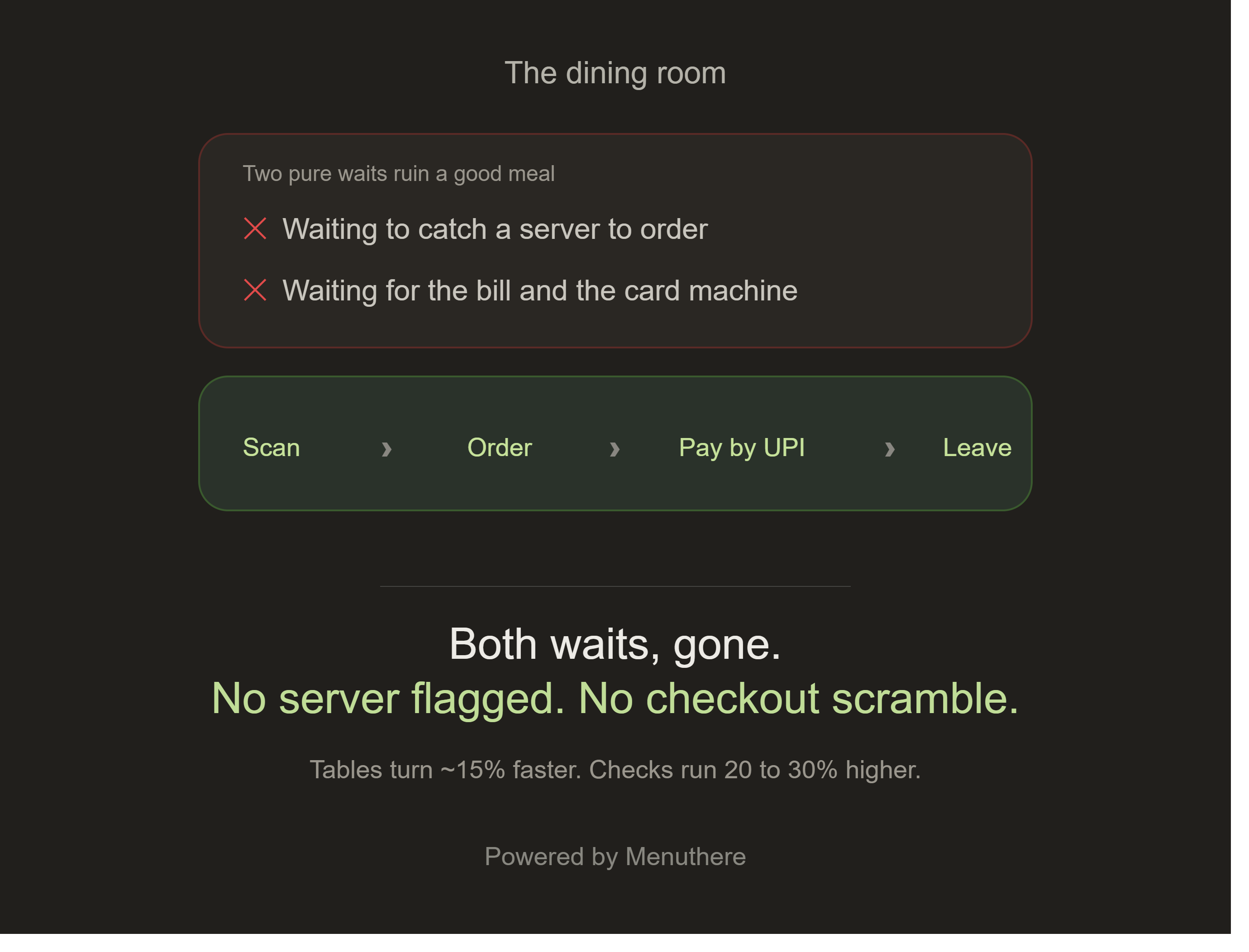
Two moments quietly spoil otherwise good meals, and neither has anything to do with the food. The first is the wait to order: you are ready, you have decided, and you spend the next few minutes trying to catch a busy server's eye. The second is worse, the wait to pay, the checkout scramble at the end where you wave for the bill, wait for it to be printed, wait for the card machine, and sit through the awkward pause while it processes.
Both are pure waiting. Both happen at the start and end of the experience, the two moments a guest remembers most. And both can disappear completely. The QR code already on the table can let a guest order the moment they are ready and pay the moment they are done, without flagging anyone down. That is scan and order at the table, and it is the part of your business that lives in the dining room, not the delivery bag.
Picture a full Friday dinner service. A table has decided what they want, but every server is carrying plates and taking orders elsewhere. Three minutes pass, then five. The guests are ready to spend money and the restaurant cannot take it fast enough. That gap is lost time and a small dent in the experience, repeated at table after table all night.
Scan to order closes it. The guest scans the code on the table, sees the full menu on their own phone, browses at their own pace, and sends the order straight to the kitchen when ready. No waiting to be noticed, no relaying, no handwriting to misread. Two thirds of guests already say they prefer a digital ordering option when it is offered, and once a restaurant turns it on, adoption is fast and nearly universal. The order arrives complete, with the guest's own modifications, so there are fewer mistakes too.
The end of the meal is where the most time leaks. The guest is finished and wants to leave, and now begins the longest unnecessary wait of the visit: catch the server, ask for the bill, wait for it, hand over a card or cash, wait again. It is the single most frustrating stretch of a good meal, and it pins the table down long after the food is done.
Scan to pay erases it. The guest pulls up the bill on their phone, pays by UPI in a tap, adds a tip if they like, and leaves when they are ready. One pay at table platform measured this as roughly twelve minutes saved per table. Twelve minutes, multiplied across every table, every night, is real capacity you already have and were simply losing to the checkout scramble.
This is not just a nicer experience, it shows up directly in the numbers. Faster ordering and faster payment turn tables quicker, and restaurants using QR payment report around a 15 percent lift in table turnover, which means more covers from the same room on a busy night without adding a single seat.
The check grows too. When guests browse a visual menu at their own pace, with photos and gentle add on prompts and no server hovering, they order more. Restaurants running full scan to order and pay report ticket sizes 20 to 30 percent higher than traditional ordering. And because the bill is settled on the phone, a quick review prompt right after payment turns satisfied diners into Google reviews, the reputation that brings the next guest in.
The fear with table ordering is that it makes service cold and robotic. The truth is the opposite, if you use it right. Taking down orders and running card machines is the robotic part of a server's job. Scan to order and pay takes those repetitive tasks off their plate and hands back the time for the human parts: a warm welcome, a real recommendation, a refilled glass, a check in at the right moment, a genuine goodbye.
Your staff stop being order takers and bill runners and become hosts again. Service does not get thinner, it gets warmer, because the people delivering it are finally free to focus on hospitality instead of admin. The screen handles the transaction so the human can handle the experience.
Here is the part that connects the dining room to everything else. Dine in has always been your most anonymous channel. A guest walks in, eats a wonderful meal, pays in cash or on a card, and walks out a complete stranger. You served them perfectly and learned nothing, with no way to bring them back except hoping they remember you.
When the order and the payment run through a channel you own, that changes. The walk in diner can become a saved contact, with their consent, the same way a delivery customer does. Your busiest channel, the one that was pure anonymity, starts building the same owned relationship every other order does, ready for a reorder, a comeback, and that review ask after a great meal. The dining room stops being a black box and starts feeding the list that is yours to keep.
Not every guest wants to order from a screen, and you should not force them to. Some diners, especially older guests and special occasion tables, want a menu in hand and a server to talk to, and a fine dining room may treat the printed menu as part of the theatre. The smart approach is to offer scan to order as the fast, frictionless default while keeping a paper menu and full table service for anyone who prefers it. The goal is to remove waiting for the people who hate it, not to take away choice from the people who do not.
Table mounted codes drive the large majority of scans, far more than codes on a poster or a receipt. Make it visible, well lit, and easy to scan from a seated position.
A menu they can only read still leaves both waits in place. The value comes from letting the guest order to the kitchen and settle the bill from the same scan.
Photos, clear sections, a pinned special, and a simple add on prompt do the upselling a rushed server cannot. This is where the bigger check comes from.
Settle the bill on the phone with UPI so the end of the meal is a tap, not a scramble. This is where the twelve minutes per table come back.
Brief your team that the screen takes the order so they can take care of the guest. Redeploy them to welcomes, recommendations, and check ins.
Invite the guest to save their details with consent, and prompt for a Google review right after payment, while the meal is still fresh.
Offer paper and full service to anyone who wants it. Scan to order should be the fast lane, not the only lane.
The two worst moments in your dining room are both just waiting, to order and to pay, and both sit at the start and end of the meal where guests remember them most. Removing them turns tables faster, lifts the check, frees your staff to actually host, and, for the first time, lets your dine in guests become customers you can reach again.
Your delivery story already lives on WhatsApp. This is the same idea, brought into the room. The code is already on the table. Let your guests scan, order, and pay, and let your servers get back to hospitality.
Bring it into the dining room. Menuthere turns your QR menu into a scan to order and pay channel, so dine in guests order and pay without waiting, and even the walk in becomes a customer you keep.
Sources: 2026 QR ordering and pay at table data from Square, MenuTiger, Supercode, Sunday and QR industry ROI reports on table turnover, average ticket size, and review generation, and National Restaurant Association data on digital ordering preference.
QR menus
The fastest way to serve faster is not hiring another server. It is removing the wait that happens before the order is even placed.
Menu strategy
Your demand has two peaks because of what you chose to sell. The split shift is downstream of menu design, and India's new labour codes just raised the price of it.