The 10km Radius: How to Turn Instagram Ads Into WhatsApp Customers You Keep
Your next 100 customers are within a few km of your door. Here is how geo-targeted Instagram ads routed into WhatsApp turn paid reach into customers you own.
Your next 100 customers are within a few km of your door. Here is how geo-targeted Instagram ads routed into WhatsApp turn paid reach into customers you own.
Previous article
In India, paying is the easy part. With UPI behind almost every digital payment, chat ordering plus a UPI link removes the last friction in direct restaurant ordering.
Next article
Your Swiggy rating lives in their app. Your Google rating decides whether anyone finds you at all. Here is how a WhatsApp relationship builds the reviews you own.
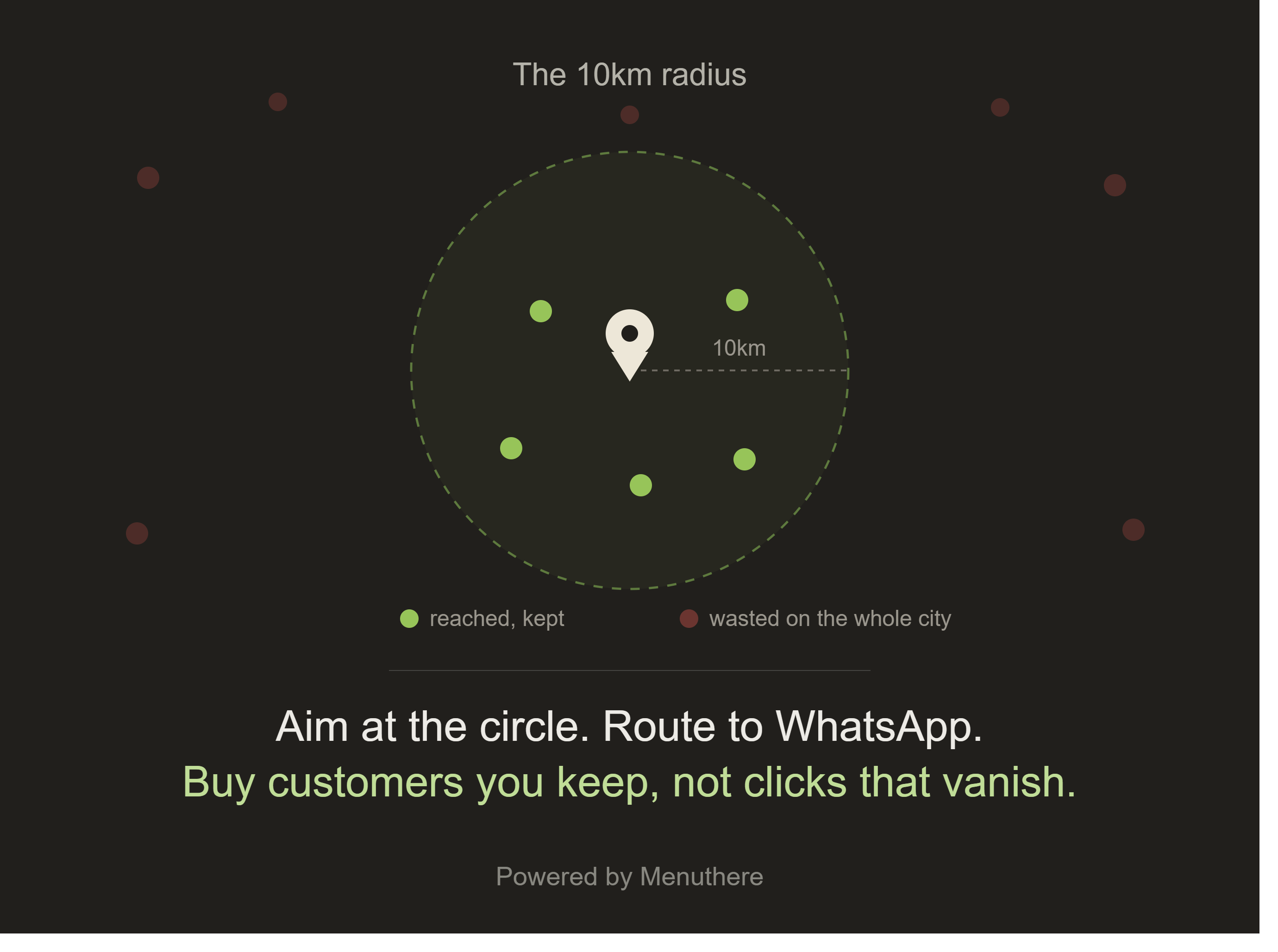
Almost every customer your restaurant will ever serve lives within a short drive of your door. A restaurant is one of the most local businesses there is. Yet most restaurant ad money is spent in one of two wasteful ways: sprayed across a whole city to people who will never travel to you, or sent to a profile or website where the click quietly dies and you learn nothing about who tapped.
There is a tighter, cheaper play, and it has two simple moves. Aim every rupee at the small circle of people who can actually become customers, and send every tap into a WhatsApp conversation instead of a dead end. Done together, your ad spend stops buying anonymous clicks and starts buying customers you keep.
Meta lets you drop a pin on your restaurant and target only the people around it. Use it. Most of your real customers, for delivery and for dine in, sit inside a tight catchment, often well under ten kilometres. Targeting the whole city, or worse, leaving the audience wide open, means paying to show your biryani to people who would need an hour in traffic to reach you.
A tight radius does two things at once. It cuts the wasted spend on people who can never order, and it raises the relevance of every impression, because everyone who sees the ad is genuinely close enough to act on it. The same budget, aimed at the right circle, simply works harder.
This is where most restaurant ads leak. The standard ad sends a tap to a website or a profile. The person leaves the app they were enjoying, waits for a page to load, faces a menu or a form, and a large share of them bounce before doing anything. You paid for the click and got nothing you can use.
A click to WhatsApp ad changes the destination. The call to action opens a WhatsApp conversation with your restaurant instead of a landing page. There is no page to load, no form to fill, no app to install. The person taps and is suddenly in a chat with you, in the messaging app they already live in.
The performance gap is not small. A Forrester study commissioned by Meta found click to WhatsApp ads delivered a 94 percent lift in conversion and a 92 percent drop in cost per lead compared with sending people to a landing page. In India, where WhatsApp is the default, the cost to start a conversation typically runs from around ₹20 to ₹120, and the leads are warm, because the person chose to open a chat rather than abandoning a form. This is the fastest growing paid channel in the country for exactly this reason.
Here is the part that ties this play to everything else a smart restaurant should be doing. When someone taps your ad and opens that chat, two valuable things happen at once. The tap itself counts as consent to start the conversation, and you capture their number. Meta even waives the WhatsApp messaging fee for the first 72 hours after the click, so you have a free window to greet them, send the menu, answer a question, and close the order.
One important detail: that 72-hour window is for the conversation the ad started. To keep messaging them with offers after it closes, you need an explicit opt in. So wire a simple "yes, send me offers" reply into your welcome flow and log it. Get that right and a single ad click becomes a customer on your owned list, not a one time visitor.
A geo-targeted ad that routes to WhatsApp does not just produce orders. It produces an audience. The people who messaged but did not order are now a warm list you can come back to, and your best customers can seed a lookalike audience so Meta finds more people like them inside your radius.
Smart retargeting does not repeat the same ad. It answers the next question. The first ad shows the craving, the second shows proof, a packed table or a five star review, the third handles the hesitation with a first order offer. Keep the windows practical: a tight window for the hottest intent, a wider one for the warm audience, a broad reminder for the rest. Each layer is cheaper than the last, because you are talking to people who already raised their hand.
Step back and compare. When you pay an aggregator for priority placement, you rent visibility that vanishes the moment you stop paying, and the customer who finds you that way still belongs to the platform. When you boost a post to a website, you buy a click that disappears.
The 10km radius play is different in kind. Every rupee aimed at your catchment and routed into WhatsApp does not just buy tonight's order. It buys a contact who joins your owned audience, ready for a reorder next week and a comeback next month. The aggregator ad is an expense that resets to zero. This is spend that builds an asset. Over a year, that difference is the difference between renting customers and owning them.
Target the real circle around your restaurant, not the city. Start with your delivery zone and the surrounding neighbourhoods, and let relevance, not reach, be the goal.
Set the destination to a WhatsApp conversation, not a website or profile. The whole point is to land the person in a chat with you, friction free.
Use vertical video, keep it under fifteen seconds, and open on the food in the first three seconds. Reels and Stories outperform static images on mobile, which is where your customers are.
Wire a quick "yes, send me offers" into the welcome message and log it. That single opt in turns a temporary ad conversation into a permanent owned contact.
The first few minutes matter. A quick, friendly reply, or an automated one, keeps the warm lead warm and turns the conversation into an order.
Bring back the people who messaged but did not buy, and use your best customers to find more like them inside your radius. Change the angle each time.
Track conversations started and cost per conversation, not impressions and likes. Those vanity numbers feel good and tell you nothing about customers gained.
Your customers are local, so your advertising should be too. A tight radius removes the waste, and a WhatsApp destination removes the leak. Together they turn a restaurant's ad budget from a stream of anonymous clicks into a steady flow of saved contacts who order, reorder, and bring their friends.
The aggregators will rent you visibility by the month. This is how you buy your own, in your own neighbourhood, and keep every customer it brings. Aim small, route to WhatsApp, and own what you pay for.
Buy customers, not clicks. Menuthere turns your QR menu into a WhatsApp ordering channel, so every ad you run lands in a chat and every tap becomes a customer you keep.
Sources: Forrester Consulting study commissioned by Meta on click to WhatsApp ad performance, 2026 India CTWA cost and best practice guides, and Meta documentation on the 72-hour messaging window and conversation consent.
WhatsApp ordering
Most operators know this number. It gets quoted in every WhatsApp group in the industry. What gets discussed far less is the second cost, the one that never appears on the invoice.
WhatsApp ordering
You built a structured ordering flow. The customer thinks they are talking to a restaurant. They are not wrong, because it is a chat. Here is how to design for that.