The Front Desk That Never Closes: An Always-On WhatsApp Assistant for Your Restaurant
Every "are you open?", "do you deliver?", "what's the special?" is a customer deciding right now. He
Every "are you open?", "do you deliver?", "what's the special?" is a customer deciding right now. He
Previous article
Something will go wrong with an order. The only question is where the customer takes it: a permanent one star review, or a chat you can fix in minutes. Here is why the channel decides.
Next article
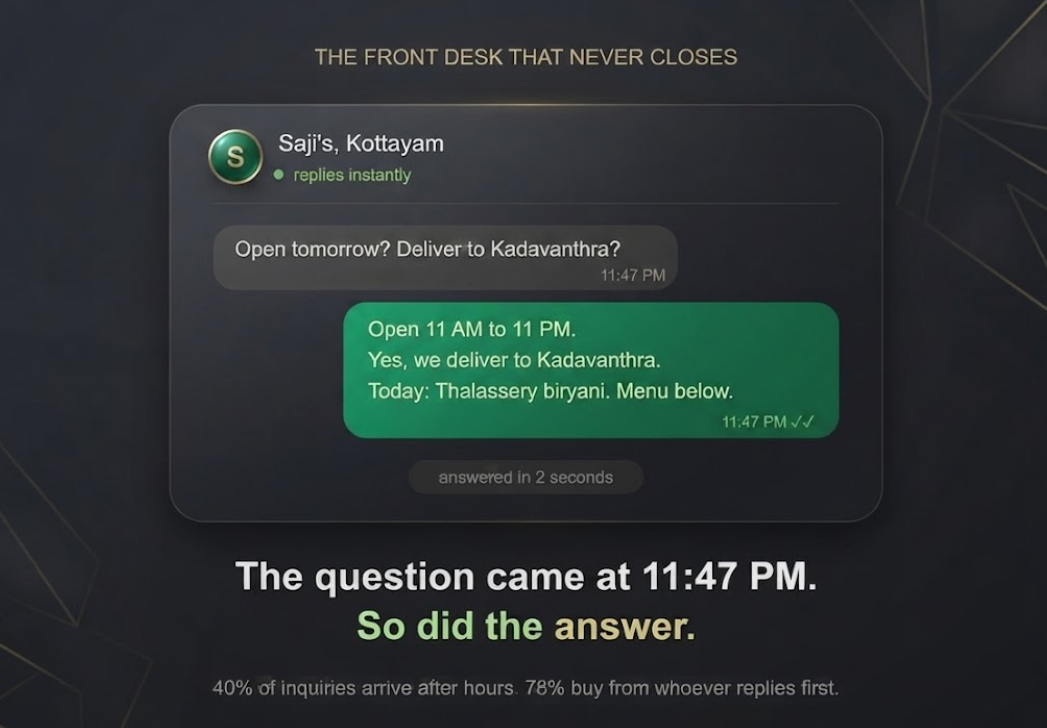
Every day, and every night, your restaurant is asked the same handful of questions. Are you open? Do you deliver to my area? What are your timings? What is today's special? Can I get a table for six tonight? Each one looks trivial, the kind of thing anyone could answer in a sentence. And each one is a customer deciding, in that exact moment, whether to give you their money or give it to someone else.
The trouble is that a startling number of those questions never get an answer, because they arrive when the kitchen is slammed and no one can reach the phone, or long after you have closed for the night. The question had a shelf life of a few minutes. The reply, if it comes at all, comes hours later, to a customer who has already eaten. An always-on WhatsApp assistant fixes exactly this: it answers every routine question in seconds, at any hour, so no query is ever missed and no warm customer ever goes cold.
These are not idle queries. Someone asking whether you deliver to their area is, quite literally, trying to give you an order. That is intent, and the data on how fast intent decays is brutal. Respond to an inquiry within five minutes and you are around 21 times more likely to qualify it than if you wait thirty. Roughly 78 percent of customers buy from the first business that responds. Being first is not a nicety, it is most of the game.
Now set that against reality. The median first response to an inbound WhatsApp message for an Indian small business is about four hours. Four hours, on a question whose shelf life was minutes. By the time someone taps out "yes, we deliver," the customer has long since ordered from whoever replied first, and your late answer arrives to an empty room. The leads are already coming. They are simply not waiting anywhere near as long as most restaurants assume.
Here is the part that quietly costs the most. More than 40 percent of high-intent inquiries arrive in the evenings and on weekends. For a restaurant that is a double bind: the evening is both your busiest service, when nobody is free to answer, and, after you close, your most silent stretch, when nobody is there at all. Nearly half your inquiries land in exactly the windows a human cannot reply.
Picture the customer deciding at eleven at night where to order lunch for the office tomorrow, or checking your timings before leaving home on a Sunday. They message, they hear nothing, and they move on to the restaurant whose page answered. That is not a lost message. It is a lost order, and then often a lost regular, decided entirely by silence. You cannot put a person on the phone at 2am. But the question still gets asked at 2am, and right now it goes unanswered.
The fix is to put a tireless front desk on your WhatsApp. The moment anyone messages, the routine questions are answered in seconds, whatever the hour: yes, we are open until eleven, yes, we deliver to your area, here is today's special, here is the menu to order right now. There is no waiting for a free pair of hands during the rush, and no waiting until morning after close. The answer arrives while the intent is still hot, and the customer's number is saved in the process.
This is your missed call goldmine, generalised. You already understand that a missed phone call is a lost customer. This is the same truth extended to every channel and every hour: not only the call you could not pick up, but the message at midnight, the "do you deliver?" in the middle of the dinner rush, the "what is the special today?" on a quiet Sunday afternoon. The assistant makes sure not one of them goes cold. It is the front desk that never closes.
Look closely at those questions and a pattern jumps out: it is the same five, over and over. Hours, delivery area, today's special, do you have a table, where are you. A machine answers those perfectly and consistently every single time, with the correct hours, the real delivery zone, and today's actual special, and it never gets tired of being asked. Automation of this kind can handle the large majority of these routine chats end to end, without a human touching them.
That is not about removing people. It is about freeing them. When the assistant is the human FAQ, your staff stop being interrupted mid service to recite your timings for the fortieth time, and get back to cooking, serving, and handling the conversations that genuinely need a person: a complaint, a large catering inquiry, an unusual request. The assistant is the front desk that greets everyone and answers the routine. Your people are the hosts who handle what matters. The best setups use the machine for the instant first response and route the real conversations to a human.
Step back and look at it as the owner. This is a full front desk, staffed every minute of every day, at almost no marginal cost. It captures the 40 percent of inquiries that arrive after hours, which today simply vanish. It makes you the first to respond, and the first to respond wins around three quarters of the time. And it turns every answered question into a saved contact that joins the audience you own, ready to be reached again.
You could never afford to pay a person to sit by the phone at 2am on the off chance someone asks about tomorrow's lunch. You do not have to. The assistant gives you a presence, round the clock and instant, that would be impossible to buy in staff, for the price of a system. In a business where being first wins the order, always on is not a luxury. It is the cheapest competitive edge available.
This only works if the assistant is trustworthy, and here is where it must be built with care. A confident wrong answer is worse than no answer at all. An assistant that promises delivery to a zone you do not serve, quotes last week's timings, invents a special that is not on today, or, worst of all, guesses about an ingredient or an allergen, does real damage, to the customer and to your name.
So the rule is simple. The assistant should answer only from your real, current information, your actual hours, your real menu, your true delivery area, and it should hand off to a person the instant it is unsure or the question is sensitive. It should never guess about allergens, dietary safety, or a delivery promise it cannot keep. And it must always offer an easy way to reach a human, because nothing enrages a customer faster than being trapped in a bot that cannot help them. Ground it in the truth, keep its scope tight, and let it escalate freely. The goal is fast and correct, or a fast handoff to someone who is. Never fast and wrong.
Cover the real high frequency questions, open or closed, delivery area, timings, today's special, the menu link, answered in seconds at any hour.
Wire the assistant to your actual hours, menu, and delivery zone. It should never improvise facts about your restaurant.
Stale answers are lies by another name. Make it trivial to update today's special and any change in hours so the assistant is never out of date.
Route complaints, catering, and unusual requests to a person, and make that human easy to reach. The assistant handles routine, not everything.
On anything about ingredients, dietary safety, or whether you can actually deliver somewhere, the assistant should defer to a human, not improvise.
Do not just answer and stop. Follow the answer with the menu and a way to order now, while the intent is hot, and save the number.
Remember what this really is: being first to respond, every time, at every hour. That is the difference between winning the order and never knowing it existed.
Your restaurant is asked the same simple questions all day and all night, and each one is a customer with money in hand deciding whether you are the answer. Right now, too many of them meet silence, at peak when no one is free and after hours when no one is there, and silence sends them elsewhere. An always-on assistant turns that silence into an instant, correct, friendly answer, at two in the afternoon and two in the morning alike.
Build it to tell the truth and to hand off gracefully, and it becomes the front desk you could never staff: always awake, always first, never missing a single question. In a business where the first to answer wins, that is as close to an unfair advantage as a restaurant can get.
Never miss a question. Menuthere turns your QR menu into a WhatsApp channel with an always-on assistant that answers the routine instantly, hands the real conversations to your team, and turns every question into an order and a saved customer. S
Sources: 2026 speed to lead research from Harvard Business Review, MIT and InsideSales via Casey, DigitalApplied and Apten on five minute response conversion and first responder advantage, Kraya AI data on median WhatsApp response times for Indian SMBs, and Blazeo 2026 benchmarks on the share of high-intent inquiries arriving after hours.
Every restaurant chasing a lower commission rate is solving the wrong problem.
WhatsApp ordering
Most operators know this number. It gets quoted in every WhatsApp group in the industry. What gets discussed far less is the second cost, the one that never appears on the invoice.
Restaurant technology
Dine in has a menu and a server. Delivery has a dashboard and analytics. Takeaway has a person standing at a counter being served by whoever is nearest.