The Order Was Never the Product. The Customer Was.
Every restaurant chasing a lower commission rate is solving the wrong problem.
By the Menuthere editorial team ·
Every restaurant chasing a lower commission rate is solving the wrong problem.
By the Menuthere editorial team ·
Previous article
Every "are you open?", "do you deliver?", "what's the special?" is a customer deciding right now. He
Next article
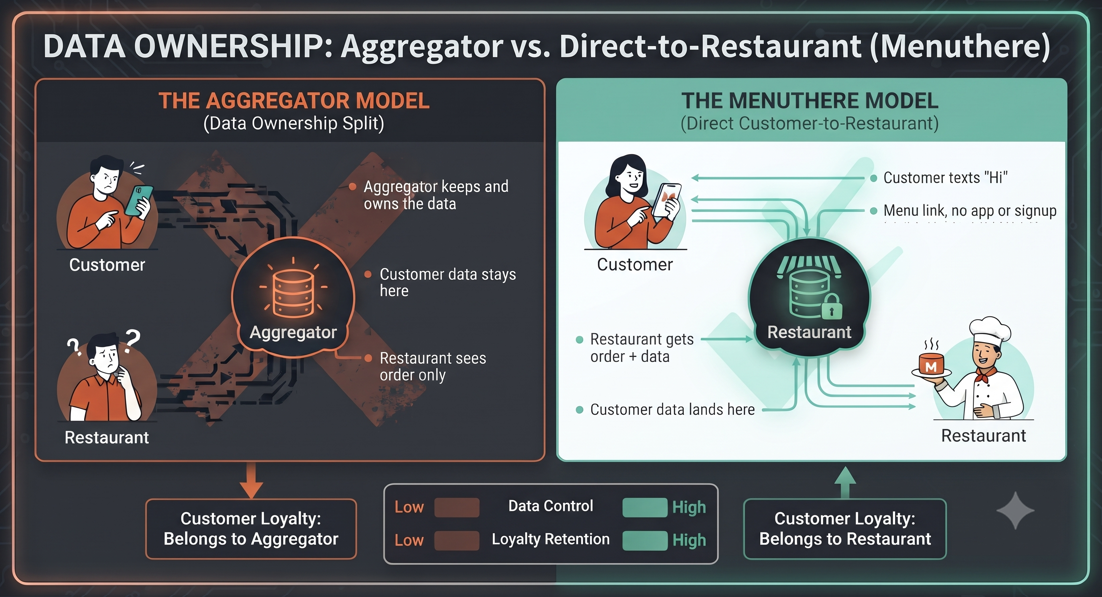
We keep having the same conversation with restaurant owners. It starts with commission. It always starts with commission. Twenty percent here, thirty three percent there, a promotional placement fee nobody remembers agreeing to. And every time, after ten minutes of commission math, we ask one question that changes the conversation entirely: do you have this customer's phone number?
Almost nobody does. Not because they do not want it. Because the system was built so they never would.
An aggregator order looks, from the restaurant's side, like an order ID, a list of items, and a payout. The customer's name, phone number, delivery address, and order history all stay with the platform. The restaurant fulfilled the meal. The platform kept the relationship.
This is not a side effect of how food delivery apps happen to work. It is the entire business model. A platform that let restaurants freely export and contact their own customers would be handing away the one asset that makes it valuable to advertisers, delivery partners, and its own growth targets. The commission is the fee for using the road. The customer data is the toll booth's real business.
Branded restaurant apps were pitched as the answer. In practice, for most independent restaurants, they became a second dependency instead of an exit from the first. An app that a customer downloads once and opens twice is not a channel. It is a line item in the App Store analytics dashboard. The data sits there, technically owned, functionally unreachable, because nobody is opening the app to generate it.
Three things are true at once, and none of them are new observations, but almost nobody connects them.
Restaurants historically had no infrastructure to capture customers directly, so free onboarding from an aggregator was the rational choice, not a mistake. Downloading a new app is real friction, and food ordering is exactly the kind of low commitment, high frequency decision where friction wins. And most operators conflated "having more channels" with "owning more of the relationship," when in practice a website, an app, and an aggregator listing that all dead end at the same third party for repeat visits is one dependency, not three.
Most operators, when they decide to fight back against commission, do the obvious thing. They launch a branded app, spend money getting people to download it, and watch the install-to-second-order rate quietly disappoint everyone in the room. Then they conclude that direct ordering "does not work for us," when what actually failed was the assumption that a new destination beats an existing habit.
What the data suggests instead: meet the customer in the channel they already open dozens of times a day. In India, that channel is unambiguous. Over 500 million people use WhatsApp, and 91 percent of online adults chat with a business on it weekly, according to a Kantar study Meta cited in its May 2026 announcement on business messaging. That is not an emerging behavior operators need to seed. It is the dominant one already.
The operators quietly pulling ahead are not the ones with the best app. They are the ones whose ordering flow requires the customer to do almost nothing new, and whose orders land with a phone number attached, in a system the restaurant actually controls.
Every industry that has gone through a platform-intermediation phase eventually splits into two kinds of operators: the ones who treat the intermediary as permanent infrastructure, and the ones who treat it as one channel among several and quietly build direct capability on the side. Hotels went through this with OTAs. Retail went through it with marketplaces. Restaurants are going through it now with delivery aggregators, and the winners will not be the ones who leave the aggregator entirely. Aggregators still bring discovery that direct channels cannot replicate on their own.
The winners will be the ones who stop confusing "processing an order" with "owning a customer," and who build the second capability deliberately instead of assuming an app store listing counts. The question worth asking is not which platform takes the smallest cut. It is: after this transaction closes, who can reach this customer again without paying for the privilege? For most restaurants right now, the honest answer is nobody. That is the gap actually worth closing.
Menuthere is a digital ordering platform for restaurants, including WhatsApp ordering that routes orders directly into a restaurant's own dashboard and POS. If you are thinking about who actually owns your customer relationships, we would love to hear what you are working on.
A 37 year old tier 2 restaurant doing 100+ call orders a day proved that demand channels and ordering channels are two different decisions. Here is the playbook.
Aggregators
Aggregator money arrives in 7 to 14 days, minus a third, in a lump you cannot reconcile. The vegetable vendor wanted cash on Monday morning.
Aggregators
A biryani and a wedding cake take the same four kilometre ride. One gives up Rs 75 in commission, the other Rs 625. Here is why bakeries pay most.