Who Owns Your Customer? The Question That Decides Whether You Have a Brand
On the apps, the platform owns your customer, not you. Here is why the customer relationship is the spine of your brand, and how to own it through WhatsApp.
On the apps, the platform owns your customer, not you. Here is why the customer relationship is the spine of your brand, and how to own it through WhatsApp.
Previous article
On the apps your top spot is rented, not earned, and your customer was never yours. Here is the rented visibility trap, and how to own your audience instead.
Next article
You can rebuild almost anything in a restaurant. Lose a chef and you hire another. Lose your lease and you find a new corner. Lose a supplier and you call the next one by lunch. There is only one thing that, if you lose access to it, leaves you with nothing to rebuild from. Your customers.
So here is the uncomfortable question every operator should sit with. Who actually owns yours? Not who eats your food. Who holds the relationship, the name, the number, the ability to reach the person again next week. Because on the apps, the honest answer is: not you.
For most of the last decade, the platforms masked customer data. The name, the phone number, the order history, the location, all of it hidden from the restaurant that actually cooked the meal. You could serve the same person their Friday biryani fifty times and never learn their name, never reach them, never know they were a regular at all.
That information did not disappear. It sat on the platform's side, and the platform put it to work. It used your customers' data to power recommendations, to personalise pricing, to build subscription programs around their loyalty, and in some cases to inform the cloud kitchens and private brands that compete with you for the very same orders. You generated the relationship through your food and your service. Someone else booked it as an asset.
The restaurant industry took this all the way to the Competition Commission of India, arguing that masking customer data was anti competitive, precisely because a business that cannot see or reach its own customers cannot build anything durable. That fight was not about a technicality. It was about who owns the foundation of the business.
Strip a brand down to its bones and what is left is simple: a group of people who choose you, and a way to reach them. Everything you think of as marketing depends on that second part. A new dish you want to push, a slow Tuesday you want to fill, a lapsed regular you want back, a second outlet you want to announce, none of it is possible if you have no way to contact the people who already like you.
A restaurant that cannot reach its own customers does not really have a brand. It has a listing on someone else's shelf. The platform decides who sees it, the platform owns the relationship behind every order, and the moment the platform changes its rules or its ranking, the restaurant has no independent line to the people who kept it alive. That is not a brand. That is a tenant.
Think about it the way you would think about your balance sheet. Money spent on aggregator visibility is an expense that resets to zero the day you stop spending. A list of customers who have ordered from you, with their numbers and their order history and their consent to hear from you, is the opposite. It is an asset that gets more valuable every time someone reorders, and it stays with you whether or not you advertise this month.
Most restaurants pour money into the expense and own almost none of the asset. They are running asset light on the one thing that actually compounds. A chain with ten thousand reachable, opted in customers is worth more than an identical chain with none, because its demand is owned, not rented, and owned demand is what every investor, lender and acquirer actually pays for.
There is real movement. Under pressure from the restaurant association, a long running competition case, and new entrants that share data freely, Zomato has begun letting customers consent to share their contact details with restaurants, and Swiggy is expected to follow. The open network hands restaurants full customer data by design, and the newest delivery challengers are built around restaurant ownership from day one.
This is progress, and it tells you which way the wind is blowing. But read the shape of it. The data sharing is consent based, partial, and controlled inside the platform's own app, on the platform's timeline. It is the landlord offering, occasionally, to share a page of the tenant list. The lesson is not to wait for permission to own your customers. It is to start building a relationship that was always yours to begin with.
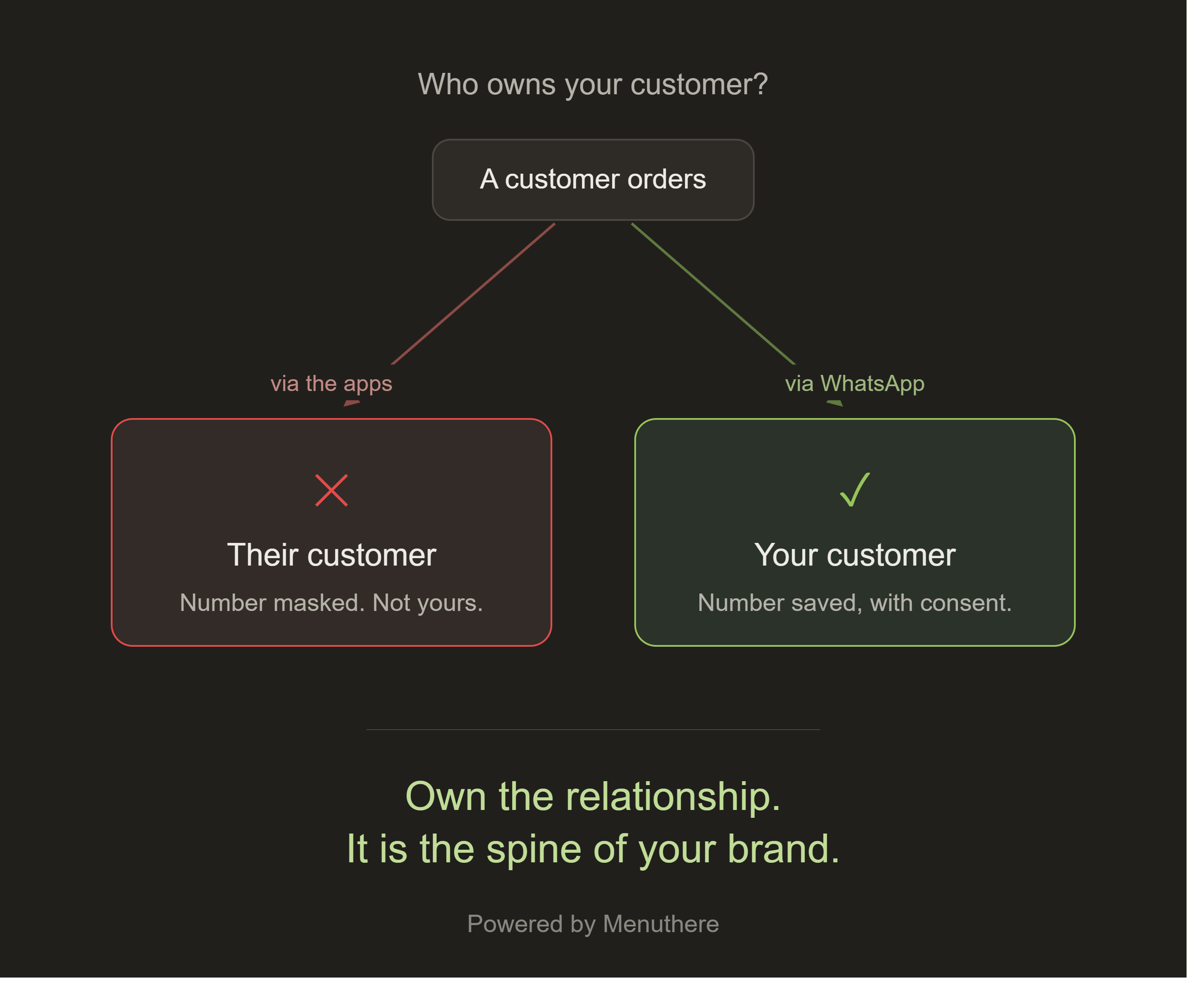
This is where the answer gets practical. When a guest orders through a channel you own, you get the one thing the aggregator never gave you: a direct line. A WhatsApp ordering setup means the customer's number, with their consent, lands with you the first time they order, and every order after that adds to a list that belongs to you.
That list is the spine. It powers the reorder, the win back, the new launch, the slow night promotion, all on a channel no algorithm can switch off. Menuthere turns your QR menu into exactly this kind of WhatsApp channel, so every order quietly builds the one asset that makes you a brand instead of a listing.
The shift starts as a decision. Stop treating order count as the goal and start treating reachable customers as the asset you are building. Once you believe that, every other choice gets easier.
The phone number is the foundation. Ask permission to send order updates and offers at the point of ordering, and that single opt in becomes the basis for everything you do to bring people back.
For dine in guests and repeat orders, route people to a channel you own. A QR on the table or the bill that opens an order in WhatsApp turns every visit into a relationship you keep, not one you rent.
Aggregators and the open network are good at discovery. Treat a new platform customer as an introduction you paid for, and make it your job to move them onto your owned channel before they become a regular you keep re renting.
An owned list is only valuable if you use it. Reorders, a gentle nudge on a quiet day, a comeback message to someone who has not ordered in a while, a heads up about a new dish. This is the brand spine doing its job.
Put it on your dashboard next to revenue. How many customers could you reach directly today, with no platform in between? Watch that number grow, and you are watching your brand become an asset.
Who owns your customer is not a philosophical question. It is the question that decides whether you are building a brand or renting a spot. On the apps, the relationship belongs to the platform, and a business that cannot reach its own people is fragile in a way no amount of order volume can fix.
The food earns you the first order. The owned relationship earns you the next thousand. Build the list that is yours, on a channel you control, and you stop being a listing on someone else's shelf and start being a brand with a spine.
Own the relationship. Menuthere turns your QR menu into a WhatsApp ordering channel, so every order adds to a customer list that is yours to keep.
Sources: National Restaurant Association of India and Competition Commission of India filings on data masking and platform neutrality, 2024 and 2025 reporting on Zomato and Swiggy consent based data sharing, ONDC documentation on customer data access, and industry reporting on direct ordering and repeat purchase behaviour.
Your most profitable customer already ate at your restaurant. Here is how a saved phone number and order history turn into your usual reorders and win back revenue.
WhatsApp ordering
Most operators know this number. It gets quoted in every WhatsApp group in the industry. What gets discussed far less is the second cost, the one that never appears on the invoice.
WhatsApp ordering
You built a structured ordering flow. The customer thinks they are talking to a restaurant. They are not wrong, because it is a chat. Here is how to design for that.